Keeping aquarium feeding consistent is easier when a connected feeder can follow a schedule, dispense measured portions, and let you check in remotely. The best WiFi automatic fish feeders add practical control without making daily tank care complicated.
We compared these 10 options by connectivity, feeding flexibility, monitoring features, power design, and suitability for different aquarium setups. Use the guide below to narrow the list by tank size, food type, and the level of remote oversight you need.
Best 10 Wifi Automatic Fish Feeders Picks for 2026
Best Temperature-Monitoring Pick

- App scheduling and feeding logs
- Water-temperature monitoring with alerts
- USB power plus battery backup
Best For: Remote feeding with temperature awareness
Best Camera Feeder
1080P WiFi Feeder with Live View

- Live 1080P viewing and recording
- Up to six feedings per day
- 230 ml capacity with adjustable portions
Best For: Remote aquarium observation and feeding
Best Dual-Band Camera Pick
Fishkeeper Feeder with 2.5K Monitoring

- 2.4G/5.0G WiFi support
- 2.5K camera with night vision
- Precise portions and two dispensing ports
Best For: High-resolution monitoring and measured feeding
Best Simple Timer

- Simple battery-powered operation
- Up to nine portions daily
- 200 ml capacity with refill access
Best For: Straightforward scheduled feeding without app control
Best Moisture Protection
Portion-Control Aquarium Feeder

- 15 individual meal grids for precise portions
- Sealed outlet helps prevent damp, jammed food
- Rechargeable battery lasts up to 1–2 months
Best For: Vacation feeding and precise dry-food portions
Best Camera Monitoring
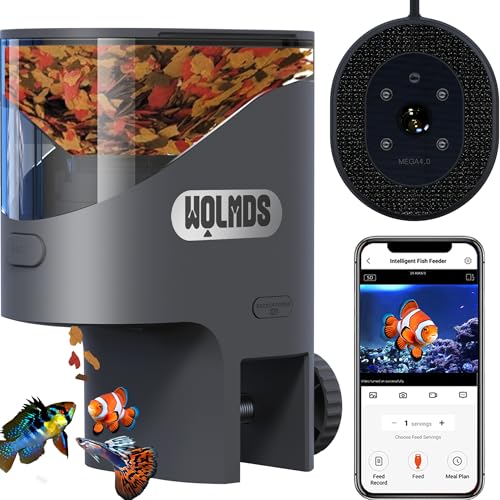
- 2.5K camera with wide-angle night vision
- Dual-band WiFi with app scheduling
- Supports flakes and 0.2g or 0.6g portions
Best For: Remote monitoring and connected aquarium feeding
Best Flexible Scheduling

- Schedules up to six meals daily
- USB and AA battery power can provide backup
- Includes 100ml and 200ml containers
Best For: Complex recurring schedules and outage protection
Best App-Controlled Pick

- Remote scheduling through Smart Life or Tuya
- Network, low-food, and feeding-history notifications
- Moisture-conscious design with adjustable mounting
Best For: Remote app control and connected feeding alerts
Best for Simple Scheduling

- App control with up to three meals daily
- LCD shows time and feeding cycle
- Two mounting methods and adjustable portions
Best For: Routine feeding with clear on-device settings
Best with Fish Monitoring
hygger WiFi Feeder with Camera

- 2K camera for remote aquarium viewing
- App schedules and 1–20 gram portions
- 230ml capacity with moisture-closing outlet
Best For: Vacation monitoring and app-controlled feeding
Best Temperature-Monitoring Pick – Smart WiFi Feeder with Alerts
This is a strong choice among wifi automatic fish feeders for aquarists who want scheduled feeding plus water-temperature awareness. Its app supports remote scheduling and feeding logs when the unit is powered by USB, while battery backup keeps preset feedings active during an outage.
Best For: Fishkeepers who want remote feeding, temperature alerts, and backup power.
Pros:
- App-based feeding schedules and feeding-history logs.
- Monitors water temperature and supports adjustable high- and low-temperature alerts.
- USB power with automatic battery backup during outages.
- Adjustable outlet, 200 ml capacity, and clamp or adhesive mounting.
Cons:
- Remote app control is unavailable while operating in battery mode.
- The temperature probe and app setup add components to manage.
Choose this model if temperature notifications are as important as feeding automation. It offers useful flexibility for different tank layouts and food types, but app connectivity requires USB power.
Best Camera Feeder – 1080P WiFi Feeder with Live View
For shoppers comparing wifi automatic fish feeders with monitoring features, this 2-in-1 feeder adds a 1080P camera to scheduled food dispensing. You can set up to six feedings daily, adjust portions, and use the app to view or record your aquarium while away.
Best For: Fishkeepers who want remote feeding and visual checks during work, travel, or vacation.
Pros:
- 1080P live viewing and recording through a WiFi app.
- Supports up to six scheduled feedings per day with adjustable portions.
- 230 ml container reduces refill frequency.
- Includes two-way audio, motion detection, and full-color night viewing.
Cons:
- Its camera-focused design may be more functionality than needed for basic feeding.
- Optional cloud storage support may involve additional considerations.
This feeder is particularly useful when seeing your fish matters as much as dispensing food. The large container and adjustable schedule suit travel, while the camera can help you observe feeding behavior and tank conditions remotely.
Best Dual-Band Camera Pick – Fishkeeper Feeder with 2.5K Monitoring
This fishkeeper model stands out among wifi automatic fish feeders for its stated 2.4G/5.0G WiFi support, precise portion options, and 2.5K camera. The app lets you schedule feedings, monitor the aquarium day or night, and select between interchangeable dispensing ports for different food sizes.
Best For: Fishkeepers needing high-resolution monitoring and small, measured portions.
Pros:
- Supports 2.4GHz and 5GHz WiFi connections.
- 2.5K camera with night vision, live monitoring, photos, and video recording.
- Adjustable schedules and portions in 1-gram increments, up to 20 grams.
- Includes small and large dispensing ports plus a 230 ml sealed container.
Cons:
- Not suitable for flakes or shrimp larger than 18 mm.
- Setup involves choosing the appropriate interchangeable dispensing port.
This is a compelling option for owners who want detailed tank viewing and tighter control over portions. Check your food size before buying, especially if you use larger flakes or shrimp.
Best Simple Timer – FISHNOSH Programmable Feeder
If you want one of the simpler wifi automatic fish feeders alternatives for routine care, this FISHNOSH model focuses on timer-based dispensing rather than app features. It can be calibrated for up to three feeding times with three cup rounds per setting and is designed for small tanks, large aquariums, and ponds.
Best For: Fish owners who prefer straightforward battery-powered scheduling without app complexity.
Pros:
- Programmable routine with up to nine feeding portions per day through three rounds at three times.
- Battery-powered automatic operation.
- Supports portion control and spill-resistant dispensing.
- 200 ml capacity and refill access without removing the feeder.
Cons:
- It does not list WiFi or smartphone app control.
- Its scheduling format is less flexible than app-based feeders.
This model makes sense for buyers prioritizing easy operation and dependable timer feeding over remote connectivity. It is a practical fit for owners who want a simple vacation or daily feeder and do not need camera or app monitoring.
Best Moisture Protection – Portion-Control Aquarium Feeder
For shoppers comparing wifi automatic fish feeders, this Petbank model stands out for portion control and moisture resistance rather than app connectivity. Its 16-grid design provides up to 15 individual meals, while the sealed outlet helps keep dry food from getting wet or jammed.
Best For: Vacation feeding, small scheduled portions, and aquariums needing flexible clamp or suction-cup mounting.
Pros:
- Stores 15 individual meals, with each grid holding up to 2g.
- Supports up to three feedings per day with adjustable schedules and manual feeding.
- Sealed moisture-resistant design helps keep food dry.
- Rechargeable 700mAh battery can last up to one to two months after charging.
Cons:
- It does not support flakes or shrimp food.
- It lacks WiFi or smartphone control.
- Each feeding can dispense a maximum of three grids.
This is a practical choice if dependable portions and long battery life matter more than remote monitoring. The main limitation is its narrower food compatibility and lack of connected features.
Best Camera Monitoring – 2.5K WiFi Fish Feeder
Among wifi automatic fish feeders, the Wolmds model is designed for owners who want both scheduled feeding and a live view of the aquarium. Its 2.5K camera, wide-angle lens, night vision, app scheduling, and food alerts provide extensive remote oversight.
Best For: Aquarium owners who want camera monitoring, remote schedules, and support for flakes, pellets, and larger fish or turtle portions.
Pros:
- 2.5K camera with a 140-degree lens and infrared night vision supports around-the-clock monitoring.
- Dual-band 2.4GHz and 5GHz WiFi enables app-based scheduling.
- High-torque motor and interchangeable 0.2g and 0.6g disks support flakes and different portion sizes.
- Sealed 200ml hopper, desiccant compartment, and smart low-food or jam alerts help with maintenance.
Cons:
- The power-bank backup is not included.
- It depends on USB power for normal operation.
- Its camera and connected features may be more than needed for basic feeding.
This is the most feature-rich option for remote aquarium care, especially during travel. Choose it if visual monitoring and food-status notifications justify a more involved setup than a timer-only feeder.
Best Flexible Scheduling – DXOPHIEX WiFi Fish Feeder
This DXOPHIEX feeder is a strong fit for shoppers seeking wifi automatic fish feeders with detailed recurring schedules. Its app supports multiple daily meals, adjustable portions, and feeding records, while dual power options add protection against household power outages.
Best For: Owners managing complex feeding routines, multiple weekly schedules, or aquariums that need backup battery power.
Pros:
- App allows up to six meals per day and one to 12 portions per meal.
- Supports recurring schedules by day and provides weekly, monthly, or yearly feeding records.
- USB power and two AA batteries can work together for automatic backup during outages.
- Includes 100ml and 200ml containers plus mounting options for rimmed or covered tanks.
Cons:
- Two AA batteries are required for battery backup and are not included.
- It does not include a camera or food-level alerts.
- WiFi app setup may be unnecessary for simple feeding schedules.
Choose this model when scheduling flexibility is the priority. The dual-container design and backup power are useful additions, but shoppers wanting visual monitoring should consider a camera-equipped alternative.
Best App-Controlled Pick – Smart Life WiFi Fish Feeder
For aquarium owners comparing wifi automatic fish feeders, this model offers app-based scheduling, remote feeding, and feeding notifications through the Smart Life or Tuya app. It supports 2.4GHz WiFi and uses USB power, making it a practical choice when you want to manage feeding while away.
Best For: Fish keepers who want remote app control, feeding history, and network alerts.
Pros:
- Schedule or trigger feedings remotely through the Smart Life or Tuya app.
- App can report network disconnection, low food, and feeding history.
- Push-pull design helps reduce exposure to dampness, with four interchangeable feeding bins.
- Adjustable clamps and support points accommodate open or covered aquariums.
Cons:
- Only supports 2.4GHz WiFi.
- Requires nearby USB power and does not operate as a battery-powered feeder.
- The optional top storage extension is sold separately.
Its strongest advantage is connected monitoring rather than maximum capacity: the standard container holds 100 ml, while the optional extension can raise total capacity to 450 ml. Check your tank setup and outlet location before buying.
Best for Simple Scheduling – 200ml WiFi Aquarium Feeder
This wifi automatic fish feeder combines phone control with a visible LCD screen for checking the clock, feeding time, and cycle. Its 200 ml container, adjustable feed cap, and two mounting options make it suited to routine daily feeding and vacations.
Best For: Aquarium owners who want straightforward scheduling, visible settings, and flexible installation.
Pros:
- Control feedings remotely through the app over 2.4GHz WiFi.
- Supports up to three fixed meals per day with one to three servings per meal.
- Large LCD displays the clock, feeding time, and feeding cycle.
- Adjustable feed cap and two feeding windows help accommodate different portion sizes and foods.
Cons:
- Only supports 2.4GHz WiFi.
- Must remain connected to home power through the USB cable.
- The listed schedule is limited to a maximum of three fixed meals per day.
This is a balanced option if you prefer practical controls over extra smart features. The 200 ml capacity is useful for regular feeding, while the included bracket and adhesive provide options for open or covered tanks.
Best with Fish Monitoring – hygger WiFi Feeder with Camera
Among wifi automatic fish feeders, this hygger model stands out by adding a 2K HD camera to remote feeding controls. The app supports personalized schedules and portion adjustments, while the camera lets you check the aquarium and feeding scene when you are at work or traveling.
Best For: Fish keepers who want video monitoring alongside scheduled feeding.
Pros:
- 2K HD camera supports live viewing, photos, video recording, and sharing through the app.
- App allows multiple daily feedings or schedules spaced across several days.
- Feeding amount is adjustable from 1–20 grams.
- 230 ml capacity, moisture-closing outlet, and two installation methods support vacation use.
Cons:
- Not suitable for shrimp or flake food according to the supplied notes.
- The camera and feeder require app and WiFi setup, adding complexity compared with basic feeders.
- Camera mounting uses adhesive on the outer tank wall, which may not suit every aquarium layout.
The camera makes this the most feature-rich option in the group, especially for checking fish while away. Its replaceable small and large outlets help match portions to fish size, but food compatibility should be confirmed before purchase.
How We Picked the Best Wifi Automatic Fish Feeders
We focused on the features that affect dependable everyday feeding: stable WiFi and app setup, scheduling flexibility, portion control, food compatibility, moisture protection, power options, and mounting practicality. Models with cameras or temperature monitoring were also considered for shoppers who want more visibility into aquarium conditions.
Because product specifications can vary by seller and revision, confirm app compatibility, supported network bands, tank-size guidance, and included accessories before ordering. A feeder should be tested for several days while you are home rather than installed immediately before a trip.
Quick Comparison
| Feature | Best For | What to Check |
|---|---|---|
| App scheduling | Remote feeding and routine control | 2.4GHz support, app quality, and notification options |
| Camera monitoring | Checking feeding and fish activity | Video quality, recording, night vision, and placement |
| Temperature monitoring | Tracking tank conditions | Sensor accuracy, alerts, and probe placement |
| Moisture-resistant design | Humid rooms and frequent use | Sealed food storage and dependable dispensing |
| Multiple food ports | Different foods or feeding schedules | Portion range and compatibility with flakes or pellets |
Key Buying Factors for Wifi Automatic Fish Feeders
Connectivity and App Control
Many smart feeders require a 2.4GHz network, while some support both 2.4GHz and 5GHz connections. Check whether the app supports remote schedule changes, manual feeding, status notifications, and multiple users. A strong local signal near the aquarium is important for reliable operation.
Food Type and Portion Accuracy
Confirm that the dispenser handles your normal food, including flakes, pellets, granules, or mixed dry foods. Small, repeatable portions are generally safer than a large single release. Look for adjustable dispensing settings and test the output with a measuring spoon before setting a long schedule.
Moisture Protection and Cleaning
Humidity can cause food to clump and block the mechanism. Choose a design with a covered or moisture-resistant hopper, and consider whether the container and dispensing parts can be removed for cleaning. Keep the feeder away from splashing and condensation whenever possible.
Power and Installation
USB power is convenient, but battery backup can protect schedules during an outage. Review the mounting method and available clearance on the tank lid. A secure installation prevents vibration, spills, and accidental movement by curious pets.
Who Should Buy Which Wifi Automatic Fish Feeders?
Choose a straightforward app-controlled model if you mainly need remote scheduling and occasional manual feeding. A camera-equipped feeder is better for travelers who want to verify that food was released and observe fish activity. Temperature-monitoring models suit owners who want feeding control alongside basic condition checks.
For large tanks, ponds, or several fish, prioritize hopper capacity, consistent portions, and a mounting system that remains stable. For small tanks, favor fine portion adjustment and avoid choosing a feeder solely because it has a large container or extra features. No automatic feeder replaces water changes, health checks, or an appropriately sized feeding plan.