Stable water parameters are essential for shrimp, and the right test kit makes it easier to catch dangerous changes before they affect your colony. This roundup compares 10 options, from established liquid-reagent kits to fast multi-parameter strips and digital testing tools.
Use the guide below to match testing speed, accuracy, parameter coverage, and ongoing cost with your tank size, shrimp species, and maintenance routine.
Best 10 Aquarium Test Kits for Shrimp Tanks Picks for 2026
Best Liquid-Test Foundation
API Freshwater Master Test Kit

- Tests pH, high-range pH, ammonia, nitrite, and nitrate
- Includes solutions, tubes, and a color card
- Made for freshwater aquariums and weekly monitoring
Best For: Freshwater shrimp keepers monitoring core water parameters
Best Everyday Strip Option
EASYTEST 8-Way Aquarium Test Strips

- Checks eight metrics, including ammonia and hardness
- Includes 50 strips for routine monitoring
- Suitable for shrimp, freshwater, saltwater, and planted tanks
Best For: Fast, broad water checks without extra testing equipment
Best Hardness Specialist

- Measures GH and KH in freshwater aquariums
- Focuses on mineral content and carbonate hardness
- Includes two solutions and capped test tubes
Best For: Shrimp keepers needing dedicated hardness measurements
Most Comprehensive Strip Kit

- Tests 11 parameters, including ammonia, GH, and temperature
- Includes 150 strips, tubes, color chart, and ebook
- Suitable for freshwater, saltwater, betta, and pond setups
Best For: Multi-tank aquarists wanting broad, convenient coverage
Simple Weekly Monitor
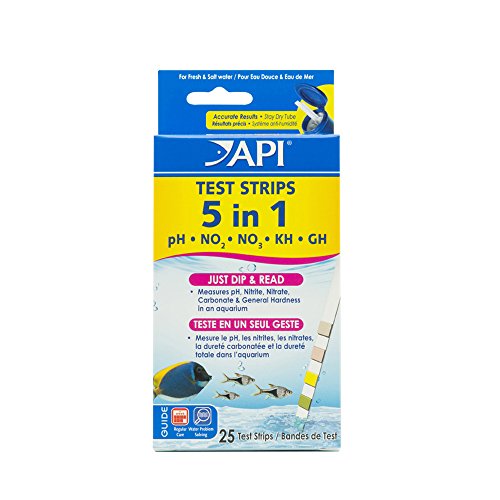
- Checks pH, nitrite, nitrate, carbonate hardness, and general hardness
- Fast dip-and-compare testing for routine monitoring
- Includes 25 strips for freshwater or saltwater aquariums
Best For: Convenient weekly water checks
Comprehensive Liquid Testing

- Measures pH, nitrite, nitrate, ammonia, and phosphate
- Uses liquid reagents with color-matching charts
- Includes up to 265 measurements for extended monitoring
Best For: Detailed, high-volume aquarium testing
High-Volume Strip Testing
AAwipes 8-in-1 Aquarium Test Kit

- Tests eight parameters, including ammonia nitrogen and hardness
- Supplies 150 strips for frequent aquarium testing
- Supports freshwater, saltwater, ponds, and shrimp tanks
Best For: Frequent testing with broad coverage
Best Everyday Coverage

- Tests ammonia plus nine other water parameters
- Dip-and-compare format is easy to use
- Includes 50 strips in a compact bottle
Best For: Routine, broad freshwater tank screening
Best Digital Convenience

- Scans test strips with the DROPLYTIX app
- Checks ammonia, nitrite, nitrate, pH, GH, and KH
- Designed for shrimp, freshwater, and saltwater tanks
Best For: App-assisted routine monitoring
Best Large Pack

- Includes 100 strips for frequent testing
- Covers 10 parameters plus temperature
- Comes with an ebook and testing accessories
Best For: High-frequency testing and maintenance routines
Best Liquid-Test Foundation – API Freshwater Master Test Kit
API Freshwater Master Test Kit 800-Test Freshwater Aquarium Water Kit, White, Single, Multi-Colored
Check Price On AmazonFor aquarists who want a traditional liquid-testing approach, this API kit is a strong foundation for aquarium test kits for shrimp tanks. It checks five core freshwater parameters—pH, high-range pH, ammonia, nitrite, and nitrate—using supplied solutions, tubes, and a color card.
Best For: Freshwater shrimp keepers who want routine monitoring of ammonia, nitrite, nitrate, and pH.
Pros:
- Tests five important freshwater water-quality parameters.
- Includes seven testing-solution bottles, four capped tubes, and a color card.
- Designed for weekly monitoring and troubleshooting water or livestock problems.
Cons:
- Designed for freshwater aquariums only.
- Does not specifically test GH or KH.
This is a practical core kit for tracking the nitrogen cycle and pH, but shrimp keepers who need hardness readings will need a separate GH/KH test.
Best Everyday Strip Option – EASYTEST 8-Way Aquarium Test Strips
These EASYTEST strips offer a quick way to screen several conditions when comparing aquarium test kits for shrimp tanks. The 50-strip kit checks pH, hardness, alkalinity, chlorine, nitrate, nitrite, carbonate, and ammonia nitrogen, with results read from a graded color chart.
Best For: Shrimp keepers who want fast, no-equipment checks across multiple water metrics.
Pros:
- Measures eight parameters, including ammonia, hardness, nitrate, nitrite, and carbonate.
- Works in freshwater, saltwater, shrimp, planted, and marine tanks.
- Simple dip-and-read process with most results available at 15 seconds.
Cons:
- Ammonia testing requires cutting off the ammonia pad for accurate testing.
- Nitrate and nitrite readings require up to 60 seconds.
The broad coverage and quick procedure make this convenient for frequent screening, while careful timing is important for interpreting the results.
Best Hardness Specialist – API GH & KH Test Kit
Hardness is especially relevant when evaluating aquarium test kits for shrimp tanks, and this API kit focuses specifically on GH and KH. It uses two testing solutions and capped tubes to measure dissolved mineral content and carbonate hardness in freshwater aquariums.
Best For: Freshwater shrimp keepers who need dedicated GH and KH readings.
Pros:
- Specifically measures GH and KH in freshwater aquariums.
- Helps monitor mineral content and carbonate hardness.
- Compact kit includes two solutions and two capped test tubes.
Cons:
- Only tests GH and KH.
- Does not replace a kit for ammonia, nitrite, nitrate, or pH.
- Designed for freshwater aquariums.
This is a focused add-on rather than a complete water-testing system, making it useful alongside a broader kit when shrimp mineral balance is a priority.
Most Comprehensive Strip Kit – 11-in-1 Aquarium Test Strips
This 11-in-1 kit provides unusually broad coverage for aquarium test kits for shrimp tanks, combining test strips with a thermometer, testing tubes, color chart, and ebook. It checks ammonia, pH, iron, chlorine, GH, carbonate, nitrate, nitrite, alkalinity, copper, and temperature.
Best For: Aquarists managing multiple tank types who want one kit covering many water-quality checks.
Pros:
- Tests 11 parameters, including ammonia, GH, nitrate, nitrite, copper, and temperature.
- Includes 150 strips, a color chart, testing tubes, and an ebook.
- Marketed for freshwater, saltwater, betta, and pond use.
Cons:
- Broad strip-based testing may require careful color-chart comparison.
- The supplied notes do not specify individual reading times for each parameter.
For shoppers prioritizing breadth and included accessories, this is the most expansive option in the group; confirm results carefully when making important tank adjustments.
Simple Weekly Monitor – API 5-in-1 Test Strips
API 5-in-1 Test Strips Freshwater and Saltwater Aquarium Test Strips 25-Count Box
Check Price On AmazonFor anyone comparing aquarium test kits for shrimp tanks, the API 5-in-1 strips offer a quick way to check several core water parameters. Each strip monitors pH, nitrite, nitrate, carbonate hardness, and general hardness for freshwater or saltwater aquariums.
Best For: Shrimp keepers who want a straightforward option for routine water checks and quick screening when water or livestock problems appear.
Pros:
- Tests five key parameters: pH, nitrite, nitrate, carbonate hardness, and general hardness.
- Dip-and-compare format provides fast results without liquid reagents.
- Suitable for both freshwater and saltwater aquariums.
- Useful for weekly monitoring and investigating potential water problems.
Cons:
- The box contains 25 tests, so frequent testing may use the supply quickly.
- Does not test ammonia, phosphate, or chlorine according to the supplied specifications.
This is a practical entry-level choice when convenience matters most. It covers several foundational readings, but shrimp keepers who specifically need ammonia testing may prefer a more comprehensive kit.
Comprehensive Liquid Testing – Pawfly 5-in-1 Master Kit
The Pawfly 5-in-1 kit is a strong contender among aquarium test kits for shrimp tanks when broader parameter coverage and liquid-reagent testing are priorities. It measures pH, nitrite, nitrate, ammonia, and phosphate for freshwater and marine aquariums.
Best For: Shrimp keepers who want ammonia and phosphate included alongside the standard pH, nitrite, and nitrate readings, with enough tests for ongoing monitoring.
Pros:
- Tests five parameters, including ammonia and phosphate.
- Uses professional liquid reagents rather than traditional test strips.
- Provides up to 265 measurements across the included tests.
- Includes color-matching charts and supports freshwater or saltwater use.
Cons:
- Liquid testing generally requires more steps than dipping a strip.
- The supplied notes do not specify a separate test for water hardness.
With its high test count and inclusion of ammonia, this kit is well suited to shrimp tanks where careful monitoring is important. Its liquid format may take more effort, but it offers a broader testing set than a basic strip kit.
High-Volume Strip Testing – AAwipes 8-in-1 Aquarium Test Kit
The AAwipes 8-in-1 kit stands out among aquarium test kits for shrimp tanks for its broad strip-based coverage and large 150-strip supply. It tests free chlorine, hardness, pH, ammonia nitrogen, nitrate, nitrite, sodium chloride, and total alkalinity in aquariums, ponds, and other listed applications.
Best For: Shrimp keepers who value a large supply of quick tests and want to monitor ammonia nitrogen, hardness, and several additional water parameters.
Pros:
- Tests eight parameters, including ammonia nitrogen, hardness, nitrate, and nitrite.
- Includes 150 strips for frequent testing.
- Designed for freshwater, saltwater, ponds, and shrimp tanks.
- Sealed bottle packaging helps protect the strips from moisture.
Cons:
- Ammonia nitrogen requires a separate five-second dip and a longer 180-second reading time.
- The multi-step timing process is less immediate than a simple single-dip test.
- Color-chart interpretation is required for every result.
This kit offers the widest parameter list and largest stated quantity of the three options. It is a convenient fit for frequent testers, provided they are comfortable following the different timing requirements for the ammonia pad.
Best Everyday Coverage – 12-in-1 Aquarium Test Strips
For routine aquarium test kits for shrimp tanks, this 12-in-1 strip set offers a broad snapshot of water conditions with a quick dip-and-compare process. It checks ammonia alongside pH, nitrate, hardness, alkalinity, chlorine, copper, iron, and H2S.
Best For: Shrimp keepers who want a simple, broad screening tool for regular freshwater tank checks.
Pros:
- Checks ammonia, nitrate, pH, hardness, alkalinity, chlorine, iron, copper, and H2S.
- Uses a straightforward dip, wait, and color-chart comparison process.
- Includes 50 strips in a compact bottle for routine testing.
Cons:
- Results require visual comparison with the printed chart.
- The supplied details do not indicate an app or digital reader.
This is a practical choice when you want many common parameters in one inexpensive-feeling strip format. For shrimp tanks, use it as a convenient screening kit and follow up with more specialized testing when a reading needs closer confirmation.
Best Digital Convenience – App-Enabled 10-in-1 Test Kit
This app-enabled option stands out among aquarium test kits for shrimp tanks by replacing manual color matching with a scan-based workflow. Its 10-in-1 coverage includes ammonia, nitrite, nitrate, pH, GH, KH, chlorine, and other listed measures for freshwater and saltwater setups.
Best For: Shrimp keepers who prefer app-assisted readings and want a multi-parameter kit for routine maintenance.
Pros:
- Uses the DROPLYTIX app to scan strips and provide digital results.
- Monitors ammonia, nitrite, nitrate, pH, GH, KH, and chlorine.
- Explicitly supports shrimp tanks, planted aquariums, freshwater, and saltwater setups.
Cons:
- Requires a mobile app rather than a standalone chart-only process.
- The supplied details list 10 strips/items, so the quantity may be less generous than larger strip packs.
The app workflow may make recurring checks easier for shoppers who dislike judging subtle color changes. It is particularly appealing for shrimp setups where tracking several parameters over time matters, provided you are comfortable using a phone-based testing process.
Best Large Pack – 10-in-1 Aquarium Test Strips
Among aquarium test kits for shrimp tanks, this 100-strip package is suited to frequent testing and longer-term maintenance. The strips check pH, iron, chlorine, GH, carbonate, nitrate, nitrite, alkalinity, copper, and temperature, with a color chart for at-home results.
Best For: Shrimp keepers who test often and want a larger supply with an ebook, thermometer, and testing accessories.
Pros:
- Includes 100 strips split between a bottle and a separate bag for freshness.
- Tests 10 parameters, including pH, GH, nitrate, nitrite, copper, and temperature.
- Includes an ebook, instruction manual, refill bag, and testing tube.
Cons:
- The supplied parameter list does not include ammonia.
- Readings depend on matching strip colors to the provided chart.
- The notes recommend using opened strips within three months for maximum accuracy.
This kit makes sense for hobbyists who want plenty of tests for cycling, water changes, and ongoing checks. However, because ammonia is not listed in the supplied coverage, shrimp keepers should confirm that a separate ammonia test is available if that parameter is important to their routine.
How We Picked the Best Aquarium Test Kits for Shrimp Tanks
We focused on kits that cover the parameters most relevant to shrimp keeping, including ammonia, nitrite, nitrate, pH, GH, and KH. We also considered test speed, ease of reading results, number of tests included, freshwater compatibility, storage convenience, and the overall cost per test.
Liquid kits generally offer clearer results for critical readings, while strips are faster and easier for routine checks. Because shrimp can react poorly to sudden changes in hardness and alkalinity, dedicated GH and KH testing received special consideration.
Quick Comparison
- Best for broad liquid testing: A multi-parameter freshwater master kit with reagent bottles and test tubes.
- Best for fast routine checks: Eight-, 10-, or 11-in-1 test strips.
- Best for shrimp-specific mineral monitoring: A dedicated GH and KH liquid test kit.
- Best for larger colonies: High-count strip packs or kits offering a low cost per test.
- Best for technology-focused users: An app-enabled digital testing system, provided you are comfortable calibrating and using a phone.
Key Buying Factors for Aquarium Test Kits for Shrimp Tanks
Parameter Coverage
At minimum, look for ammonia, nitrite, nitrate, and pH. GH measures general hardness, while KH measures carbonate hardness and buffering capacity. These values are especially important when keeping Neocaridina or Caridina shrimp with specific mineral requirements.
Accuracy and Readability
Liquid-reagent kits require more steps but can make subtle color differences easier to evaluate. Test strips are convenient, though results may be harder to read when colors are close or the strips are exposed to humidity. Follow the timing instructions precisely and compare results under consistent lighting.
Testing Frequency and Cost
New tanks, tanks with recent livestock additions, and systems experiencing problems need frequent testing. A large strip pack may be economical for regular screening, while a liquid kit can be a better choice when you need dependable confirmation of ammonia, nitrite, or nitrate readings.
Freshwater Compatibility and Storage
Confirm that the kit is intended for freshwater aquariums and includes the parameters you actually need. Keep strips sealed and reagents tightly closed, away from heat and moisture. Expired or poorly stored tests can produce misleading results.
Who Should Buy Which Aquarium Test Kits for Shrimp Tanks?
Choose a liquid master kit if you are cycling a new shrimp aquarium, troubleshooting losses, or want more confidence in core water readings. Choose multi-parameter strips if you maintain an established tank and value quick checks over maximum precision.
Add a GH/KH kit if your shrimp species has specific mineral needs, you use remineralized water, or you are adjusting buffering conditions. Choose a high-count pack for multiple aquariums or frequent testing, and consider an app-enabled kit if digital records and guided readings would help you maintain a consistent routine.
No test kit replaces gradual acclimation, regular water changes, and stable maintenance. Use test results to identify trends, then make adjustments slowly rather than attempting a large correction all at once.