Timed automatic fish feeders make it easier to maintain a consistent feeding routine when you are working, traveling, or managing multiple tanks. The right model can dispense measured portions on schedule while helping reduce overfeeding.
This roundup compares 10 options for aquariums, betta and turtle tanks, larger setups, and ponds, with attention to programming, food compatibility, capacity, moisture protection, and power design.
Best 10 Timed Automatic Fish Feeders Picks for 2026
Best Flexible Schedule Pick

- Up to four scheduled feedings daily
- USB-C charging with stated 3–6 month runtime
- 200ml container and two mounting options
Best For: Flexible aquarium feeding schedules
Best for Outdoor Ponds

- Five-pound pellet capacity
- Solar, AC, and battery power options
- 120-degree broadcast up to 10 feet
Best For: Large outdoor koi and goldfish ponds
Best Battery-Powered Portion Control
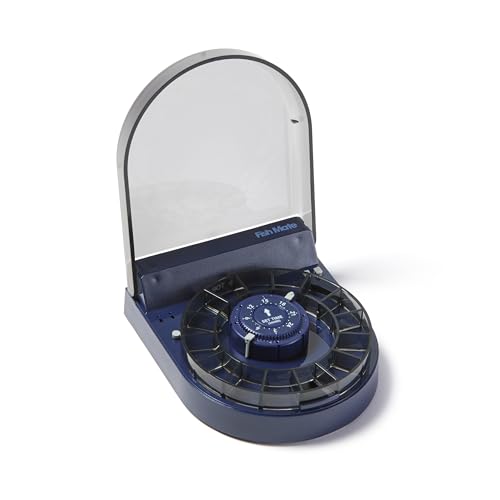
- Schedules one to four meals per day
- Holds up to 14 individual portions
- Over one year of operation on one AA battery
Best For: Compact, portion-controlled aquarium feeding
Best Smart-Control Option

- App control with up to six meals daily
- Supports recurring schedules and feeding records
- USB power with two-AA battery backup
Best For: Remote aquarium feeding management
Best for Precise Portions
Petbank 16-Grid Automatic Feeder

- 15 individual meals with up to 2g per grid
- Moisture-resistant sealed outlet
- Rechargeable battery and flexible scheduling
Best For: Portion-conscious owners using dry food
Best for Backup Power
DXOPHIEX Dual-Power Fish Feeder

- USB and AA-battery power options
- 100ml and 200ml containers included
- Automatic 8-, 12-, or 24-hour intervals
Best For: Vacation feeding with power redundancy
Best for Easy Setup
Freesea 3-Timer Aquarium Feeder
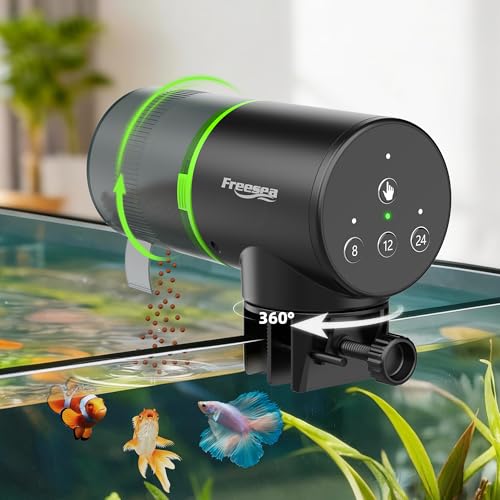
- One-touch setup with three programmable timers
- 200ml dispenser for 7–14 days of feeding
- Adjustable slider and moisture-proof lid
Best For: Simple vacation feeding with flexible scheduling
Best for Flexible Schedules

- Up to nine feeding events per day
- 200 ml capacity with adjustable portions
- Includes clip and stand mounting options
Best For: Busy owners with varied tank or pond setups
Best for Precise Quiet Feeding

- Up to three programmable feedings daily
- Portions up to 2 g per feeding
- Moisture-resistant and under 30 dB
Best For: Indoor aquarium owners using compatible food types
Best for Large-Capacity Vacation Feeding

- 200 ml capacity for longer absences
- Three automatic interval modes
- Accepts flakes, granules, powder, and strips
Best For: Vacation feeding for fish and turtles
Best Flexible Schedule Pick – 4-Timer Aquarium Feeder
This compact option is a practical choice for anyone comparing timed automatic fish feeders for an aquarium. It supports up to four feeding times per day, adjustable portions, interval settings, and two mounting methods, making it useful for everyday routines or short trips away.
Best For: Aquarium owners who want flexible schedules, USB charging, and a relatively large 200ml food container.
Pros:
- Programs up to four feeding times per day and one to three spins per session.
- Offers 8-, 12-, 24-, and 48-hour interval modes plus manual feeding.
- Uses USB-C charging and includes an adjustable slider for portion control.
- Mounts with an adjustable rim clamp or included adhesive sticker.
Cons:
- The listed power details describe USB charging but also identify the power source as battery powered.
- Hand washing is required for care.
Choose this feeder if schedule flexibility and mounting versatility matter more than app control. Its 200ml capacity and long stated charge life can also reduce the need for frequent refills.
Best for Outdoor Ponds – KoiGrower 5-Gallon Feeder
For pond owners seeking timed automatic fish feeders, this model is built around high capacity and outdoor operation. It combines solar, AC, and battery power with a locking lid, moisture-management features, and a broadcast range suited to koi and goldfish ponds.
Best For: Outdoor pond owners feeding koi, goldfish, or other fish with 3–10mm pellets.
Pros:
- Five-pound capacity reduces how often the hopper needs refilling.
- Supports solar, AC, and battery power for multiple operating options.
- Moisture Lock Technology and a refillable desiccant rack help limit clogs.
- Broadcasts pellets in a 120-degree pattern up to 10 feet.
Cons:
- Its 14-by-10-by-16.5-inch footprint is much larger than typical aquarium feeders.
- Designed for outdoor dry food and may be excessive for a small indoor tank.
This is the strongest fit when capacity, weather-conscious food storage, and broad pond distribution are priorities. Its animal-resistant locking lid adds practical protection for outdoor use.
Best Battery-Powered Portion Control – Fish Mate F14 Aquarium Feeder
The Fish Mate F14 is a straightforward choice among timed automatic fish feeders for aquarium owners who prefer scheduled portions without a large hopper. It can deliver one to four meals per day, holds up to 14 individual portions, and gradually dispenses food over several hours.
Best For: Aquarium keepers who want compact, battery-operated feeding with portion-based scheduling.
Pros:
- Schedules one to four meals daily with up to 14 individual portions.
- Gradual dispensing helps support more consistent feeding patterns.
- Works with flakes, pellets, and sticks.
- Runs for over one year on a single AA battery, according to the supplied details.
Cons:
- The required AA battery is not included.
- Its 14-ounce capacity is smaller than the 200ml and five-pound options in this roundup.
- Mounting depends on the included brackets and compatible aquarium surfaces.
Select this model for a compact, low-maintenance setup focused on measured meals. It is especially appealing if long battery life matters more than Wi-Fi control or a large refill capacity.
Best Smart-Control Option – WiFi Aquarium Feeder
This WiFi model is designed for shoppers who want timed automatic fish feeders that can be managed remotely. Its app supports up to six meals per day, repeat schedules, 1–12 portions per meal, and feeding-history records, while dual power options provide a backup during outages.
Best For: Fish keepers who want app-based scheduling and remote feeding control while away from home.
Pros:
- App scheduling supports up to six meals per day and 1–12 portions per meal.
- Allows recurring weekly schedules and feeding records by week, month, or year.
- Can use USB power and two AA batteries, with automatic battery backup described.
- Includes 100ml and 200ml containers plus a feeding ring.
Cons:
- Two AA batteries are not included.
- WiFi and app features add setup requirements compared with simpler timer feeders.
- Hand washing is specified for product care.
Consider this feeder if remote access and detailed recurring schedules are central to your buying decision. The included container choices and dual-power design add flexibility for routine feeding and travel.
Best for Precise Portions – Petbank 16-Grid Automatic Feeder
For aquarists who want highly controlled feeding, this timed automatic fish feeder uses 16 grids to provide up to 15 individual meals. Its sealed design, rechargeable battery, and flexible schedule make it a practical option for routine or vacation feeding.
Best For: Portion-conscious fish owners who want rechargeable, moisture-resistant feeding with up to three scheduled feedings per day.
Pros:
- Provides 15 individually portioned meals, with each grid holding up to 2g.
- Sealed outlet helps keep food dry and reduce moisture-related jamming.
- Offers clamp or suction-cup mounting and a USB-C rechargeable battery.
- Supports custom feeding times, manual feeding, and repeat intervals.
Cons:
- Not designed for shrimp or flake food.
- Its 30g capacity is smaller than the larger reservoir-style feeders.
The Petbank stands out when portion accuracy and food freshness matter more than maximum capacity. It is a strong fit for dry particle, pellet, powder, or small-strip food, provided those formats suit your fish.
Best for Backup Power – DXOPHIEX Dual-Power Fish Feeder
This timed automatic fish feeder is built for straightforward feeding during travel or busy routines. It can run from USB power or two AA batteries, with automatic intervals and manual feeding available when you need flexibility.
Best For: Aquarium owners who want a larger food reservoir and power redundancy for vacations or possible outages.
Pros:
- Supports automatic feeding every 8, 12, or 24 hours, plus manual feeding.
- USB and two-AA-battery power options can provide backup during outages.
- Includes 100ml and 200ml containers for different capacity needs.
- Mounts to a tank edge or hood and includes a feeding ring.
Cons:
- AA batteries are not included.
- Its preset intervals offer less scheduling precision than fully programmable timers.
The DXOPHIEX is a sensible choice if dependable power options and reservoir capacity are priorities. Its adjustable volume control also accommodates several common food types, including flakes, crisps, pellets, and granules.
Best for Easy Setup – Freesea 3-Timer Aquarium Feeder
Designed for simple vacation feeding, this timed automatic fish feeder combines one-touch setup with three programmable timers and a 200ml dispenser. Adjustable portion control and a moisture-resistant lid help make daily feeding more consistent.
Best For: Aquarium owners seeking a simple, higher-capacity feeder for freshwater or saltwater tanks and common pellet or powder food.
Pros:
- Offers three programmable timers and one-touch setup.
- 200ml capacity is suited to 7–14 days of automatic feeding, according to the supplied notes.
- Sliding control enables adjustable portions to help limit overfeeding.
- Moisture-proof lid is designed to block 90% of humidity.
Cons:
- Uses battery power rather than offering a stated USB power option.
- Supplied details do not specify the battery type or battery life.
The Freesea offers a convenient balance of setup simplicity, capacity, and scheduling. Its salt-fog-resistant ABS construction and included adjustable slider make it especially practical for users who want uncomplicated, hands-free feeding.
Best for Flexible Schedules – Programmable Fish Feeder
For fish owners who need timed automatic fish feeders with a larger food reservoir and flexible scheduling, the FISHNOSH offers up to nine feeding events per day. Its adjustable portions, 200 ml capacity, and battery-powered operation make it practical for busy days, vacations, and larger aquariums or ponds.
Best For: Owners needing multiple daily feeding portions for small or large tanks, multiple pets, or ponds.
Pros:
- Supports up to nine feeding events daily through three scheduled times with three cup rotations.
- Large 200 ml capacity can reduce the need for frequent refills.
- Includes adjustable portions, spill-proof operation, and both clip and stand mounting components.
- Food can be refilled without removing the feeder.
Cons:
- Battery-powered, so batteries need to be monitored and replaced.
- The scheduling system may require careful setup because it combines feeding times with cup rotations.
Choose this model if feeding flexibility and capacity matter most. Its two-year warranty and broad aquarium, fish, and pond positioning add practical value for owners managing varied setups.
Best for Precise Quiet Feeding – LCD Fish Feeder
The Papettly is one of the more feature-focused timed automatic fish feeders, pairing an LCD display with precise portion control and USB charging. Its 15-compartment design suits several food types, while moisture-resistant ports and quiet operation help it work unobtrusively during vacations or everyday feeding.
Best For: Indoor aquarium owners who prioritize measured portions, quiet operation, and programmable feeding schedules.
Pros:
- Schedules up to three daily feedings with customizable frequencies and alternating-day feeding.
- Dispenses up to 2 g per feeding for more controlled portions.
- Auto-closing ports help protect food from moisture, and operation is rated below 30 dB.
- Includes a USB cable, LCD display, and feeding spoon.
Cons:
- Not suitable for flake or shrimp food according to the product notes.
- Its 30 g capacity is smaller than the 200 ml reservoirs of some competing feeders.
- USB charging adds a charging requirement compared with fully battery-powered designs.
This feeder is a good fit when portion accuracy and low noise are more important than maximum capacity. Check that your preferred food type is compatible before choosing it.
Best for Large-Capacity Vacation Feeding – Moisture-Resistant Feeder
For vacation planning, this model combines a 200 ml reservoir with three automatic interval modes that feed every 8, 12, or 24 hours. Among timed automatic fish feeders, it stands out for broad food compatibility, a moisture-proof lid, manual feeding, and two installation methods.
Best For: Fish and turtle owners seeking simple interval feeding for vacations, weekends, or varied food types.
Pros:
- Offers automatic feeding every 8, 12, or 24 hours, plus manual feeding on demand.
- Adjustable sliders help control portions, while the 200 ml capacity supports longer absences.
- Moisture-proof design is intended to reduce water vapor entering the food chamber by more than 90%.
- Works with flakes, granules, powder, and strips and supports clamp or adhesive mounting.
Cons:
- Uses fixed interval modes rather than individually selectable clock times.
- Battery-powered operation requires attention to battery life before travel.
- Hand-wash care may be less convenient than dishwasher-safe maintenance.
This is a practical choice for owners who want a straightforward vacation feeder with generous capacity and broad food compatibility. Its fixed intervals are convenient, but shoppers wanting highly customized schedules may prefer a more programmable design.
How We Picked These Timed Automatic Fish Feeders
We selected models across several common use cases, including compact aquarium feeders, higher-capacity dispensers, pond-focused units, and connected options. Our comparison emphasizes practical ownership factors: scheduling flexibility, portion consistency, hopper size, setup difficulty, power requirements, and resistance to humidity. Because fish food varies in size and shape, we also considered whether each design appears suited to flakes, pellets, or other dry foods.
Quick Comparison
For a small aquarium or betta tank, prioritize a compact feeder with simple controls and precise low-volume dispensing. Larger aquariums and ponds benefit from bigger hoppers and longer operating capacity. Models with LCD displays or one-touch setup can reduce programming friction, while Wi-Fi connectivity is useful when you want to check or adjust feeding remotely. Battery-powered units are convenient during outages, whereas USB-powered designs may be easier to use near a dependable outlet.
Key Buying Factors for Timed Automatic Fish Feeders
Schedule and Portion Control
Look for multiple daily feeding times and adjustable portion sizes. Smaller, repeatable meals are generally more useful than one large release, especially in community aquariums. Confirm that the smallest setting is appropriate for your fish and that the programming remains active after battery replacement.
Capacity and Food Compatibility
A larger hopper reduces refills during vacations, but capacity should match your stocking level and food type. Check whether the feeder is designed for flakes, pellets, or both. Fine flakes can bridge or clump, so a model with a controlled outlet and an enclosed, dry compartment may perform more consistently.
Moisture Protection and Placement
Humidity can spoil food and interfere with dispensing. Prefer covered hoppers, sealed compartments, or moisture-resistant construction, and position the unit away from direct splashing. Secure mounting is also important so the feeder cannot fall into the tank or shift its outlet.
Power and Setup
Battery operation offers placement flexibility and backup protection, while USB power can reduce ongoing battery changes. If using a USB model, consider whether the cable reaches a safe outlet and whether an outage backup is needed. Before relying on any feeder, test it for several days and measure the delivered portion.
Who Should Buy Which Timed Automatic Fish Feeders?
Choose a compact, easy-setup model for a small tank, betta aquarium, or occasional travel. Select a moisture-protected feeder with flexible portion settings for daily aquarium use. A larger-capacity unit is better for multiple tanks, bigger aquariums, or extended trips, provided its output can be calibrated accurately. Pond owners should choose a dispenser designed for outdoor or pond feeding rather than adapting a small indoor aquarium model. Finally, choose a Wi-Fi-enabled feeder only if remote monitoring and schedule changes justify the added setup and connectivity requirements.