Feeding a saltwater aquarium consistently can be difficult when work, travel, or an unpredictable schedule gets in the way. The right automatic feeder can deliver measured portions on time while helping reduce overfeeding and water-quality problems.
We selected 10 options with different strengths, from app-connected feeders with cameras and temperature monitoring to straightforward battery-powered models. Use the guide below to match capacity, control features, and moisture protection to your reef or marine setup.
Best 10 Automatic Fish Feeders for Saltwater Tanks Picks for 2026
Best Smart-Viewing Pick

- 1080P live viewing and recording
- Up to six feedings daily with portion control
- Large 230 mL container
Best For: Remote feeding and aquarium monitoring
Best Long-Running Battery Option

- Up to four scheduled feeding times
- 200 mL adjustable food container
- Clamp and adhesive mounting options
Best For: Simple feeding schedules and extended use
Best Backup-Power Choice

- Up to six meals and 12 portions per meal
- USB and automatic AA-battery backup
- Includes 100 mL and 200 mL containers
Best For: Detailed schedules and outage protection
Best Moisture-Control Design

- Up to 15 individual meals
- Sealed opening helps resist moisture
- 2 g grid portions with rechargeable power
Best For: Precise, moisture-protected feeding
Best Smart Monitoring Pick
WiFi Automatic Feeder with Temperature Alerts

- App scheduling and feeding logs via USB power
- Temperature probe with adjustable alerts
- Battery backup and multi-food portion control
Best For: Remote monitoring and scheduled feeding for busy saltwater aquarists
Best High-Frequency Feeding Option
FISHNOSH Automatic Aquarium Feeder

- Programs up to nine feedings daily
- Supports up to three cup rounds per feeding
- Refillable without removing the feeder
Best For: Simple, frequent feeding across aquariums and ponds
Best Easy-Setup Pick
Freesea Feeder with Three Timers
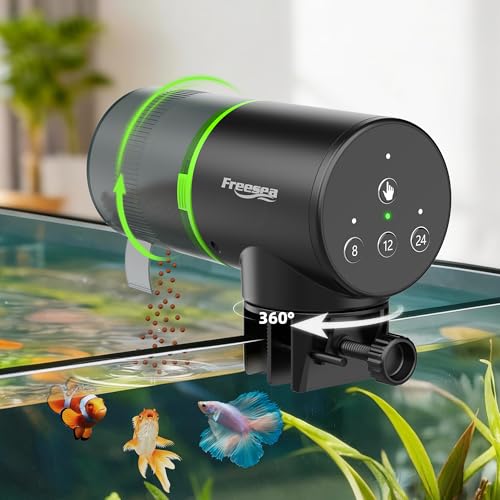
- One-touch setup with three programmable timers
- Adjustable portions for powder and pellets
- Moisture-proof lid and salt-fog-resistant ABS
Best For: Simple vacation feeding in humid saltwater aquarium setups
Smartest Monitoring Pick

- 2.5K camera with night vision and app sharing
- Dual-band WiFi with local schedule memory
- 230 ml sealed hopper with food and jam alerts
Best For: Remote monitoring and scheduled feeding in larger saltwater aquariums
Best Simple Vacation Option

- Three feeding intervals: 8, 12, or 24 hours
- Battery-powered with manual feeding control
- Clamp or adhesive mounting for covers up to 1 inch
Best For: Basic scheduled feeding without WiFi or camera features
Best App Scheduling Pick

- WiFi app supports customizable feeding schedules
- 2K camera enables remote viewing and recording
- 230 ml hopper with 0.2 g and 0.6 g outlets
Best For: Remote scheduling and monitoring when using compatible non-flake food
Best Smart-Viewing Pick – WiFi Camera Fish Feeder
For aquarists comparing automatic fish feeders for saltwater tanks, this model adds remote viewing to scheduled feeding. It supports up to six daily feedings, adjustable portions, manual dispensing, and a 230 mL container, while its WiFi camera helps you check the aquarium when you are away.
Best For: Saltwater tank owners who want feeding control and remote aquarium monitoring in one device.
Pros:
- 1080P live viewing and recording through a phone app
- Schedules up to six feedings per day with adjustable portions
- 230 mL capacity reduces refill frequency
- Supports two-way audio, motion detection, and color night viewing
Cons:
- WiFi and app features require a compatible network and phone setup
- Designed for suitable dry foods rather than every food type
This is the most feature-rich option in the group, especially if observing fish behavior and feeding activity remotely matters as much as dispensing food. Its mounting hardware is intended for many open-top and covered aquariums.
Best Long-Running Battery Option – USB Fish Feeder
If you want automatic fish feeders for saltwater tanks with straightforward controls, this USB-powered model offers up to four feeding times per day and adjustable dispensing. Its 200 mL container, interval settings, and two mounting options make it practical for regular routines and vacations.
Best For: Aquarists seeking a simple feeder with long battery life, flexible mounting, and programmable portions.
Pros:
- Programs up to four feeding times per day
- Allows one to three spins per feeding session
- 200 mL container accommodates pellets, granules, and powders
- Clamp and adhesive mounting options fit different tank setups
Cons:
- Does not offer WiFi control or remote viewing
- USB charging is convenient, but the listed power details also describe battery operation
Choose this feeder when dependable scheduling matters more than app connectivity. The interval mode and manual-feed button keep operation uncomplicated, while the adjustable slider helps tailor portions to the aquarium.
Best Backup-Power Choice – WiFi Schedule Feeder
For saltwater keepers who want flexible scheduling, this WiFi feeder lets you manage feeding from a phone whether you are home or away. It supports up to six meals daily, one to 12 portions per meal, recurring schedules, and both USB and AA-battery power.
Best For: Connected aquarium owners who want detailed recurring schedules and backup power during outages.
Pros:
- App control supports up to six meals and 12 portions per meal
- Recurring weekly schedules can be customized by day and time
- USB power and automatic AA-battery backup add flexibility
- Includes 100 mL and 200 mL containers plus a feeding ring
Cons:
- AA batteries are not included
- WiFi setup is required for phone-based control
This model stands out for schedule precision and power redundancy. Its two mounting methods accommodate tanks with or without hoods, and the adjustable opening is designed for flakes, crisps, pellets, and granules.
Best Moisture-Control Design – Portion-Control Feeder
Among automatic fish feeders for saltwater tanks, this Petbank model focuses on measured portions and moisture resistance. Its 16-grid design provides up to 15 individual meals, while the sealed opening helps keep food dry between feedings.
Best For: Aquarists who prioritize precise portions, scheduled multi-day feeding, and protection against damp food.
Pros:
- Provides up to 15 individual meals from 16 grids
- Each grid holds up to 2 g for controlled portions
- Moisture-resistant design automatically closes the opening after feeding
- Rechargeable battery lasts up to one to two months per charge
Cons:
- Not intended for shrimp or flake food
- Supports up to three feedings per day
- 30 g listed capacity is smaller than the other container-style feeders
This is a strong fit when food freshness and portion accuracy are more important than maximum capacity or app control. The clamp and suction-cup mounting options also help it adapt to different aquarium covers and rims.
Best Smart Monitoring Pick – WiFi Automatic Feeder with Temperature Alerts
For saltwater tank owners who want feeding control and basic condition monitoring in one device, this automatic fish feeder for saltwater tanks combines app scheduling with a built-in temperature probe. It is especially useful when travel or a busy schedule makes consistent feeding difficult.
Best For: Aquarists who want remote feeding schedules, feeding logs, and water-temperature alerts.
Pros:
- WiFi app control, customizable schedules, and feeding logs when powered by USB.
- Monitors water temperature and supports adjustable high- and low-temperature alerts.
- USB power with battery backup keeps preset feeding schedules active during outages.
- Adjustable portion baffle works with flakes, pellets, powder, and small sticks.
Cons:
- App remote control is unavailable when operating in battery mode.
- Temperature monitoring requires positioning the included probe in the aquarium.
This is the most feature-rich option of the three, particularly for saltwater keepers who value remote access and temperature notifications. Its 200 ml capacity and flexible mounting add everyday convenience, while the app limitation in battery mode is worth planning around.
Best High-Frequency Feeding Option – FISHNOSH Automatic Aquarium Feeder
The FISHNOSH feeder is a straightforward choice for automatic fish feeders for saltwater tanks when you need frequent programmed meals without app setup. Its timer supports up to nine feedings per day, making it suitable for owners who prefer a simple battery-powered routine.
Best For: Fish keepers seeking easy, frequent feeding for small tanks, large aquariums, or ponds.
Pros:
- Programmable for up to nine feedings per day.
- Each feeding can be calibrated for up to three cup rotations.
- Includes a clip and stand for flexible placement.
- Food can be refilled without removing the feeder.
Cons:
- Battery-powered operation does not offer app control or remote monitoring.
- The supplied notes provide fewer details about compatibility with different food textures.
Choose this model if feeding frequency and uncomplicated operation matter more than connected features. Its 200 ml capacity and portion-control design suit routine aquarium care, though saltwater users should confirm that the included mounting method fits their tank.
Best Easy-Setup Pick – Freesea Feeder with Three Timers
For vacation feeding in saltwater tanks, the Freesea automatic feeder emphasizes quick setup and straightforward portion control. It offers three programmable timers, a 200 ml dispenser, and a moisture-resistant lid designed to help protect food in humid aquarium environments.
Best For: Saltwater aquarium owners who want simple timed feeding for trips, weekends, or daily routines.
Pros:
- One-touch setup with three programmable timers.
- Supports powder and pellet food with an adjustable sliding portion control.
- Advertised 7- to 14-day feeding capacity for hands-free trips.
- Salt-fog-resistant ABS material and a moisture-proof lid are suited to humid setups.
Cons:
- Battery-powered and lacks app-based remote control.
- Three timers provide less scheduling flexibility than the FISHNOSH model.
- Food capacity and runtime can vary with portion size and feeding frequency.
This is a practical pick for aquarists prioritizing easy installation and vacation coverage. The salt-fog-resistant material and moisture-focused design are useful considerations around saltwater, while its simpler timer system keeps operation uncomplicated.
Smartest Monitoring Pick – WiFi Camera Fish Feeder
For aquarists comparing automatic fish feeders for saltwater tanks, the Wolmds feeder stands out for combining scheduled dispensing with remote visual monitoring. Its 2.5K camera, dual-band WiFi, moisture-sealed hopper, and interchangeable impellers make it a feature-rich option for tanks larger than 10 gallons.
Best For: Saltwater aquarists who want app-based scheduling, feeding alerts, and the ability to check their fish remotely.
Pros:
- 2.5K camera with a 170-degree viewing angle and infrared night vision.
- Local schedule memory can continue routines during connectivity interruptions when powered by a compatible power bank.
- Interchangeable impellers support approximately 0.2-gram micro-portions or larger pellets.
- Sealed 230 ml hopper includes low-food and jam alerts.
Cons:
- Requires WiFi for smart app features and a power bank for emergency backup operation.
- Large flakes must be broken into smaller pieces to help prevent jams.
- The camera and smart features may be more than needed for simple feeding schedules.
This is a strong choice when vacation oversight matters as much as portion control. The adjustable clamp fits frames up to 1 inch thick, while the adhesive option accommodates covered or rimless setups.
Best Simple Vacation Option – 200 ml Battery Fish Feeder
This Aoyar model is a straightforward option for shoppers seeking automatic fish feeders for saltwater tanks without app connectivity. It offers battery-powered operation, adjustable portions, three preset feeding intervals, and a 200 ml moisture-resistant container for routine feeding during weekends or trips.
Best For: Aquarists who prefer simple button controls, battery power, and flexible installation over smart monitoring features.
Pros:
- Three automatic interval modes feed every 8, 12, or 24 hours.
- Manual feeding is available when you want to dispense food outside the schedule.
- Adjustable slider helps control portions and the 200 ml hopper supports vacation use.
- Clamp and adhesive mounting options fit covers from 0 to 1 inch thick.
Cons:
- No WiFi, camera, or smartphone alerts are listed.
- Battery-powered operation requires monitoring and replacing batteries as needed.
- As with any feeder accepting multiple food types, powder or damp food may require extra care to avoid clumping.
Its uncomplicated controls and rotating installation design make it practical for basic scheduled feeding. Choose it when dependable automation is more important than remote access or detailed monitoring.
Best App Scheduling Pick – hygger WiFi Camera Feeder
The hygger feeder is designed for aquarists who want app-controlled scheduling and a live view of feeding activity. Among automatic fish feeders for saltwater tanks, it combines a 2K camera, 230 ml hopper, adjustable feeding plans, and two mounting methods for open or lidded aquariums.
Best For: Saltwater tank owners who want remote scheduling, portion adjustments, and camera access through a smartphone app.
Pros:
- WiFi app supports recurring, multiple-times-per-day, or less-frequent schedules.
- 2K camera allows photos, video recording, and remote viewing through the app.
- Two outlets dispense approximately 0.2 or 0.6 grams per release for different fish sizes.
- Automatically closing outlet helps protect food freshness after feeding.
Cons:
- It is not recommended for shrimp or flakes according to the supplied product information.
- WiFi and app access are required for its smart features.
- The advertised 1-20 gram adjustment range may not correspond to every single-release setting, so portion testing is advisable.
This feeder is a good middle ground for users who want more control than a basic timer but do not need the Wolmds model’s listed food and jam alerts. Test the outlet and portion settings with your specific food before relying on it for an extended trip.
How We Picked the Best Automatic Fish Feeders for Saltwater Tanks
We compared these feeders by the features that matter most in a marine aquarium: portion consistency, scheduling flexibility, hopper design, moisture resistance, power options, setup requirements, and monitoring capabilities. Wi-Fi and camera features can add convenience, but they should not outweigh dependable dispensing. We also considered whether each design can suit small tanks, larger aquariums, ponds, or mixed feeding routines.
Saltwater environments are especially sensitive to excess food, so practical control and repeatable dosing were prioritized over flashy extras. Product specifications and included functions can vary, so confirm compatibility with your preferred pellet, flake, or granule size before buying.
Quick Comparison
| Type | Best For | Advantages | Potential Trade-Offs |
|---|---|---|---|
| Wi-Fi or camera feeder | Remote monitoring | App control, alerts, live viewing, and scheduling | Requires network setup and may cost more |
| Moisture-resistant feeder | Humid aquarium areas | Helps protect food from clumping | Still needs regular cleaning and dry placement |
| Large-capacity feeder | Long vacations or multiple tanks | Fewer refills | More food can be wasted if portions are not calibrated |
| Basic programmable feeder | Simple daily feeding | Easy setup and fewer failure points | Limited remote access |
Key Buying Factors for Automatic Fish Feeders for Saltwater Tanks
Portion Control and Scheduling
Choose a feeder with adjustable output and enough daily feeding times for your livestock. Start with the smallest practical portion, test it for several days, and adjust only after observing uneaten food and fish behavior.
Food Compatibility and Hopper Design
Check whether the unit supports flakes, pellets, granules, or mixed foods. A sealed or moisture-resistant hopper is useful around saltwater, but no feeder should be mounted where splashes or salt spray can enter the mechanism.
Power and Reliability
Battery operation can continue during short outages, while USB or adapter-powered models may be convenient for permanent installations. Look for clear low-battery indicators, secure mounting, and a manual feeding option.
Smart Monitoring Features
Wi-Fi, cameras, and temperature monitoring are helpful for vacation checks and troubleshooting. They are most valuable when the app is stable and the feeder also works reliably on its scheduled routine without constant intervention.
Who Should Buy Which Automatic Fish Feeders for Saltwater Tanks?
Choose a Wi-Fi or camera model if you travel frequently, want to verify feeding remotely, or need app-based schedule changes. Choose a moisture-resistant programmable model for a typical reef or marine aquarium where dependable dosing matters more than remote access. Choose a large-capacity feeder for extended trips or several fish, but calibrate the output carefully to avoid polluting the tank. Choose a simple multi-timer model if you prefer quick setup, fewer connected features, and straightforward everyday operation.
Whichever model you select, test it with the actual food and aquarium before relying on it during a trip. Keep backup batteries available, inspect the outlet regularly, and continue normal maintenance such as water testing and filter care.