Adding carbon dioxide can help aquarium plants grow more vigorously, develop better color, and fill in a planted layout. The right DIY system can deliver those benefits without the expense or footprint of a full commercial setup.
These 10 options cover compact desktop kits, slow-release solutions, and larger generator systems with pressure gauges, regulators, bubble counters, or solenoid valves. Use the guide below to match capacity, control, and maintenance demands to your aquarium.
Best 10 Diy Aquarium Co2 Systems Picks for 2026
Best All-in-One DIY System
MagTool 2.5–5L CO2 Generator Kit
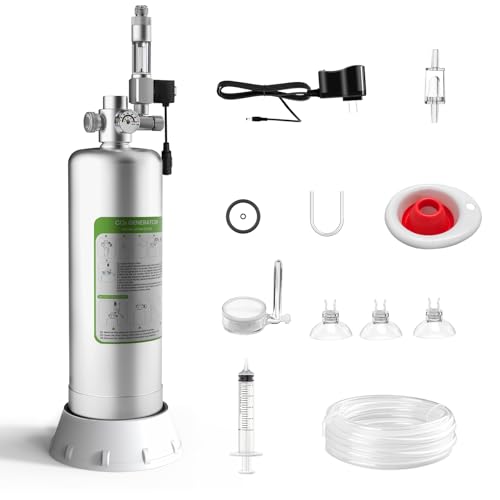
- Thick 304 stainless steel bottle
- Integrated solenoid and bubble counter
- Includes core setup accessories
Best For: Planted tanks needing a durable refillable system
Best Compact Cartridge Kit
FZONE Desktop Aquarium CO2 System

- Slim desktop-friendly design
- Supports 5/8-inch and 3/8-inch threads
- 45g cartridge for low-maintenance use
Best For: Small aquariums and desktop planted tanks
Best Slow-Release Option

- Made for freshwater and display setups
- Slow-release format for aquatic plants
- Available in 200 ml and 300 ml sizes
Best For: Aquatic plants in aquariums, terrariums, and paludariums
Best Long-Run Generator
G700S Double-Runtime CO2 System

- Approximately two months per fill
- Triple filter and self-cleaning counter
- Includes regulator, solenoid, and diffuser
Best For: Planted tanks where fewer refills are a priority
Best Stainless Steel Value

- 304 stainless steel pressure-resistant bottle
- Automatic relief valve and waterproof 12V solenoid
- Complete refillable accessory kit
Best For: Planted-aquarium owners wanting a durable, refillable system
Best Budget Bottle Setup

- 4-in-1 diffuser with bubble counter
- Metal needle valve for fine adjustment
- Designed for carbonated beverage bottles
Best For: Hands-on aquarists seeking a simple, economical setup
Best Long-Running Capacity

- Thick 2.5L SUS304 stainless steel bottle
- About one month at the stated usage rate
- Precision valve, check valve, and 12V solenoid
Best For: Larger planted tanks and users wanting fewer refills
Budget-Friendly Starter

- Citric acid and baking soda reaction
- Pressure gauge and relief valve
- Requires two 2L beverage bottles
Best For: Budget-conscious planted aquarium owners
Heavy-Duty Upgrade

- Thick 304 stainless-steel body
- Precision flow and pressure controls
- Includes diffuser and installation accessories
Best For: Planted tanks needing a larger, durable generator
Timed Precision Pick
2L CO2 Generator with Solenoid

- Durable SUS304 stainless-steel bottle
- Timer-compatible 12V solenoid valve
- Built-in check valve in bubble counter
Best For: Planted aquariums needing scheduled CO2 injection
Best All-in-One DIY System – MagTool 2.5–5L CO2 Generator Kit
For aquarists comparing diy aquarium co2 systems, the MagTool kit combines a stainless steel generator bottle with an integrated solenoid and bubble counter. It is designed for planted tanks and includes the main tubing, diffuser, safety components, and setup accessories, though raw materials must be purchased separately.
Best For: Planted-tank keepers who want a refillable, accessory-rich system with an integrated control setup.
Pros:
- 304 stainless steel bottle with a thicker construction and external thread designed to resist residue-related sticking.
- Integrated 12V solenoid and bubble counter reduce connections and include an injection port for fluid refills.
- Includes diffuser, check valve, tubing, suction cups, funnel, syringe, ceramic disc, sealing rings, and power adapter.
- Manual shut-off and automatic pressure-relief valve provide two safety controls.
Cons:
- Raw material is not included.
- The larger bottle options may be more than needed for very small aquariums.
With a one-year warranty on key components, this is a practical choice for users prioritizing durability, included accessories, and straightforward refill access over a compact disposable setup.
Best Compact Cartridge Kit – FZONE Desktop Aquarium CO2 System
The FZONE desktop kit is a space-saving option among diy aquarium co2 systems, using a 45g disposable cartridge rather than a refillable generator bottle. Its narrow profile, quick-connect tubing, and compatibility with 5/8-inch and 3/8-inch cartridge threads make it suited to small aquariums and desktop setups.
Best For: Small or desktop aquariums where compact size and low-maintenance cartridge replacement matter most.
Pros:
- Compact design measures about 9.84 inches tall and 1.96 inches wide.
- Includes a 3/8-inch adapter and supports 5/8-inch threaded cylinders.
- The 45g cartridge may last up to 50 days at 1 BPS on an eight-hour daily schedule, according to the supplied testing.
- Quick-connect tubing and a seamless aluminum body simplify setup and help limit leak risk.
Cons:
- Disposable cartridges require replacement instead of refilling.
- The 45g format is intended for smaller systems rather than high-capacity applications.
This kit trades refillability for convenience and a small footprint, making it an appealing choice when a full-size CO2 cylinder would be impractical.
Best Slow-Release Option – Aquario Neo CO2 DIY Kit
The Aquario Neo CO2 kit takes a simpler slow-release approach to diy aquarium co2 systems and is listed for freshwater aquariums, terrariums, and paludariums. Its supplied details identify a liquid-form kit with 200 ml and 300 ml volume options, making it a compact alternative to pressurized generator systems.
Best For: Aquatic-plant keepers seeking a slow-release CO2 kit for freshwater tanks, terrariums, or paludariums.
Pros:
- Designed for freshwater aquariums, terrariums, and paludariums.
- Uses a slow-release format for aquatic plants.
- Available in 200 ml and 300 ml liquid-volume options.
Cons:
- The supplied information does not specify an integrated solenoid, pressure regulator, or bubble counter.
- Setup requires waiting the full 24 hours as instructed; skipping that step may cause issues.
Its appeal is simplicity and versatility rather than advanced pressurized control. Follow the full preparation instructions carefully, especially the stated 24-hour wait.
Best Long-Run Generator – G700S Double-Runtime CO2 System
The G700S is a high-capacity choice among diy aquarium co2 systems, with a stated 4L-equivalent gas capacity and approximately two months of runtime per fill. It combines a stainless steel generator, solenoid valve, regulator, safety valve, bubble counter, and filter, while raw materials are sold separately.
Best For: Fishkeepers who want longer intervals between refills and maintainable components for a planted aquarium setup.
Pros:
- Designed to provide about two months of runtime, with approximately 125L equivalent CO2 output per fill.
- Triple stainless steel filter elements and a self-cleaning bubble-counter design help address debris and clogging.
- Includes regulator, safety and needle valves, solenoid bubble counter, diffuser, check valve, tubing, stand, and power adapter.
- John Guest quick-connect fittings allow tool-free tubing changes, and replacement accessories are available.
Cons:
- Raw materials are not included and must be purchased separately.
- At 5.6 pounds, it is less portable than compact cartridge systems.
The G700S stands out for runtime and serviceability. Its refill-focused design and replaceable accessories suit users who prefer maintaining one generator over repeatedly replacing small cartridges.
Best Stainless Steel Value – 2L Aquarium CO2 System
For hobbyists comparing DIY aquarium co2 systems, this 2L kit offers a stainless steel generator, pressure monitoring, and the core parts needed to begin producing CO2 with citric acid, baking soda, and water. Its automatic pressure relief valve and waterproof 12V solenoid add practical safety and scheduling features.
Best For: Planted-aquarium owners seeking a durable, refillable 2L system with included accessories.
Pros:
- 304 stainless steel bottle is designed to be more durable and pressure resistant than a plastic bottle generator.
- Automatic pressure relief activates when internal pressure exceeds 30KG.
- Includes a bubble counter, atomizer, check valve, tubing, solenoid, and installation accessories.
- Uses readily available citric acid and baking soda for refills.
Cons:
- Initial atomizer bubbles may be large and can take up to three days to settle.
- Requires mixing and replenishing the raw materials as the gas supply runs out.
This is a well-equipped option for buyers who prioritize a metal bottle, built-in safety features, and a complete accessory package without relying on disposable CO2 cartridges.
Best Budget Bottle Setup – G211 DIY Aquarium CO2 Kit
This G211 kit is a straightforward choice among DIY aquarium co2 systems, pairing a diffuser with bubble counting, a built-in check valve, and a metal needle valve. It is designed for use with carbonated beverage bottles and includes a starting tube intended to reduce frequent bottle squeezing.
Best For: Budget-conscious aquarists comfortable using a carbonated beverage bottle and manually tuning output.
Pros:
- 4-in-1 diffuser combines diffusion, bubble counting, and a built-in check valve.
- Metal needle valve supports more precise adjustment and can be set around 4–5 seconds per bubble.
- Upgraded pressure relief valve is designed for more accurate, durable operation.
- Starting tube helps the system reach its green pressure range with shaking and waiting rather than frequent squeezing.
Cons:
- Must be used with carbonated beverage bottles; other bottles are not recommended.
- Needle valve adjustment is intended as a one-time setting, while daily switching uses the separate on/off valve.
The G211 keeps the setup relatively simple and economical, but its bottle requirement and manual operating approach make it better suited to hands-on users than those seeking a dedicated stainless steel generator.
Best Long-Running Capacity – Fzone 2.5L CO2 Generator
For larger planted tanks or shoppers who want longer intervals between refills, this Fzone model is a strong contender among DIY aquarium co2 systems. Its 2.5L SUS304 bottle, precision needle valve, bubble counter, and 12V DC solenoid are built around steady output and scheduled injection.
Best For: Planted-tank keepers who want a larger refill capacity and a durable stainless steel generator.
Pros:
- Thick 1.5mm SUS304 stainless steel bottle is rated to withstand up to 80kg/cm2 pressure.
- At 1 bubble per second for 8 hours daily, it can generate CO2 for about one month when filled with 300–400g of raw materials.
- Precision needle valve and bubble counter support fine output adjustment; the bubble counter includes a check valve.
- 12V DC solenoid can be placed on a timer to control injection periods.
Cons:
- Citric acid and sodium bicarbonate powders are not included.
- At 2.36kg, it is heavier than smaller DIY systems.
Fzone is a practical upgrade for users who value capacity, stable control, and scheduled operation. Remember to budget separately for the required powders before setting it up.
Budget-Friendly Starter – G200 DIY CO2 Generator
For aquarists exploring DIY aquarium co2 systems on a budget, the G200 uses a citric acid and baking soda reaction to supply planted tanks. Its quick-reaction test tube, acid-absorption ball, pressure gauge, and pressure-relief valve are designed to make operation easier to manage.
Best For: Low-cost planted aquarium setups where you already have suitable bottles and want a straightforward DIY CO2 method.
Pros:
- Uses an accessible citric acid and baking soda reaction.
- Includes a quick-reaction test tube and acid-control design.
- Features pressure-resistant tubing and a pressure-relief valve.
- Includes most accessories needed for setup.
Cons:
- Requires two additional 2L carbonated beverage bottles.
- Citric acid, baking soda, check valve, and diffuser are not included.
- It should only be used with carbonated beverage bottles, as directed.
The G200 is a practical entry point for DIY aquarium co2 systems, especially when keeping initial costs down matters. Its control features are useful, but the extra bottle and accessory requirements should be included in your setup budget.
Heavy-Duty Upgrade – FZONE 2.5L CO2 Generator
The FZONE 2.5L is a robust option among DIY aquarium co2 systems, using citric acid and sodium bicarbonate to produce CO2 for planted tanks. Its thicker 304 stainless-steel body, precision needle valve, pressure gauge, and dual safety features support controlled operation.
Best For: Planted aquarium keepers who want a larger stainless-steel generator with included control and installation accessories.
Pros:
- 2.5L food-grade 304 stainless-steel body is described as 50% thicker.
- Includes a precision needle valve, bubble counter, gauge, diffuser, and check valve.
- Manual shut-off and automatic pressure-relief valves provide dual safety control.
- Built-in fill port and upgraded external threads simplify maintenance.
Cons:
- Citric acid and sodium bicarbonate raw materials are not included.
- At 4.44 pounds, it is heavier than smaller DIY systems.
- Its 2.5L size may be more capacity than smaller aquariums require.
With its larger capacity and stainless-steel construction, the FZONE is suited to shoppers prioritizing durability and convenient maintenance. It is a more substantial choice, though you will still need to supply the reaction materials.
Timed Precision Pick – 2L CO2 Generator with Solenoid
This 2L system is a capable choice for DIY aquarium co2 systems when timed injection and durable construction are priorities. It combines a 1.2mm SUS304 stainless-steel bottle with a regulator, precision needle valve, bubble counter, and 12V solenoid valve.
Best For: Aquarium owners who want timer-based CO2 scheduling and a stainless-steel generator with integrated flow monitoring.
Pros:
- 1.2mm SUS304 stainless-steel bottle is designed for durability and pressure resistance.
- 12V solenoid valve supports scheduled CO2 injection with a timer.
- Automatic pressure relief activates above the stated pressure range.
- Bubble counter includes a built-in check valve to help prevent backflow.
Cons:
- Citric acid and sodium bicarbonate powders must be purchased separately.
- The solenoid valve is not waterproof and must be kept away from water.
- The diffuser may require a 24-hour soak before producing bubbles.
This kit stands out for aquarists who want more control over when CO2 runs, thanks to its solenoid-compatible design. Pay close attention to the electrical and diffuser-use instructions during installation.
How We Picked the Best Diy Aquarium Co2 Systems
We compared these Diy Aquarium Co2 Systems by looking at tank compatibility, generator capacity, pressure and flow control, included accessories, operating convenience, and likely maintenance needs. Systems with solenoid valves or pressure gauges generally offer more precise control, while compact cartridge and slow-release kits can be simpler choices for nano aquariums or occasional use.
Because DIY CO2 equipment varies in fittings and included parts, verify the listing details before buying. Check whether the kit includes tubing, a diffuser, bubble counter, regulator, safety valve, or compatible cartridge. Replacement availability and clear instructions also matter for long-term value.
Quick Comparison
| System type | Best for | What to prioritize |
|---|---|---|
| Compact cartridge kit | Nano and desktop aquariums | Small footprint, easy refills, compatible fittings |
| Slow-release kit | Low-maintenance planted setups | Predictable diffusion and simple installation |
| 2L generator | Small to medium planted tanks | Pressure gauge, regulator, and stable output |
| 2.5L to 5L generator | Larger tanks or longer runtime | Capacity, safety features, and solenoid control |
Key Buying Factors for Diy Aquarium Co2 Systems
Capacity and Runtime
Larger bottles usually provide longer runtime, but they also take up more space and may require more preparation. Match the generator to your aquarium size and available cabinet or shelf space rather than choosing the largest option automatically.
Control and Safety
A needle valve helps fine-tune CO2 output, while a bubble counter makes changes easier to observe. Pressure gauges provide useful feedback, and a solenoid valve can shut CO2 off with a timer when aquarium lights are off. Look for secure connections, a pressure-relief feature, and sturdy construction.
Diffusion and Compatibility
The diffuser determines how efficiently gas enters the water. Confirm the tubing size and connector style, especially when replacing parts or connecting a system to an existing regulator. A properly sized diffuser and good circulation help distribute CO2 more evenly.
Routine Maintenance
DIY generators may require periodic refilling, cleaning, gasket checks, or replacement of reaction ingredients. Choose a design you can comfortably service. Always monitor livestock, use a drop checker or other reliable indicator, and avoid increasing CO2 faster than plants and animals can tolerate.
Who Should Buy Which Diy Aquarium Co2 Systems?
Choose a compact FZONE cartridge system or the Aquario Neo CO2 kit if you have a nano tank, desktop aquarium, terrarium, or paludarium and want a small, approachable setup. These are attractive when minimal equipment and straightforward installation matter most.
For small to medium planted aquariums, a 2L system with a pressure gauge, regulator, or needle valve offers a useful balance of capacity and control. The G211 and G200-style kits can suit buyers who want a conventional DIY generator without moving to the largest bottles.
If you want longer runtime or more automation, consider a 2.5L to 5L generator such as the MagTool, FZONE upgraded models, or the G700S. These are better suited to larger planted tanks or owners who value solenoid control and reduced refill frequency. Before operating any pressurized kit, follow the manufacturer’s instructions, test every connection for leaks, and introduce CO2 gradually.