Adding carbon dioxide can help aquarium plants grow more vigorously, develop richer color, and fill in more densely. The right setup depends on tank size, desired growth, refill convenience, and how much control you want over dosing.
These 10 aquarium CO2 systems include DIY generator kits, compact 2L and 2.5L options, larger-capacity bottles, solenoid-equipped designs, and essential monitoring accessories. Use the guide below to narrow the choices by installation needs, runtime, and budget.
Best 10 Aquarium Co2 Systems Picks for 2026
Best DIY Large-Tank Pick
Fzone 5.5 L Aquarium CO2 System

- Large 5.5-liter DIY bottle
- Precision needle valve and bubble counter
- 12V solenoid with safety valve
Best For: Planted tanks needing a high-capacity refillable CO2 setup
Best Long-Runtime System
Clscea G700S Aquarium CO2 Generator

- Advertised two-month runtime per fill
- Triple stainless filter protects the solenoid
- Quick-connect fittings and replaceable parts
Best For: Aquarists seeking fewer refills and easier maintenance
Best CO2 Monitoring Accessory

- Includes reagent and suction cups
- Simple color-based CO2 readings
- Clear glass with one-year warranty
Best For: Monitoring CO2 levels in planted aquariums
Best Upgraded DIY Design
FZONE 5.5L Aquarium CO2 Generator

- 5.5-liter stainless steel generator
- Dual safety valves and pressure gauge
- Convenient fill port with complete accessories
Best For: DIY users wanting easier refilling and controlled CO2 delivery
Large-Tank Ready Pick

- 4L capacity for medium or large planted tanks
- Includes 600g each of citric acid and baking soda
- 304 stainless-steel construction with triple filter element
Best For: Medium to large planted aquariums needing longer runtime
Safety-Focused Upgrade
- Thick 304 stainless-steel body
- Precision control with gauge, needle valve, and bubble counter
- Includes accessories but requires separate reaction materials
Best For: Planted tanks needing monitored flow and safety controls
Convenient 2L Choice

- Pre-measured materials included for one full cycle
- Dual bubble counters include a spare
- SUS304 reactor with pressure gauge and relief valve
Best For: Planted tanks prioritizing easy startup and precise monitoring
Long-Run DIY Pick
Fzone 2.5L Aquarium CO2 System
- Thick 1.5mm SUS304 stainless-steel bottle
- Includes regulator, diffuser, tubing, and solenoid
- Designed for about one month of output under stated conditions
Best For: Planted tanks needing a refillable 2.5L DIY system
All-in-One Upgrade
MagTool 2.5-5L DIY Aquarium CO2 Kit
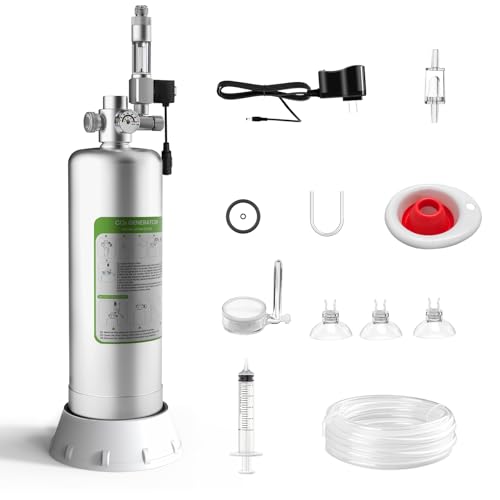
- Available in 2.5L and 5L capacities
- Integrated solenoid and bubble counter
- Includes a broad set of setup accessories
Best For: Users wanting flexible capacity and a simplified integrated design
Compact Safety Choice
2L Aquarium CO2 Generator System

- Compact 2L SUS304 stainless-steel bottle
- Includes regulator, needle valve, diffuser, and solenoid
- Automatic pressure relief and built-in check valve
Best For: Smaller planted tanks needing scheduled DIY CO2 delivery
Best DIY Large-Tank Pick – Fzone 5.5 L Aquarium CO2 System
For aquarists comparing aquarium co2 systems, this Fzone kit offers a refillable DIY setup with a 5.5-liter SUS304 stainless steel bottle, regulator, precision needle valve, bubble counter, diffuser, tubing, and 12V DC solenoid. It is designed for adjustable, steady CO2 delivery, but citric acid and sodium bicarbonate must be purchased separately.
Best For: Planted-tank owners who want a large-capacity DIY CO2 system with timer-compatible solenoid control.
Pros:
- Thick 1.5mm SUS304 stainless steel bottle rated for high pressure.
- Precision needle valve and bubble counter support fine flow adjustment.
- Built-in bubble-counter check valve helps prevent water backflow.
- 12V DC solenoid can be connected to a timer.
Cons:
- Reaction powders are not included.
- A timer is not included for automated solenoid scheduling.
Its larger bottle and safety-focused construction make it a practical choice for sustained planted-aquarium use, provided you are comfortable mixing the required refill ingredients yourself.
Best Long-Runtime System – Clscea G700S Aquarium CO2 Generator
Among aquarium co2 systems, the G700S stands out for its advertised extended runtime and maintenance-oriented design. Its 4-liter-equivalent gas capacity, stainless steel cylinder, solenoid valve, filter, bubble counter, diffuser, tubing, and quick-connect fittings create a complete setup, although raw refill materials are sold separately.
Best For: Aquarists who prioritize fewer refills and replaceable system components.
Pros:
- Advertised to provide approximately two months of runtime per fill.
- Triple stainless steel filter element helps protect the solenoid.
- Self-cleaning bubble-counter design flushes valve pathways during water refills.
- John Guest quick-connect fittings allow tool-free tubing changes.
Cons:
- Raw refill materials are not included.
- Its listed liquid volume is 600 ml, despite the higher equivalent gas-capacity rating.
The G700S is a strong convenience-focused option for planted aquariums where reducing refill frequency matters. Its repairable accessory design may also appeal to owners who prefer maintenance over replacing the entire system.
Best CO2 Monitoring Accessory – Pawfly Glass CO2 Drop Checker
A drop checker is a useful companion to aquarium co2 systems because it provides a visual indication of dissolved CO2 levels. This Pawfly kit includes a curved glass checker, reagent solution, and two suction cups, with color changes intended to help identify insufficient, balanced, or excessive CO2.
Best For: Planted-aquarium owners who want a simple visual CO2 monitor.
Pros:
- Includes glass tubing, reagent solution, and two suction cups.
- Color interpretation is straightforward: blue, green, light green, or yellow.
- Clear glass supports easy reading and vertical tank-wall mounting.
- Includes a one-year warranty.
Cons:
- It monitors CO2 but does not generate or inject it.
- Results take about two hours to appear.
- The tubing opening must face downward during installation.
This is an inexpensive monitoring add-on rather than a complete aquarium CO2 system. Use it to check the apparent CO2 balance while adjusting a separate generator or injection setup.
Best Upgraded DIY Design – FZONE 5.5L Aquarium CO2 Generator
This upgraded FZONE kit is one of the more complete aquarium co2 systems for DIY users. It uses a citric acid and sodium bicarbonate reaction, then regulates delivery through a needle valve, pressure gauge, bubble counter, diffuser, and all-in-one solenoid. The package includes setup accessories, but raw materials are not included.
Best For: Planted-tank keepers who want convenient filling, stable control, and added safety features.
Pros:
- 5.5-liter 304 stainless steel generator is designed for pressure resistance.
- Manual shut-off and automatic pressure-relief valves provide dual safety control.
- All-in-one solenoid reduces connections and potential leak points.
- Includes diffuser, check valve, tubing, funnel, syringe, seals, and power adapter.
Cons:
- Citric acid and sodium bicarbonate are not included.
- DIY preparation is required before operation.
The upgraded threaded design and built-in fill port make this a convenient choice for users who expect to refill and clean the generator regularly. Its included accessories also reduce the need to source additional setup parts.
Large-Tank Ready Pick – 4L Clscea CO2 Generator Kit
Clscea Aquarium CO2 Generator Complete kit with 600g +600g raw Materials,4L G802S
Check Price On AmazonFor aquarists comparing aquarium co2 systems for a medium or large planted tank, this 4L generator emphasizes longer use between fills and an out-of-the-box setup. It includes 600g each of citric acid and baking soda for one reaction, plus a stainless-steel construction designed for durability.
Best For: Medium to large planted aquariums where extended capacity and included reaction materials are priorities.
Pros:
- 4L capacity is suited to medium or large plant tanks.
- Includes 600g citric acid and 600g baking soda for one reaction.
- 304 stainless-steel bottle, regulator, and filter element offer a durable build.
- Triple stainless-steel filter element and Ice-Start refill approach are designed to help minimize solenoid-valve failure risk.
Cons:
- Its larger 4L format may be more capacity than smaller aquariums need.
- Refilling requires adding the recommended reactants and water, or using the optional refill ice tray approach.
The combination of high capacity, included ingredients, and stainless-steel components makes this a practical choice for planted-tank keepers who want fewer interruptions between reactions. Check the available space and refill routine before choosing it for a compact setup.
Safety-Focused Upgrade – FZONE 2.5L CO2 Generator
This FZONE kit is a capable option among aquarium co2 systems for planted tanks, combining a 2.5L reactor with flow-control hardware and multiple safety features. It arrives with the main accessories needed for setup, but citric acid and sodium bicarbonate must be purchased separately.
Best For: Planted-aquarium owners who want adjustable CO2 delivery, visible pressure and bubble monitoring, and built-in pressure protection.
Pros:
- 304 stainless-steel body is 50% thicker for added strength and pressure resistance.
- Includes a precision needle valve, bubble counter, pressure gauge, and all-in-one solenoid.
- Manual shut-off and automatic pressure-relief valves provide two stated safety controls.
- Includes diffuser, check valve, tubing, fittings, suction cups, funnel, syringe, sealing rings, and power adapter.
Cons:
- Raw reaction materials are not included.
- At 2.5L, it may offer less capacity than a larger 4L generator.
Its strongest appeal is control: the pressure gauge and bubble counter make adjustments easier to monitor, while the dual safety design adds reassurance. Budget for the separate reaction ingredients when comparing total setup cost.
Convenient 2L Choice – CO2FY Aquarium CO2 Generator
For shoppers seeking aquarium co2 systems with a straightforward first setup, this 2L CO2FY reactor includes pre-measured reaction materials for one full cycle. Its pressure gauge, precision needle valve, and dual bubble counters support hands-on flow adjustment and monitoring for planted tanks.
Best For: Planted-aquarium keepers who value included starter materials, precise adjustment, and a spare bubble counter.
Pros:
- Pre-measured starter materials let you begin after adding water.
- Includes two bubble counters, with one available as a spare.
- Thick-walled SUS304 stainless-steel reactor is built for durability.
- Precision needle valve, pressure gauge, and automatic pressure relief support controlled operation.
Cons:
- The 2L capacity is smaller than some larger generator options.
- Although starter materials are included, future cycles require additional refill ingredients.
This system is especially practical for buyers who want to avoid measuring the first batch and appreciate backup monitoring hardware. Its 2L size can also be easier to match with setups that do not need the capacity of a larger reactor.
Long-Run DIY Pick – Fzone 2.5L Aquarium CO2 System
For planted-tank keepers comparing aquarium co2 systems, the Fzone 2.5L kit emphasizes a thicker SUS304 stainless-steel bottle, adjustable CO2 delivery, and timer-based operation. It generates CO2 from separately purchased citric acid and sodium bicarbonate powders.
Best For: Planted aquariums that need a refillable DIY system with a larger 2.5L bottle and adjustable injection timing.
Pros:
- 1.5mm SUS304 stainless-steel bottle is designed for durability and can generate CO2 for about one month at 1 bubble per second for eight hours daily when properly filled.
- Includes a regulator, precision needle valve, bubble counter, diffuser, tubing, and 12V DC solenoid.
- Built-in check valve helps prevent aquarium water from flowing back into the tank, while the safety valve releases excess pressure.
Cons:
- Citric acid and sodium bicarbonate powders are not included.
- The larger bottle weighs about 2.36 kg and may require more space than smaller systems.
Its thicker bottle and complete control hardware make this a practical option for aquarists who prefer longer intervals between refills and scheduled CO2 dosing. The one-year warranty and stated round-the-clock customer service add useful support.
All-in-One Upgrade – MagTool 2.5-5L DIY Aquarium CO2 Kit
The MagTool is a flexible choice among aquarium co2 systems, offering 2.5L and 5L bottle options with an integrated solenoid and bubble counter. Its external-thread bottle and included accessories are intended to simplify setup and refilling.
Best For: Planted-tank owners who want a compact integrated control assembly and the choice of two bottle capacities.
Pros:
- Food-grade 304 stainless-steel bottle uses an external thread designed to reduce sticking from residue buildup.
- Integrated solenoid and bubble counter reduce the number of connections and include an injection port for fluid observation and refill.
- Includes a diffuser, check valve, tubing, U-connector, suction cups, funnel, syringe, ceramic disc, sealing rings, and power adapter.
- Manual shut-off and automatic pressure-relief valves provide two stated safety controls.
Cons:
- Raw materials for generating CO2 are not included.
- The supplied notes do not specify expected runtime for either bottle size.
MagTool stands out for convenience: the integrated control body can help keep the setup compact, while the 5L option accommodates substantially more material than the 2.5L version. A one-year warranty covers key components such as the solenoid valve and regulator.
Compact Safety Choice – 2L Aquarium CO2 Generator System
This 2L generator is a compact option for aquarium co2 systems, combining a SUS304 stainless-steel bottle with a regulator, precision needle valve, bubble counter, and 12V solenoid. The required citric acid and sodium bicarbonate powders must be purchased separately.
Best For: Aquarists seeking a smaller DIY CO2 system with scheduled dosing and pressure-relief protection.
Pros:
- 1.2mm SUS304 stainless-steel bottle is designed to be more durable and pressure-resistant than plastic bottle generators.
- Automatic pressure relief activates when pressure exceeds the stated 30-35KG range.
- Includes a regulator, solenoid valve, filter, precision needle valve, adjustable bubble counter, and built-in check valve.
Cons:
- CO2-generating powders are not included.
- The motorized valve is not waterproof and must be kept away from water.
- The diffuser should be soaked for 24 hours before use, and initial bubble output may require troubleshooting for leaks or low pressure.
With a 2L footprint and timer-compatible 12V solenoid, this system suits planted tanks where space is limited. Its setup guidance is especially important: proper diffuser preparation and dry placement of the valve can help avoid common installation problems.
How We Picked the Best Aquarium Co2 Systems
We focused on the features that most affect planted-tank performance and day-to-day usability: bottle capacity, included regulator or solenoid hardware, bubble-counting control, safety features, runtime potential, and compatibility with common aquarium layouts. We also separated complete generator systems from accessories such as drop checkers, since they serve different buying needs.
Because DIY Aquarium Co2 Systems require mixing or replacing reaction materials, we considered refill practicality as well as initial equipment. A suitable kit should provide a stable connection, adjustable output, and a clear way to monitor whether the aquarium is receiving too much or too little carbon dioxide.
Quick Comparison
- Best for larger planted tanks: 5.5L generator kits generally offer greater capacity and longer runtime between maintenance cycles.
- Best for compact setups: 2L and 2.5L systems take up less space and can suit nano or medium-sized aquariums.
- Best for automated dosing: Models with an integrated solenoid valve can help coordinate CO2 delivery with a timer and aquarium lighting.
- Best monitoring add-on: A glass drop checker provides a visual indication of dissolved CO2 when used with the correct indicator solution.
- Best for extended runtime: Double-runtime or higher-capacity systems may reduce how often you need to service the generator.
Key Buying Factors for Aquarium Co2 Systems
Tank Size and Capacity
Choose capacity based on tank volume, plant density, available space, and how often you are willing to maintain the system. A larger bottle does not automatically mean better performance, but it can provide longer intervals between refills.
Output Control
Look for a regulator, needle valve, and bubble counter that allow gradual adjustment. Fine control is important because CO2 demand varies with lighting, plant mass, surface agitation, and photoperiod.
Solenoid and Scheduling
A solenoid valve can shut CO2 off when the aquarium lights are off, which is useful for consistent schedules and may help avoid unnecessary overnight dosing. Confirm that the valve can be connected safely to a suitable timer.
Monitoring and Safety
Use a drop checker or another reliable indicator alongside careful observation of livestock. Introduce CO2 gradually, check fittings for leaks, keep tubing secure, and prioritize fish behavior and surface movement over chasing a particular bubble rate.
Included Materials and Maintenance
Some generator kits include reaction chemicals while others may require separate ingredients. Check what is supplied, how replacement materials are sourced, and whether the bottle, seals, tubing, and valves are easy to clean or replace.
Who Should Buy Which Aquarium Co2 Systems?
Choose a 5.5L system if you have a larger, heavily planted aquarium or want fewer maintenance interruptions. Choose a 2L or 2.5L kit when cabinet space is limited or your tank has modest CO2 demand. Choose a solenoid-equipped model if automated day-and-night scheduling matters to you. Choose a double-runtime design if convenience and longer service intervals are higher priorities than compact size.
If you already own a generator but lack a visual monitor, add a glass drop checker with fresh solution. For beginners, the most practical choice is usually a complete kit with a regulator, needle valve, bubble counter, and clear instructions rather than a bare bottle or partial component set.