Choosing the right CO2 system can make a major difference in plant growth, color, and overall aquarium stability. The best setup depends on your tank size, desired runtime, available space, and how much control you want over daily dosing.
We compared 10 pressurized aquarium CO2 systems, including compact cartridge kits and larger generator systems with solenoids, bubble counters, regulators, and safety-focused designs.
Best 10 Pressurized Aquarium Co2 Systems Picks for 2026
Best Ready-to-Run Pick
2L Stainless Steel CO2 Generator

- Pre-measured starter materials included
- SUS304 steel with pressure relief
- Dual bubble counters and precision control
Best For: Planted tanks needing a convenient, adjustable starter system
Best Compact Option

- Slim design for desktop aquariums
- Includes 45g disposable cartridge
- Supports 5/8-inch and 3/8-inch threads
Best For: Small tanks and space-constrained aquarium setups
Best Long-Run Generator
G700S Double-Runtime CO2 System

- Approximate two-month runtime per fill
- Triple stainless-steel filtration
- Quick-connect fittings and replaceable parts
Best For: Aquarists seeking extended runtime and maintainability
Best Large-Capacity DIY Pick

- Large 5.5L reaction vessel
- 304 stainless-steel safety-focused build
- Integrated solenoid and refill-friendly design
Best For: Larger planted tanks and DIY refill users
Best Compact Kit

- Complete kit with solenoid, diffuser, tubing, and bubble counter
- 80g cartridge tested for up to 90 days at 1 BPS
- Compact aluminum design for nano and desktop tanks
Best For: Planted nano aquariums and desktop aquascapes
Best High-Capacity Generator
- 2.5L stainless steel reaction vessel for DIY CO2 generation
- Includes gauge, solenoid, needle valve, diffuser, and tubing
- Manual shut-off and automatic pressure relief provide added control
Best For: Planted aquariums needing a larger DIY CO2 setup
Best Budget DIY Option

- Citric acid and baking soda system for low-cost CO2 generation
- Includes reaction-control components and pressure-relief valve
- Uses two additional 2-liter carbonated beverage bottles
Best For: Budget-conscious planted-tank hobbyists comfortable with DIY setup
Best Large DIY Value
Fzone 5.5L Aquarium CO2 System

- Large 5.5L stainless-steel bottle
- Precision needle valve and bubble counter
- 12V timer-compatible solenoid
Best For: Larger planted tanks and refillable DIY setups
Best Integrated Design
MagTool Upgraded DIY CO2 Generator Kit
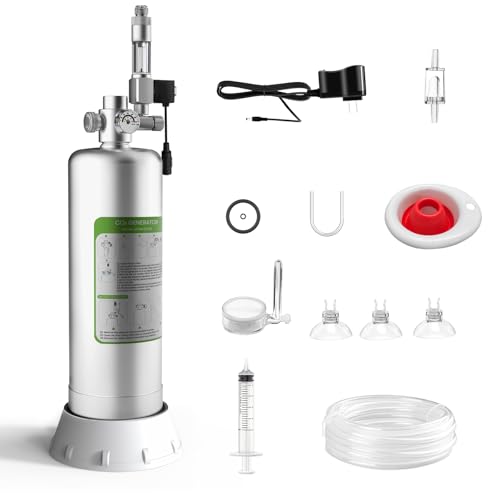
- Integrated solenoid and bubble counter
- External-thread 304 stainless bottle
- Includes core setup accessories
Best For: Compact, accessory-rich planted-tank setups
Best Simple Pick
2L Aquarium CO2 Generator System

- Compact 2L stainless-steel bottle
- Automatic pressure relief valve
- 12V solenoid and precision needle valve
Best For: Smaller planted aquariums and space-conscious setups
Best Ready-to-Run Pick – 2L Stainless Steel CO2 Generator
For shoppers comparing pressurized aquarium co2 systems, this 2L generator stands out for its ready-to-run setup and stainless-steel construction. Pre-measured reaction materials, dual bubble counters, a precision needle valve, and a pressure gauge make it a practical option for planted tanks.
Best For: Planted-aquarium owners who want a complete starter kit with adjustable output and included reaction materials.
Pros:
- Includes pre-measured materials for one full reaction cycle, so no separate measuring or ingredient shopping is needed initially.
- Thick-walled SUS304 stainless-steel reactor includes an automatic pressure-relief valve.
- Precision needle valve and pressure gauge support controlled, observable CO2 dosing.
- Includes a spare bubble counter, diffuser, tubing, and check valve.
Cons:
- Refill ingredients are needed after the included starter cycle.
- Its 2L capacity may require more frequent refilling than larger generator systems.
This is a well-equipped choice when convenience and durable construction matter. Its included starter materials simplify the first setup, while the adjustable regulator components give experienced users room to fine-tune bubble output.
Best Compact Option – FZONE Desktop 45g CO2 System
Among pressurized aquarium co2 systems, this FZONE desktop model is designed for smaller tanks and limited spaces. Its slim 9.84-by-1.96-inch form, 45g disposable cartridge, quick-connect tubing, and compatibility with 5/8-inch and 3/8-inch threads keep installation compact and straightforward.
Best For: Desktop aquariums and small planted tanks where a full-size cylinder would be unnecessarily bulky.
Pros:
- Compact, portable design is suited to small aquariums and tight setups.
- Includes a 45g cartridge and a 3/8-inch adapter for compatibility with different cartridge threads.
- Disposable cartridges avoid refilling, while quick-connect tubing speeds installation.
- High-strength aluminum construction and precision sealing are designed to help prevent leaks.
Cons:
- The single-use cartridge design requires replacement cartridges rather than refilling.
- Its compact cartridge capacity is intended for smaller setups, not high-demand large tanks.
This system prioritizes footprint and simplicity over long-term refill flexibility. The stated runtime can reach up to 50 days at 1 bubble per second on an eight-hour daily schedule, though actual performance depends on aquarium settings.
Best Long-Run Generator – G700S Double-Runtime CO2 System
If minimizing refill frequency is your priority when comparing pressurized aquarium co2 systems, the G700S is built around extended runtime. Its 2.4L volume is rated at 4L equivalent gas capacity, and the system combines stainless-steel filtration with a solenoid valve, quick-connect fittings, and replaceable accessories.
Best For: Planted-tank owners who want longer intervals between refills and maintainable components.
Pros:
- Rated for approximately 125L of CO2 output per fill, or about two months according to the supplied notes.
- Three-layer stainless-steel filtration helps block debris before it reaches the solenoid.
- Self-cleaning bubble-counter design flushes valve pathways when water is topped up.
- Includes quick-connect fittings, diffuser, tubing, safety valve, and a one-year warranty.
Cons:
- Raw reaction materials are not included and must be purchased separately.
- The longer-runtime generator is heavier than the compact desktop option, at 5.6 pounds.
The G700S is a strong fit for users who would rather maintain a larger generator than refill a smaller one frequently. Its replaceable accessories and filtration features also make it appealing for shoppers focused on serviceability, provided they are prepared to source the refill materials.
Best Large-Capacity DIY Pick – FZONE 5.5L CO2 Generator
This FZONE 5.5L model is a practical contender among pressurized aquarium co2 systems for users who prefer a larger reaction vessel and refillable operation. It uses citric acid and sodium bicarbonate, with a regulator, solenoid, bubble counter, diffuser, and safety features included; the raw materials must be added separately.
Best For: Planted-aquarium keepers who want a larger DIY generator with integrated control and safety hardware.
Pros:
- 5.5L generator uses a citric-acid and sodium-bicarbonate reaction without requiring CO2-station refills.
- Food-grade 304 stainless-steel body is described as 50% thicker for added pressure resistance.
- Combines manual shutoff, automatic pressure relief, precision needle valve, gauge, and all-in-one solenoid.
- Includes diffuser, tubing, check valve, connectors, suction cups, funnel, syringe, and power adapter.
Cons:
- Citric acid and sodium bicarbonate are not included.
- The larger generator may be more equipment than needed for very small tanks.
Its main appeal is the combination of capacity, integrated controls, and simplified maintenance. The external-thread design and built-in fill port are intended to make cleaning and refilling easier, while the supplied accessories reduce the need to source additional setup parts.
Best Compact Kit – 80g Desktop CO2 System
For smaller planted tanks, this pressurized aquarium CO2 system combines an 80g cartridge, solenoid valve, bubble counter, diffuser, check valve, and tubing in a compact package. Its quick-connect design and included 3/8-inch adapter simplify installation, while the larger cartridge is intended to reduce replacement frequency compared with a 45g setup.
Best For: Nano aquariums, desktop aquascapes, and planted tanks where compact size and scheduled CO2 control matter.
Pros:
- Includes the main installation accessories, including diffuser, tubing, bubble counter, and solenoid valve.
- 80g cartridge is tested for up to 90 days at 1 BPS with an 8-hour daily schedule.
- Compact aluminum design measures 10.63 inches tall and 2.76 inches wide.
- Compatible with 5/8-inch and 3/8-inch CO2 threads using the included adapter.
Cons:
- Designed for nano and desktop aquariums rather than larger tanks.
- Cartridge supply eventually requires replacement.
This is a convenient choice when you want a ready-to-install system without a bulky cylinder. The solenoid and bubble counter add useful control for maintaining a consistent planted-tank schedule.
Best High-Capacity Generator – 2.5L Aquarium CO2 Generator
This pressurized aquarium CO2 system uses a citric acid and sodium bicarbonate reaction instead of refillable CO2 cylinders. The 2.5L stainless steel generator includes a regulator, pressure gauge, precision needle valve, solenoid, bubble counter, diffuser, and setup accessories, making it a comprehensive option for planted aquariums.
Best For: Planted aquarium keepers who prefer a larger DIY generator with pressure monitoring, included accessories, and built-in safety features.
Pros:
- 2.5L food-grade 304 stainless steel body is described as 50% thicker for added strength and pressure resistance.
- Includes a pressure gauge, precision needle valve, bubble counter, diffuser, tubing, and power adapter.
- Manual shut-off and automatic pressure-relief valves provide two stated safety controls.
- External-thread design and built-in fill port are intended to simplify cleaning and maintenance.
Cons:
- Raw reaction materials are not included.
- At 4.44 pounds, it is less portable than a small cartridge-based system.
- Requires mixing and replenishing the citric acid and sodium bicarbonate reaction.
The larger vessel and pressure-monitoring hardware make this a more substantial DIY solution than a compact cartridge kit. It suits users who value longer operating capacity and hands-on maintenance over the simplest possible setup.
Best Budget DIY Option – G200 CO2 Generator System
The G200 is a low-cost pressurized aquarium CO2 system that generates CO2 from citric acid and baking soda. Its reaction test tube, acid-absorbing ball, pressure-relief valve, and pressure-resistant tubing are designed to make output control more manageable, though setup requires two compatible 2-liter carbonated beverage bottles and separate reaction materials.
Best For: Budget-minded planted-tank owners comfortable preparing their own bottles and reaction ingredients.
Pros:
- Uses readily available citric acid and baking soda for DIY CO2 generation.
- Reaction test tube and acid-absorbing ball are intended to simplify reaction and acid-consumption control.
- Includes pressure-resistant, acid-resistant, and hydrolysis-resistant tubing between the caps.
- Features a pressure-relief valve and stable ABS engineering-plastic caps.
Cons:
- Requires two additional 2-liter carbonated beverage bottles.
- Baking soda, citric acid, check valve, and diffuser must be prepared separately.
- The supplied guidance says to use the needle valve for initial adjustment and the on/off valve for daily switching.
This system keeps entry cost down by using household-style bottles, but it demands more preparation than a complete cartridge kit. Follow the bottle restriction and operating guidance carefully for the intended setup.
Best Large DIY Value – Fzone 5.5L Aquarium CO2 System
For aquarists comparing pressurized aquarium co2 systems, the Fzone 5.5L kit stands out for its larger stainless-steel bottle, adjustable bubble counter, and timer-compatible 12V solenoid. It is a complete DIY setup, but citric acid and sodium bicarbonate must be purchased separately.
Best For: Larger planted tanks and hobbyists who want a refillable DIY system with stable output.
Pros:
- 5.5L SUS304 stainless-steel bottle with a stated pressure capacity up to 1137 PSI
- Precision needle valve and bubble counter support fine CO2 adjustment
- Built-in check valve helps prevent aquarium water from flowing back into the tank
- 12V solenoid can be connected to a timer for scheduled injection
Cons:
- Citric acid and sodium bicarbonate powders are not included
- Timer is not included
This is a practical choice when capacity and safety features matter more than having the smallest possible setup. Its larger bottle may also suit users who want fewer refills.
Best Integrated Design – MagTool Upgraded DIY CO2 Generator Kit
The MagTool upgraded kit is one of the more streamlined pressurized aquarium co2 systems for planted tanks. Its integrated solenoid and bubble counter reduce connections, while the external-thread stainless-steel bottle is designed for easier refilling and cleanup. Raw materials are not included.
Best For: Planted-tank owners who value an integrated, space-saving design and included accessories.
Pros:
- Food-grade 304 stainless-steel bottle with an external thread intended to reduce residue-related sticking
- Integrated solenoid and bubble counter create a compact setup with fewer connections
- Manual shut-off and automatic pressure-relief valves provide dual safety controls
- Includes diffuser, tubing, check valve, funnel, syringe, sealing rings, and power adapter
Cons:
- Citric acid and sodium bicarbonate raw materials are not included
- Capacity choice varies between the 2.5L and 5L versions
The integrated layout and accessory bundle make this a convenient option for buyers who want fewer separate parts. A one-year warranty on key components adds useful ownership support.
Best Simple Pick – 2L Aquarium CO2 Generator System
This 2L generator system offers a compact entry point into pressurized aquarium co2 systems, with a SUS304 stainless-steel bottle, regulator, precision needle valve, and 12V solenoid. It is supplied as a DIY kit, so citric acid and sodium bicarbonate powders must be sourced separately.
Best For: Smaller planted aquariums and users seeking a compact system with scheduled CO2 control.
Pros:
- 2L SUS304 stainless-steel bottle is described as thicker than standard tanks
- Automatic pressure relief activates when pressure exceeds 30–35KG
- 12V solenoid works with a timer for controlled injection periods
- Bubble counter includes a check valve to help prevent backflow
Cons:
- CO2-generating powders are not included
- The motorized valve is not waterproof and must be kept away from water
- Diffuser may require a 24-hour soak before producing bubbles
With its smaller bottle and core controls, this kit is suited to aquarists who need a straightforward system without the footprint of a larger generator. Follow the diffuser and valve-use instructions for the best setup experience.
How We Picked the Best Pressurized Aquarium Co2 Systems
We focused on the features that matter most in a planted aquarium: usable CO2 capacity, pressure control, solenoid operation, bubble-counting visibility, compatibility with common tubing sizes, refill or replacement convenience, and overall practicality. The list includes systems for nano and desktop tanks as well as larger planted aquariums that need longer runtime.
Because generator-style kits can differ in bottle size and operating method, check the included regulator, fittings, seals, and instructions before purchase. A complete-looking kit is only useful if its components match your aquarium and maintenance routine.
Quick Comparison
| System type | Best suited to | Advantages | Considerations |
|---|---|---|---|
| Desktop cartridge kit | Nano and small tanks | Compact, simple, space-saving | Shorter runtime and smaller cartridges |
| 2L generator | Small to medium planted tanks | Balanced capacity and footprint | Requires preparation and periodic maintenance |
| 2.5L to 4L generator | Medium tanks | Longer runtime and flexible output | Needs more cabinet or stand space |
| 5.5L generator | Large or heavily planted tanks | High capacity and fewer refills | Larger size and higher setup commitment |
Key Buying Factors for Pressurized Aquarium Co2 Systems
Tank Size and Capacity
Choose capacity based on aquarium volume, plant density, and how often you want to service the system. Compact 45g or 80g cartridge systems are convenient for small tanks, while 4L and 5.5L generators are better suited to larger layouts or longer intervals between preparation.
Solenoid and Timing Control
A solenoid lets you connect the system to a timer so CO2 runs during the lighting period and shuts off overnight. This is one of the most useful upgrades for consistency and safety. If a kit includes a solenoid, confirm that it is compatible with your power supply and regulator configuration.
Regulator, Needle Valve, and Bubble Counter
The regulator controls working pressure, while the needle valve enables gradual output adjustments. A visible bubble counter makes it easier to monitor changes, but bubbles are only a starting reference; use plant response, a drop checker, and aquarium livestock behavior to fine-tune delivery.
Safety and Maintenance
Look for secure bottles, reliable seals, pressure-rated components, and clear operating instructions. Inspect tubing and connections regularly, keep the generator upright, and never exceed the recommended pressure. CO2 should be increased gradually, particularly in tanks containing shrimp or fish.
Who Should Buy Which Pressurized Aquarium Co2 Systems?
Choose a desktop cartridge system if you have a nano aquarium or want the simplest compact installation. A 2L kit is a practical middle ground for many small and medium planted tanks. Select a 2.5L or 4L generator when you want more runtime and adjustable output without moving to the largest equipment. A 5.5L system makes the most sense for larger, densely planted aquariums or users who prefer fewer refills.
For beginners, prioritize a complete kit with a solenoid, regulator, needle valve, bubble counter, and compatible fittings. Experienced aquascapers may prefer a higher-capacity generator that offers more control and longer service intervals. Whichever system you choose, match CO2 output to lighting and nutrient levels rather than treating maximum output as a performance target.