Keeping a saltwater aquarium within a stable temperature range can be challenging when room temperatures rise or lighting adds heat. The right cooling fan can improve evaporation-based cooling without the cost or complexity of a dedicated chiller.
This roundup compares 10 aquarium cooling fans for saltwater tanks, focusing on controllability, coverage, noise, installation flexibility, and features that make daily reef maintenance easier.
Best 10 Aquarium Cooling Fans for Saltwater Tanks Picks for 2026
Flexible Multi-Tank Cooling

- Three independently adjustable fan heads
- Five speeds plus 0.5–12-hour timer
- 2.2W motor for low-power operation
Best For: Multi-tank setups and adjustable airflow control
Automatic Temperature Control

- Probe-controlled start and stop operation
- LCD display with 50–99°F settings
- Three speeds and flexible airflow adjustment
Best For: Hands-off temperature monitoring and cooling
High-Airflow Cooling
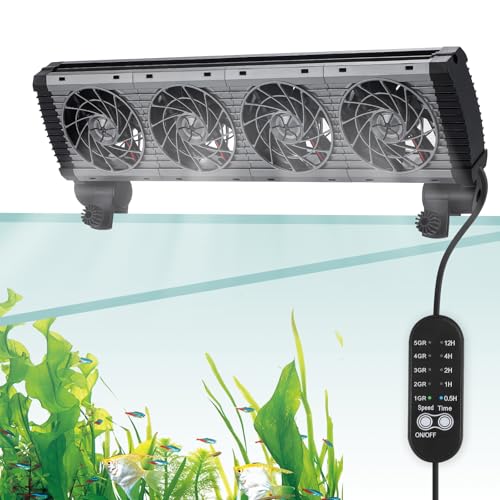
- Four fan heads for broad surface airflow
- Five speeds and 180° head rotation
- Five timer settings for scheduled cooling
Best For: Tanks needing wide, manually controlled airflow
Smart Temperature Monitoring

- Automatic start/stop with temperature probe
- LCD display switches between °F and °C
- Memory restores settings after power loss
Best For: Hands-off cooling for reef, saltwater, or freshwater tanks
Smart Control Pick

- Automatic temperature control with ±0.5°F probe accuracy
- Four independently positionable fan heads with extension cable
- Advertised 2–5°F cooling for 30–60 gallon tanks
Best For: Automated cooling and broad airflow coverage
Powerful Quiet Pick
AQUASMITH Dual-Fan Aquarium Cooler

- Focused dual-fan airflow with claimed 3–7°F cooling
- Three speed modes and a 35 dB brushless motor
- Clamp fits rimmed and rimless tanks from 20–50 gallons
Best For: Quiet, adjustable cooling for saltwater and reef tanks
Simple Budget Pick
DaToo Two-Fan Aquarium Chiller
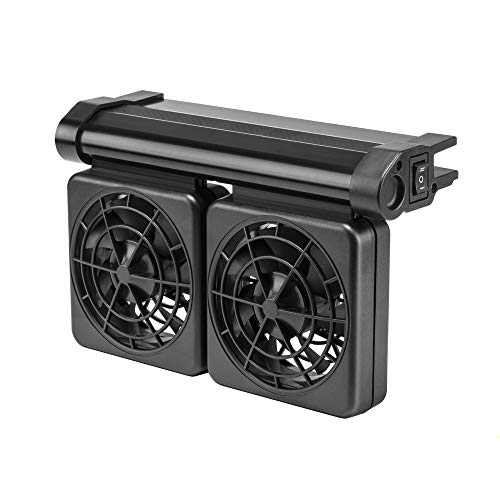
- Two speed settings with claimed 4–6°F cooling
- Durable clip and ABS construction for continuous use
- 12V operation plus a one-year warranty
Best For: Simple manual cooling with a sturdy tank-edge mount
Flexible Multi-Head Cooling

- Two-piece set with three adjustable heads
- Five speeds plus 0.5–12-hour timer
- Fits glass up to 0.59 inches thick
Best For: Multi-head cooling coverage for compatible saltwater and freshwater tanks
Quiet Programmable Cooling
hygger Single-Head Aquarium Fan

- Five speeds with automatic timer control
- Quiet motor and FDB-bearing design
- Adjustable angle for tanks under 0.45 inches thick
Best For: Quiet, scheduled cooling for compatible saltwater or coral aquariums
Flexible Multi-Tank Cooling – hygger 3-Fan Aquarium Cooler
For aquarium cooling fans for saltwater tanks, the hygger 3-fan model is a flexible option when you want adjustable airflow and timer control. Its three independently adjustable fan heads, five speed levels, and 2.2-watt motor let you tailor evaporation-based cooling for changing conditions.
Best For: Saltwater or freshwater setups needing multi-directional airflow, low power use, and scheduled operation.
Pros:
- Three fan heads can be angled independently.
- Five wind-speed settings accommodate different seasons and tank conditions.
- Timer settings from 0.5 to 12 hours can reduce the need for manual shutoff.
- One controller can operate fan heads positioned on up to three tanks.
Cons:
- The wall-mount design is intended for tanks under 0.45 inches thick.
- It does not include automatic temperature-based start and stop control.
This hygger fan stands out for its adaptable three-head layout and simple timer scheduling. Check the mounting limits and confirm that evaporation-based cooling suits your tank before choosing it.
Automatic Temperature Control – PAIZOO Dual-Fan Chiller
The PAIZOO is a strong choice among aquarium cooling fans for saltwater tanks if you prefer automatic temperature management. Its probe and LCD display monitor the water, while the fan starts when the selected temperature is exceeded and stops after cooling.
Best For: Aquarists who want temperature-triggered cooling, real-time readings, and a compact clip-on design.
Pros:
- Temperature settings range from 50°F to 99°F.
- Automatic operation helps avoid repeated manual switching.
- Dual copper brushless motors run below 40 dB according to the supplied specifications.
- Three speeds, 45-degree outlet adjustment, and 360-degree base rotation offer airflow control.
Cons:
- The probe and fan are not waterproof, so placement requires care.
- Cooling performance is dependent on ambient conditions and evaporation.
- The clip accommodates openings up to 26 mm.
With automatic control, a display, and a claimed 3–7°F cooling effect, the PAIZOO is more hands-off than a basic fan. It is a practical fit when monitoring water temperature is a priority.
High-Airflow Cooling – BAOSHISHAN 4-Head Fan
The BAOSHISHAN 4-head model is designed for aquarists who want broad airflow from aquarium cooling fans for saltwater tanks. Four fan heads, five speeds, and 180-degree head rotation help direct evaporation across the water surface, with a timer for scheduled cooling.
Best For: Larger or warmer tanks that benefit from multiple fan heads and manually scheduled airflow.
Pros:
- Four heads provide wide cooling coverage.
- Five speed settings suit different tank sizes and cooling needs.
- Five timer choices include 0.5, 1, 2, 3, and 12 hours.
- Corrosion-resistant plastic is specified for saltwater and freshwater use.
Cons:
- It uses manual timer and speed controls rather than a temperature probe.
- The clamp fits tanks up to 0.6 inches thick.
- The listed 65-watt specification is higher than the low-power ratings of some comparable models.
The BAOSHISHAN emphasizes coverage and adjustability, with a supplied claim of lowering a 20-gallon aquarium by up to 6°F in 3–5 hours. Because results vary with ambient conditions, use the timer and speed controls alongside regular temperature checks.
Smart Temperature Monitoring – Novique Auto Chiller Fan
The Novique combines a temperature probe, LCD display, and automatic start/stop control in a compact dual-turbine fan. For aquarium cooling fans for saltwater tanks, it offers convenient monitoring while allowing the airflow outlet to be adjusted for the tank’s layout.
Best For: Saltwater, reef, or freshwater aquariums where automatic cooling and temperature visibility matter.
Pros:
- Automatically starts and stops according to the selected temperature.
- Displays temperature in either Fahrenheit or Celsius.
- Power-off memory restores the previous operating state after power returns.
- Adjustable clip fits glass under 0.98 inches thick.
Cons:
- The supplied notes do not specify the number of speed settings.
- As an evaporative cooler, its claimed 3–8°F effect depends on ambient conditions.
- The temperature probe and display add components that need careful placement around water.
Novique is appealing when you want cooling to respond automatically instead of relying on a timer. Its wide mounting range and Fahrenheit/Celsius display add flexibility, while the stated 3–8°F effect should be treated as condition-dependent.
Smart Control Pick – hygger 4-Fan Aquarium Cooler
For 30–60 gallon saltwater tanks, this hygger model combines multi-fan airflow with automatic temperature control. Its probe, digital display, adjustable fan heads, and memory function make it a practical option for managing warm-weather temperature swings.
Best For: Aquarists wanting automated cooling and flexible airflow coverage for medium-to-large tanks.
Pros:
- Automatic start and stop control with a temperature probe accurate to ±0.5°F.
- Four modular fan heads can be positioned independently, with a 20 cm extension cable for wider coverage.
- 180° fan adjustment, tool-free clip mounting, and settings memory after power loss.
- Advertised cooling of 2–5°F in 75–80°F room temperatures.
Cons:
- Designed for aquarium rims up to 0.6 inches thick.
- Cooling relies on evaporation, so evaporation-related water replacement should be expected.
This is one of the more convenient aquarium cooling fans for saltwater tanks when temperature automation and directed airflow matter more than a simple manual setup.
Powerful Quiet Pick – AQUASMITH Dual-Fan Aquarium Cooler
This AQUASMITH cooler is a versatile choice among aquarium cooling fans for saltwater tanks, with a focused dual-fan duct, three speed modes, and mounting for both rimmed and rimless aquariums. It is rated for 20–50 gallon tanks and can also be used with coral reef setups.
Best For: Saltwater, coral, and rimless-tank owners who want adjustable, concentrated airflow with quieter operation.
Pros:
- Dual-turbine airflow is advertised to lower water temperature by 3–7°F.
- Three speed settings support gentle nighttime use, everyday cooling, or stronger airflow.
- Adjustable clamp fits 0.2–0.95-inch edges and works with rimmed or rimless aquariums.
- Brushless motor is rated at 35 dB, with 360° rotation and 30° wind-direction adjustment.
Cons:
- It does not include automatic temperature-based control.
- Its stated tank range is 20–50 gallons, which may not suit larger aquariums.
With focused airflow and flexible installation, this model stands out for saltwater and reef tanks where mounting compatibility and manual speed control are priorities.
Simple Budget Pick – DaToo Two-Fan Aquarium Chiller
The DaToo two-fan unit offers a straightforward approach to cooling saltwater tanks during hot weather. It provides two speed settings, adjustable airflow direction, a durable clip, and a one-year warranty without relying on an automated temperature controller.
Best For: Aquarists seeking simple, low-energy supplemental cooling with a sturdy tank-edge mount.
Pros:
- Advertised to provide approximately 4–6°F of cooling through continuous airflow.
- Two wind speeds allow basic adjustment for different cooling needs.
- Aluminum alloy clip and engineering-grade ABS construction are designed for durability.
- Uses a 12V safety voltage and includes a one-year warranty.
Cons:
- No digital temperature display or automatic temperature control is listed.
- Wind-direction adjustment is limited to a 90°–190° angle range.
- The supplied details do not specify a tank-size range.
This DaToo model is best suited to buyers who want uncomplicated aquarium cooling fans for saltwater tanks and are comfortable monitoring temperature manually.
Flexible Multi-Head Cooling – Tujoe 3-Head Aquarium Fan
For aquarium cooling fans for saltwater tanks, the Tujoe 2-piece set offers strong airflow, flexible positioning, and convenient controls. Its three-head design, five wind speeds, and timer make it easy to tailor cooling for changing conditions.
Best For: Saltwater or freshwater aquarists who want multi-head coverage and adjustable cooling for tanks with glass up to 0.59 inches thick.
Pros:
- Two fans with three adjustable heads and a 180° positioning range.
- Five wind speeds and timer settings from 0.5 to 12 hours.
- Seven-blade motor is designed to reduce water temperature by 5.4°F to 10.8°F.
- Clamps onto compatible glass without additional installation accessories.
Cons:
- Only fits tank glass up to 0.59 inches thick.
- The two-piece setup weighs 3.16 pounds and may require more mounting space.
Choose this model when broad, directional airflow and detailed control matter more than a compact single-head design. Verify your tank rim thickness and available space before ordering.
Simple Dual-Fan Cooling – Marine Aquarium 2-Fan Chiller
Among aquarium cooling fans for saltwater tanks, this marine two-fan unit is a straightforward option for smaller setups. It uses two-speed control, adjustable mounting jaws, and a 12V power supply to provide basic water cooling with a relatively simple installation.
Best For: Aquarists with a tank around 40 cm long and a rim up to 12 mm thick who want a basic dual-fan cooling system.
Pros:
- Two-speed wind control for adjusting airflow to room conditions.
- Adjustable jaws clamp tank walls up to 1.2 cm thick.
- 12V operating voltage is designed with safety in mind.
- Fan and bracket angle can adjust up to 100°.
Cons:
- Recommended two-fan use is for a 40 cm fish tank, limiting its ideal coverage.
- Only two wind speeds are available.
- Cooling performance is listed as a reduction of about 2–3°C, so results may vary with conditions.
This is a practical choice if you need uncomplicated cooling and your tank matches the stated size and rim limits. Its smaller adjustment range and two-speed controller make it less versatile than more feature-rich models.
Quiet Programmable Cooling – hygger Single-Head Aquarium Fan
The hygger single-head model is a useful choice among aquarium cooling fans for saltwater tanks when quiet operation and scheduling are priorities. It combines five wind levels, a timer controller, adjustable positioning, and a wall-style mount for tanks with glass under 0.45 inches thick.
Best For: Saltwater and freshwater aquariums, including coral tanks, where adjustable airflow, low-noise operation, and automatic run times are important.
Pros:
- Five wind-speed levels for seasonal or environmental adjustments.
- Timer options from 0.5 to 12 hours can stop the fan automatically.
- All-copper motor and FDB bearings are designed for quiet operation.
- Adjustable fan angle and a three-pin cord can support placement across one to three tanks.
Cons:
- Single-fan-head version provides less direct coverage than multi-head sets.
- Mounting is limited to tank walls under 0.45 inches thick.
- Requires an electrical connection and fixed mounting setup.
Consider this hygger fan if you want fine airflow control without manually switching it off at night. Its narrow glass-thickness limit should be checked carefully, especially on rimmed or thicker aquarium designs.
How We Picked the Best Aquarium Cooling Fans for Saltwater Tanks
We focused on the features that matter most in marine aquariums: adjustable airflow, temperature monitoring, reliable controls, noise-conscious operation, and compatibility with different tank sizes. Models with probes, LCD displays, timers, multiple speed settings, or several fan heads received particular attention because they offer more control than basic single-speed fans.
Cooling claims vary by room temperature, humidity, lighting, water movement, and aquarium cover design. We therefore treat advertised temperature reductions as estimates rather than guarantees. A fan should be viewed as an evaporation-based cooling tool, not a replacement for a compressor or thermoelectric chiller when precise temperature control is essential.
Quick Comparison
Choose a multi-head model when you need broader surface coverage or have a larger aquarium. Single- or dual-fan units are often simpler for nano and mid-sized systems. Temperature-probe models can automate operation and reduce unnecessary runtime, while timer-equipped fans are useful when you want scheduled cooling around lighting periods.
- Best for adjustable control: Models with multiple speeds and timer settings.
- Best for automation: Fans with a temperature probe and LCD display.
- Best for larger coverage: Four-head or three-head designs.
- Best for simple setups: Compact fans with straightforward speed controls.
Key Buying Factors for Aquarium Cooling Fans for Saltwater Tanks
Tank Size and Coverage
Match fan capacity and head count to the aquarium’s surface area. A small fan may be adequate for a nano tank, while larger or heavily lit systems may benefit from multiple heads aimed across the water surface.
Temperature Control
A built-in probe and display make it easier to monitor conditions and automate cooling. Confirm the controller’s temperature range and placement requirements before buying, and use a separate, trusted thermometer to verify readings.
Noise and Airflow
Fans with adjustable speeds let you balance cooling against noise. Ultra-quiet claims are useful but subjective; mounting position, vibration, and the selected speed can affect actual sound levels.
Evaporation and Salt Creep
Fans increase evaporation, so plan for more frequent top-offs or pair the system with an auto top-off unit. Keep saltwater splash away from the fan motor and controller, and inspect the equipment regularly for salt buildup.
Who Should Buy Which Aquarium Cooling Fans for Saltwater Tanks?
Choose a temperature-controlled fan if you want automatic operation and more consistent monitoring. Select a multi-head fan for broad airflow across a larger reef tank or multiple hot spots. A timer-equipped model suits aquarists who mainly need cooling during warm daylight or lighting hours. For a smaller aquarium or backup application, a compact adjustable fan is typically the most practical choice.