Warm water can stress fish, axolotls, shrimp, and other aquatic life, especially in smaller tanks or rooms without consistent air conditioning. The right aquarium cooling fan can lower surface temperature through evaporation while improving airflow above the water.
This roundup compares 10 aquarium cooling fans with different approaches to speed control, temperature monitoring, timers, fan-head counts, and tank coverage, so you can choose a practical match for your setup.
Best 10 Aquarium Cooling Fans Picks for 2026
Best Adjustable 3-Fan Aquarium Cooling System

- Five adjustable wind speeds
- Independently angle three fan heads
- 0.5- to 12-hour timer settings
Best For: Multi-tank setups and aquarists wanting customizable airflow
Best Simple Cooling and Quiet Operation
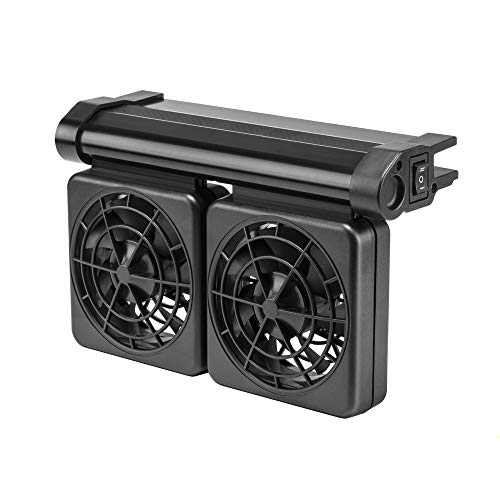
- Two adjustable fan speeds
- Clip-on aluminum alloy mount
- One-year warranty included
Best For: Simple, low-energy cooling for everyday fish tanks
Best Smart Temperature Control
hygger Aquarium Fan for 20-40 Gallons

- Probe and digital temperature display
- Automatic on/off based on set temperature
- Three independently positionable fan heads
Best For: 20- to 40-gallon tanks needing automated cooling
Best Powerful Quiet Airflow
AQUASMITH Dual-Fan Aquarium Cooler

- Focused dual-fan airflow
- Three adjustable speed modes
- 35 dB brushless motor and wide clamp range
Best For: 20- to 50-gallon rimmed or rimless aquariums
Best for Everyday Use
AQUASMITH Aquarium Chiller Fan

- 59°F-93°F temperature setting
- Automatic start-stop operation
- Three speeds and dual fans
Best For: Temperature-sensitive freshwater or saltwater setups
High-Capacity Airflow
Four-Head Aquarium Cooling Fan

- Four adjustable fan heads
- Two-speed manual airflow
- Fits glass up to 1.2cm
Best For: Wider tanks needing broader airflow coverage
Best Automatic Control

- Automatic start/stop temperature control
- Dual fans with adjustable 45° airflow
- Probe, LCD display, and power-off memory
Best For: Hands-off cooling with real-time temperature monitoring
Best for Flexible Coverage

- 10 speed settings for adjustable airflow
- 720° flexible gooseneck for precise direction
- 24-hour programmable timer
Best For: Scheduled cooling and adaptable airflow placement
Best Simple Adjustable Setup

- Five adjustable wind-speed levels
- Five timer options from 0.5 to 12 hours
- 180° airflow adjustment with stable brackets
Best For: Manual cooling control on compatible rimless tanks
Best Adjustable 3-Fan Aquarium Cooling System – hygger 3-Fan Aquarium Chiller
For flexible aquarium cooling, the hygger 3-fan system combines five speed settings, independently adjustable fan heads, and timer controls. It is designed for freshwater or saltwater tanks and can help move heat away from the water surface during warmer conditions.
Best For: Aquarists who want multi-directional airflow, adjustable cooling, and timer-based operation for one to three tanks.
Pros:
- Five wind-speed levels support seasonal and environmental adjustments.
- Three fan heads can be angled independently for targeted airflow.
- Timer settings range from 0.5 to 12 hours for automatic shutoff.
- Wall-mount design fits tank walls under 0.45 inches thick.
Cons:
- The wall-mount fit is limited to aquarium walls under 0.45 inches thick.
- It uses a controller and cord setup that may require extra cable organization.
This hygger model is a strong choice when broad, customizable airflow matters more than a simple single-fan setup. Its timer and five-speed controller add useful control for day-to-night cooling.
Best Simple Cooling and Quiet Operation – DaToo Aquarium Chiller Fan
The DaToo aquarium cooling fan is a straightforward option for reducing heat in a fish tank. Its two-fan design provides continuous airflow, with two speed levels and an adjustable clip for positioning across different aquarium setups.
Best For: Fish keepers who want an easy-to-install, low-energy cooling fan with basic speed and direction adjustment.
Pros:
- Designed to provide approximately 4°F to 6°F of cooling under suitable conditions.
- Two speed settings allow simple airflow adjustment.
- Aluminum alloy clip attaches firmly to the aquarium edge.
- Uses a 12V safety voltage and is backed by a one-year warranty.
Cons:
- Only two fan speeds are available.
- The two-fan configuration offers less coverage than larger multi-fan systems.
DaToo keeps aquarium cooling uncomplicated: clip it to the tank, select a speed, and adjust the fan direction. It is a practical fit for shoppers who prioritize simple installation and quieter operation over advanced controls.
Best Smart Temperature Control – hygger Aquarium Fan for 20-40 Gallons
Among aquarium cooling fans, this hygger model stands out for automatic temperature management. A probe and digital display monitor the water, while the fan turns on when the temperature rises above the selected point and shuts off after conditions stabilize.
Best For: Owners of 20- to 40-gallon tanks who want automatic temperature-based cooling and real-time readings.
Pros:
- Temperature probe is specified with ±0.5°F accuracy.
- Automatic activation and shutoff can reduce unnecessary operation.
- Three modular fan heads can be positioned independently.
- 180° fan adjustment and a clip fitting rims up to 0.6 inches thick improve placement flexibility.
Cons:
- It is sized for 20- to 40-gallon tanks, limiting its intended range.
- Cooling performance is rated up to 5°F under stated room-temperature conditions, so results can vary.
This is the most control-focused option in the roundup. Its temperature display, automatic response, and settings memory are useful for aquarists who prefer the fan to manage routine temperature changes with less manual attention.
Best Powerful Quiet Airflow – AQUASMITH Dual-Fan Aquarium Cooler
The AQUASMITH aquarium cooling fan uses a dual-fan pressurized duct to focus airflow on the water surface. With three speed modes, a brushless motor, and a clamp that fits both rimmed and rimless aquariums, it offers a flexible approach to cooling freshwater, saltwater, coral, planted, and axolotl tanks.
Best For: Aquarists seeking concentrated airflow and broad installation compatibility for 20- to 50-gallon tanks.
Pros:
- Focused dual-turbine airflow is designed to support 3°F to 7°F of cooling.
- Three modes cover gentle, standard, and strong airflow needs.
- Brushless motor is rated at 35 dB for quieter operation.
- Adjustable clamp fits 0.2- to 0.95-inch rims, including rimless aquarium setups.
Cons:
- Cooling results depend on evaporation and surrounding conditions.
- It does not list automatic temperature control or a timer.
For shoppers who want strong, directed airflow without moving to a traditional chiller, the AQUASMITH offers a compelling feature mix. Its wide clamp range and three modes make it particularly adaptable across different aquarium styles and daily cooling needs.
Adjustable 12V Cooling – Dual-Fan Aquarium Cooler
This dual-fan aquarium cooling fan is a practical option for tanks where simple, adjustable airflow is enough to manage warmer water. It offers two-speed control, adjustable mounting jaws, and a 12V power supply designed with safety in mind.
Best For: Aquariums with rims up to 12mm thick, especially tanks around 40cm wide that need straightforward seasonal cooling.
Pros:
- Two fan speeds let you adjust airflow for indoor conditions.
- Adjustable jaws fit tank walls up to 1.2cm thick.
- Fan angle and bracket width adjust by up to 100 degrees.
- 12V operation and included after-sales technical support.
Cons:
- Designed for rims no thicker than 12mm.
- The supplied guidance specifically suggests two fans for a 40cm tank, so tank coverage may vary.
Choose this model if you want a compact, movable aquarium fan with basic speed and positioning controls rather than an automatic temperature-control system.
Best for Everyday Use – AQUASMITH Aquarium Chiller Fan
Among aquarium cooling fans, this AQUASMITH model stands out for its built-in temperature control. A probe and LED controller display both the set and current temperatures, while automatic start-stop operation helps maintain a more consistent target.
Best For: Freshwater or saltwater aquariums housing temperature-sensitive fish, plants, axolotls, corals, or grass tanks where automated cooling is useful.
Pros:
- Temperature setting adjusts from 59°F to 93°F.
- Automatic start-stop mode helps stabilize water temperature.
- Three airflow speeds, dual fans, and cooling performance listed at 3°F-7°F.
- Adjustable clip fits aquarium edges from 0.2 to 0.95 inches.
Cons:
- More feature-heavy than a basic manual aquarium fan.
- Cooling results depend on room conditions and evaporative cooling.
- The temperature probe and controller add components that require careful placement around water.
This is the strongest choice of the three for shoppers who want monitoring and automatic operation, particularly when temperature stability matters more than the simplest setup.
High-Capacity Airflow – Four-Head Aquarium Cooling Fan
This four-head aquarium cooling fan is built for shoppers who want broad airflow coverage with manual controls. Its adjustable fan heads, two wind speeds, and aluminum alloy bracket make it a flexible choice for freshwater or saltwater tanks.
Best For: Larger or wider aquarium setups that can accommodate a clamp up to 0.47 inches thick and benefit from multiple adjustable fan heads.
Pros:
- Four fan heads provide expanded airflow coverage.
- Two speeds are rated at about 30dB and 50dB.
- Heads adjust through 100 degrees for flexible positioning.
- ABS fan construction and an aluminum alloy bracket support durability.
Cons:
- Maximum compatible glass or rim thickness is 1.2cm.
- Higher-speed operation is louder than first gear at the stated ratings.
- No automatic temperature controller is listed.
Consider this model when airflow reach is the priority. The four-head layout offers more coverage than a basic dual-fan design, but temperature adjustments remain manual.
Best Automatic Control – Novique Aquarium Cooling Fan
If you want aquarium cooling fans that require less manual monitoring, the Novique adds automatic temperature control to a dual-fan design. Its probe and LCD display show water temperature, while the adjustable airflow and automatic start/stop settings help manage warming conditions.
Best For: Aquarists who want temperature-based automatic cooling for freshwater, saltwater, coral reef, betta, or axolotl tanks.
Pros:
- Automatic start/stop operation based on the selected temperature range
- Dual turbo fans with a 45-degree adjustable air outlet
- Temperature probe, LCD display, Fahrenheit/Celsius switching, and power-off memory
- Fits glass under 0.98 inch and includes a 12-month warranty
Cons:
- Cooling performance is listed as 3–8°F, so results may vary with tank conditions
- Its clamp is not designed for glass 0.98 inch or thicker
The Novique is a feature-rich choice when automatic operation and temperature visibility matter more than a basic manual fan setup. Confirm your tank glass thickness and allow for evaporation-based cooling before installation.
Best for Flexible Coverage – SEAOURA Aquarium Chiller Fan
Among aquarium cooling fans, the SEAOURA stands out for adjustable airflow and scheduled operation. It offers 10 speed settings, a flexible gooseneck, and configurations with one to three fan heads for directing cooling across one or multiple tanks.
Best For: Aquarists who need flexible air direction, timer-based operation, or cooling for freshwater, saltwater, turtle, axolotl, terrarium, and aquatic plant setups.
Pros:
- Ten speed levels support gentle or stronger airflow
- 720-degree flexible gooseneck helps aim air at the target water area
- 24-hour programmable timer supports unattended cooling schedules
- Thickened bracket fits rimless aquariums from 0.2 to 1 inch thick
Cons:
- Recommended fan quantity changes with tank size, from one fan under 10 gallons to three under 60 gallons
- The supplied details identify this listing as a one-fan-head size
The SEAOURA is a practical option when positioning and scheduling are priorities. Its stated 3–7°F cooling range and quiet air duct system make it versatile, but selecting the appropriate number of fan heads is important for larger tanks.
Best Simple Adjustable Setup – Pawfly Aquarium Chiller Fan
The Pawfly is one of the more straightforward aquarium cooling fans for users who want adjustable speed, direction, and runtime controls. Its seven-blade fan is designed to promote heat dissipation, while the bracket and screws provide a firm mounting point on compatible rimless tanks.
Best For: Freshwater and saltwater aquarium owners seeking manual speed and timer control for axolotl or other aquatic-pet tanks.
Pros:
- Five wind-speed levels accommodate different cooling needs
- Timer settings include 0.5, 1, 2, 4, and 12 hours
- 180-degree adjustable direction helps aim airflow where needed
- Heavy-duty bracket and two screws support stable installation
Cons:
- Designed for lipless aquariums with glass under 0.6 inches
- Cooling performance is listed as 2–4°C, and the unit does not include automatic temperature-probe control
The Pawfly suits shoppers who prefer uncomplicated controls instead of temperature automation. Check the rim style and glass thickness first, then use the five speeds and timer to tailor airflow to the tank’s conditions.
How We Picked the Best Aquarium Cooling Fans
We focused on the features that matter most during warm weather: cooling performance, noise, adjustability, temperature control, installation flexibility, and suitability for freshwater or marine aquariums. We also considered whether each design offers useful extras such as timers, LCD displays, probes, automatic start/stop functions, or multiple fan heads.
Because evaporative cooling depends on room temperature, humidity, tank size, water movement, and lid design, advertised temperature reductions should be treated as estimates rather than guarantees. A fan should supplement, not replace, a thermometer and regular water-temperature checks.
Quick Comparison
- Best for basic adjustability: Choose a model with several speed settings or a dedicated controller.
- Best for automatic operation: Look for a temperature probe, thermostat, or auto start/stop feature.
- Best for larger tanks: Multi-head fans can move more air across a wider water surface.
- Best for quiet rooms: Prioritize ultra-quiet construction and adjustable low-speed operation.
- Best for convenience: Timer functions and LCD displays make monitoring and scheduling easier.
Key Buying Factors for Aquarium Cooling Fans
Tank Size and Airflow
Match the fan’s stated coverage to your aquarium and consider how much open surface area it can reach. A compact single-head fan may be adequate for a nano tank, while a two-, three-, or four-head design may distribute airflow more effectively across a wider tank.
Temperature Control
Manual speed control is simple and inexpensive, but temperature-controlled models can reduce overcooling and unnecessary evaporation. If your room temperature changes significantly throughout the day, a probe and automatic shutoff may be worth prioritizing.
Noise, Speed, and Evaporation
Higher airflow generally increases cooling but also accelerates evaporation and may create more noise. Multiple speeds let you balance cooling with comfort, while a timer can limit operation to the warmest part of the day. Keep replacement water ready and monitor salinity in marine systems.
Installation and Compatibility
Check how the fan attaches to the tank rim, whether it works with a lid, and whether the controller or probe can be positioned safely away from splashes. Confirm the listed voltage, tank compatibility, and freshwater or saltwater suitability before buying.
Who Should Buy Which Aquarium Cooling Fans?
Choose a straightforward adjustable fan if you want affordable seasonal cooling and are comfortable checking the temperature yourself. Select a smart temperature-control model if you want automatic operation or have sensitive livestock that needs a narrower temperature range. Multi-head options make more sense for broad tanks or setups with several warm areas, while timer-equipped fans suit owners who want scheduled daytime cooling.
Whichever model you choose, use a reliable aquarium thermometer, maintain adequate water level, and keep the fan away from direct splashes. If evaporation cannot provide enough cooling, or if your aquarium requires very precise temperature regulation, consider a dedicated aquarium chiller instead.