Keeping an aquarium stable does not have to require expensive automation. The best aquarium controllers under $50 can help regulate heaters, cooling fans, lighting schedules, or water levels with less daily guesswork.
This roundup focuses on practical, budget-friendly controllers for freshwater, saltwater, reef, shrimp, and specialty tanks. Use the guide below to compare features, compatibility, safety functions, and setup requirements before buying.
Best 10 Aquarium Controllers Under 50 Picks for 2026
Best Dual-Stage Pick
Inkbird ITC-308S Aquarium Temperature Controller

- Controls heating and cooling simultaneously
- Displays set and measured temperatures
- Includes temperature and sensor alarms
Best For: Aquariums needing dual-stage temperature control
Best Overflow Safety Pick
Aquarium High-Water Power-Off Switch

- Cuts power at a preset high-water level
- Adds backup protection for ATO systems
- Supports pumps up to 350W
Best For: Preventing aquarium overflow
Best Submersible Probe Pick
Inkbird ITC308S Temperature Controller
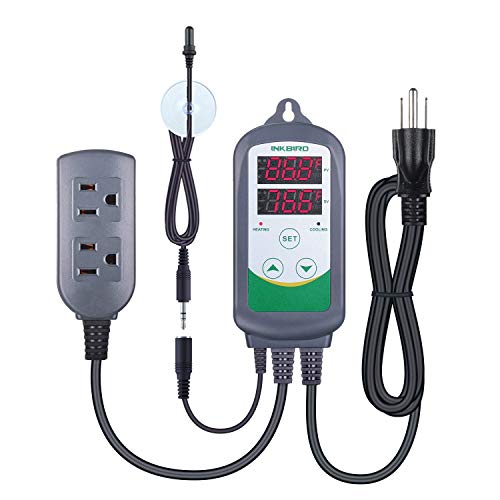
- Uses a fully submersible aquarium probe
- Controls heating and cooling devices
- Includes calibration and sensor alarms
Best For: Temperature control with a submerged probe
Best Lighting Schedule Pick
Aquarium Light Timer and Dimmer

- Offers eight timed brightness settings
- Simulates gradual day-and-night lighting
- Dims compatible LEDs from 0% to 100%
Best For: Automated aquarium lighting schedules
Best Heating Controller

- Dual temperature displays
- Day/night temperature cycles
- Heating-only, 1,200W maximum
Best For: Scheduled aquarium heating
Best Multi-Light Controller

- Automated 24/7 lighting mode
- Synchronizes up to three lights
- IP68 waterproof light units
Best For: Synchronized aquarium lighting
Best Aquarium Temperature Controller

- Water-temperature probe included
- Day/night heating schedules
- Alarm with output shutoff
Best For: Scheduled aquarium heater control
Best Budget Light Timer

- Three repeating 6-, 10-, and 12-hour cycles
- Color-coded setup with manual override
- Compact 12–24V DC light compatibility
Best For: Automating schedules for compatible aquarium LED lights
Best Dual-Outlet Thermostat
HiTauing Digital Temperature Controller

- Independently controls heating and cooling
- Seawater-resistant probe with long cables
- Fahrenheit/Celsius display and one-year warranty
Best For: Aquariums using both heaters and chillers
Best Fan Temperature Controller

- Automatic fan start/stop for temperature control
- LCD monitoring with memory after power loss
- Designed for 12V DC fans with matching connector
Best For: Automated cooling with a compatible aquarium fan
Best Dual-Stage Pick – Inkbird ITC-308S Aquarium Temperature Controller
For aquarium controllers under 50, the Inkbird ITC-308S is a practical choice when you need to manage both heating and cooling. It displays the measured and set temperatures simultaneously, supports Celsius or Fahrenheit, and is designed for freshwater, saltwater, coral, shrimp, and tropical fish setups.
Best For: Aquarists who want one controller for a heater and cooling device.
Pros:
- Controls heating and cooling devices at the same time.
- Includes high- and low-temperature alarms plus a sensor-failure alarm.
- Supports loads up to 1200W at 110V and has a corrosion-protection design.
Cons:
- Its maximum output is limited to 1200W at 110V.
- The controller is focused on temperature management rather than broader aquarium automation.
Choose this model if temperature stability is your main priority and you want dual-stage control with visible readings and alarm support.
Best Overflow Safety Pick – Aquarium High-Water Power-Off Switch
Among aquarium controllers under 50, this safety switch is aimed at preventing overflow rather than regulating temperature. Its float sensor cuts power when water reaches the set level, making it a useful backup for an auto top-off system, pump, or filter setup.
Best For: Freshwater and saltwater aquariums that need an extra high-water shutoff.
Pros:
- Automatically cuts power when the water reaches the set level.
- Works as a backup if an auto top-off system fails.
- Plug-and-play design supports pumps and devices up to 350W.
Cons:
- It is a high-water safety switch, not a complete auto top-off system.
- Its supported load is limited to 350W.
This is a focused protection device for aquarists concerned about overflow from clogged filters, restricted flow, or pump malfunctions.
Best Submersible Probe Pick – Inkbird ITC308S Temperature Controller
For aquarium controllers under 50, the Inkbird ITC308S offers a simple way to control a heater and cooling fan with a fully submersible probe. Its dual display shows the current and target temperatures, while calibration and alarm functions help support routine temperature management.
Best For: Aquariums where a fully submersible temperature probe is preferred.
Pros:
- Controls heating and cooling using on/off temperature control.
- Fully submersible probe is designed for aquarium water.
- Provides temperature calibration, sensor-fault alarms, and dual-display readings.
Cons:
- Maximum output is 1200W at 110V.
- It provides temperature control rather than a full multi-function aquarium controller.
This model is a straightforward fit for fishkeepers who want heating and cooling control with a probe intended to remain submerged.
Best Lighting Schedule Pick – Aquarium Light Timer and Dimmer
For aquarium controllers under 50, this light timer and dimmer focuses on creating a repeatable lighting routine. It offers eight timed brightness settings, automatic on/off programming, and adjustable output from 0% to 100% for compatible 5V-30V aquarium lighting.
Best For: Aquarists who want scheduled lighting with sunrise-and-sunset-style brightness changes.
Pros:
- Combines a timer and dimmer in one controller.
- Provides eight time-and-brightness settings.
- Adjusts LED brightness from 0% to 100% and includes a remote control.
Cons:
- Designed for compatible 5V-30V lighting rather than aquarium equipment generally.
- Its value depends on whether your lamp supports the controller’s electrical range.
Select this controller when lighting automation is more important than temperature or water-level management, and verify compatibility with your aquarium lamp before buying.
Best Heating Controller – Inkbird ITC-306T-A
For aquarium controllers under 50, the Inkbird ITC-306T-A is a practical choice when you need straightforward heating control rather than a full cooling system. It uses dual displays, supports Celsius or Fahrenheit, and lets you program separate day and night temperatures.
Best For: Aquariums and other setups that need scheduled heating control up to 1,200 watts.
Pros:
- Plug-and-play design with simultaneous measured and set-temperature displays
- Supports separate daytime and nighttime temperature settings
- Includes temperature calibration and over-temperature or sensor-fault alarms
Cons:
- Heating-only design; it does not provide cooling control
- Both outlets control heating devices and share a 1,200-watt maximum load
This controller is best suited to buyers who want simple, scheduled heat management and clear temperature monitoring. It is not the right fit if your aquarium also requires automated cooling.
Best Multi-Light Controller – hygger 24/7 LED Light Set
Among aquarium controllers under 50, this hygger set stands out for managing aquarium lighting instead of temperature. Its controller can synchronize up to three lights, automate sunrise and moonlight-style transitions, and adjust brightness and color for a more flexible lighting schedule.
Best For: Medium to large aquariums, irregular-shaped tanks, or multiple smaller tanks using compatible lights.
Pros:
- 24/7 mode provides programmed sunrise, daylight, and moonlight periods
- DIY controls offer multiple timing, brightness, and color options
- One controller synchronizes two or three lights and helps reduce cable clutter
- IP68 waterproof lights can be used as submerged or hidden aquarium lighting
Cons:
- This is a lighting controller, not a temperature or general aquarium controller
- The set is designed for compatible lights and a stated 16- to 48-gallon application
Choose this option if lighting automation is your priority. The included three-light setup and synchronized controls are useful for creating consistent schedules across multiple lighting units.
Best Aquarium Temperature Controller – Inkbird ITC-306T
If you are comparing aquarium controllers under 50 for dependable heater management, the Inkbird ITC-306T combines a water-temperature probe with scheduled control. It is designed for freshwater, seawater, reef, coral, shrimp, and tropical fish tanks, with dual displays and separate day/night settings.
Best For: Freshwater, marine, reef, coral, shrimp, and tropical aquariums that need controlled heating.
Pros:
- Probe includes a suction tray for placement in a water tank
- Supports separate daytime and nighttime temperature cycles
- Offers Celsius/Fahrenheit display, calibration, and sensor-fault alerts
- Shuts off outputs and sounds an alarm when temperature moves outside its fixed range
Cons:
- Heating-only operation with no cooling function
- Maximum output load is 1,200 watts at 110 volts
- Over- and under-temperature alarm settings are fixed and non-adjustable
The ITC-306T is a strong fit for aquarium keepers who want dedicated water-temperature monitoring and safety alerts. Its lack of cooling control means it works best in systems where only heater automation is needed.
Best Budget Light Timer – Aquarium Light Timer & Dimmer
For shoppers comparing aquarium controllers under 50, this two-pack light timer is a practical way to automate a consistent aquarium day-night schedule. It supports 6-, 10-, and 12-hour repeating cycles, with gradual dimming intended to simulate sunset.
Best For: Freshwater, saltwater, planted, betta, shrimp, and reef aquariums using compatible 12–24V DC single-channel LED lights.
Pros:
- Offers three programmable daily timer cycles.
- Color-coded indicators make the selected mode easy to verify.
- Supports manual on/off operation while retaining the timer function.
- Compact, low-voltage design and a 5.5mm x 2.1mm barrel connector suit many aquarium LED fixtures.
Cons:
- Compatibility depends on a single-channel 12–24V DC light with the matching connector.
- It controls lighting rather than aquarium temperature or other equipment.
This is a focused lighting controller rather than a full aquarium automation hub. Choose it if your main goal is reliable, repeatable photoperiod control and your light matches the voltage and connector requirements.
Best Dual-Outlet Thermostat – HiTauing Digital Temperature Controller
Among aquarium controllers under 50, the HiTauing S10B stands out for temperature management across both heating and cooling equipment. Its dual outlets independently regulate connected devices, while the probe monitors conditions and can cut power when temperatures move beyond the configured thresholds.
Best For: Freshwater or saltwater aquariums that use both a heater and a chiller, plus compatible reptile, greenhouse, or seedling-mat setups.
Pros:
- Provides separate heating and cooling outlets.
- Uses a seawater-resistant probe with extended cables for flexible placement.
- Supports Fahrenheit and Celsius readings with a touch-control LED display.
- Offers a broad stated control range from -22°F to 230°F and includes a one-year warranty.
Cons:
- It is a controller for connected heaters and coolers, not a complete aquarium monitoring system.
- The included suction cup is described as small and may require extra attention when securing the probe cable.
- Correct setup requires configuring the heating and cooling modes and thresholds.
For aquarists who want one controller to coordinate temperature equipment, the S10B offers more flexibility than a heater-only thermostat. Confirm your equipment and outlet requirements before installation, especially in a saltwater system.
Best Fan Temperature Controller – DaToo Aquarium Fan Controller
For a targeted cooling solution among aquarium controllers under 50, the DaToo controller automates a compatible 12V DC aquarium fan. It displays water temperature in real time, starts the fan when the selected threshold is exceeded, and stops it after the water returns to the configured level.
Best For: Aquariums that need automatic cooling with a 12V DC plug-in fan using a 5.5mm x 2.1mm barrel connector.
Pros:
- Automatically starts and stops the fan based on water temperature.
- LCD display shows current readings, with Fahrenheit/Celsius switching.
- Power-off memory retains settings after an unexpected outage.
- Compact mounting design includes reusable Velcro and hook holes.
Cons:
- It is designed for cooling fans and does not control aquarium heaters.
- The 12V adapter is not included.
- Configured start temperatures are limited to the stated 68–86°F range.
This is a simple, specialized choice for managing heat with a fan rather than a general-purpose aquarium thermostat. It makes the most sense when you already have—or plan to add—a compatible 12V fan and adapter.
How We Picked the Best Aquarium Controllers Under 50
We selected products based on the aquarium task they automate, control precision, ease of setup, probe or outlet design, and compatibility with common tank equipment. The list includes dual-stage temperature controllers, heater thermostats, fan controllers, light timers and dimmers, an automatic top-off safety switch, and an LED light controller.
Because budget controllers vary widely, we considered whether each model solves a specific problem reliably rather than treating every product as interchangeable. A temperature controller is not a substitute for a light timer, and a water-level safety switch may require a compatible automatic top-off system.
Quick Comparison
| Controller type | Best for | Key feature to look for |
|---|---|---|
| Dual-stage temperature controller | Heating and cooling | Independent heater and fan or chiller outlets |
| Heater thermostat | Basic temperature automation | Reliable probe and adjustable temperature range |
| Fan controller | Warm tanks and summer cooling | Automatic start/stop temperature control |
| Light timer or dimmer | Consistent lighting schedules | Voltage compatibility and programmable cycles |
| Water-level safety switch | Top-off protection | High-water shutoff and system compatibility |
Key Buying Factors for Aquarium Controllers Under $50
Match the Controller to the Equipment
Check the controller’s voltage, maximum load, plug type, and outlet configuration before connecting a heater, fan, pump, or light. Some products are designed for low-voltage LED systems, while others switch standard mains-powered equipment. Never exceed the stated electrical rating.
Choose the Right Temperature Control Method
For tanks that need both heating and cooling, a dual-stage model can activate a heater when temperatures drop and a fan or chiller when they rise. If you only need heater protection, a single temperature controller may be simpler. Look for a submersible or seawater-resistant probe when using the controller around saltwater.
Consider Programming and Display Features
Lighting controllers may offer 24-hour schedules, sunrise and sunset simulation, dimming, or separate day-and-night settings. These features are useful for fish health and viewing routines, but only when the controller matches the light’s voltage and connector.
Prioritize Fail-Safes
Temperature alarms, high- and low-temperature limits, sensor placement, and automatic shutoff can reduce risk. A controller adds protection but does not eliminate the need for an appropriately sized heater, regular water checks, and a secondary thermometer.
Who Should Buy Which Aquarium Controllers Under 50?
- For all-in-one temperature management: Choose a dual-stage Inkbird or HiTauing controller that can operate heating and cooling equipment.
- For heater-focused protection: An Inkbird heater controller with day-and-night settings is a practical choice for freshwater, shrimp, reef, or breeding tanks.
- For hot rooms or warm seasons: A DaToo aquarium fan controller can automate cooling without running the fan continuously.
- For scheduled or dimmed lighting: Select an aquarium light timer and dimmer, checking voltage and connector compatibility first.
- For LED lighting control: The hygger dual-channel controller is better suited to compatible aquarium LED fixtures and programmed color or intensity changes.
- For top-off protection: Use the aquarium safety switch only with a compatible automatic top-off setup and test its shutoff function before leaving the system unattended.
The best choice depends on the failure you want to prevent: temperature swings, overheating, excessive cooling, inconsistent lighting, or a high water level. Confirm compatibility and test the setup in person before relying on any budget controller for unattended aquarium operation.