Keeping aquarium conditions stable does not have to require an expensive smart-home system. The best aquarium controllers under $100 can automate heating, cooling, lighting, or water-level protection while helping reduce daily monitoring.
This roundup covers temperature thermostats, aquarium light timers, fan controllers, safety switches, and multi-outlet units for freshwater, saltwater, reef, and breeding setups. Use the guide below to match the controller type and features to your tank.
Best 10 Aquarium Controllers Under 100 Picks for 2026
Best Dual-Stage Control
Inkbird ITC-308S Aquarium Temperature Controller

- Controls heating and cooling together
- Works with freshwater and saltwater setups
- Includes dual display and temperature alarms
Best For: Temperature-sensitive aquariums using separate heater and cooling equipment
Best Timer and Power Strip
Zoo Med AquaSun Aquarium Controller

- Combines a timer with a power strip
- Provides eight grounded outlets
- Supports aquarium lamp day/night schedules
Best For: Simple, scheduled aquarium lighting and multi-outlet setup
Best Submersible Probe
Inkbird ITC-308S Aquarium Controller
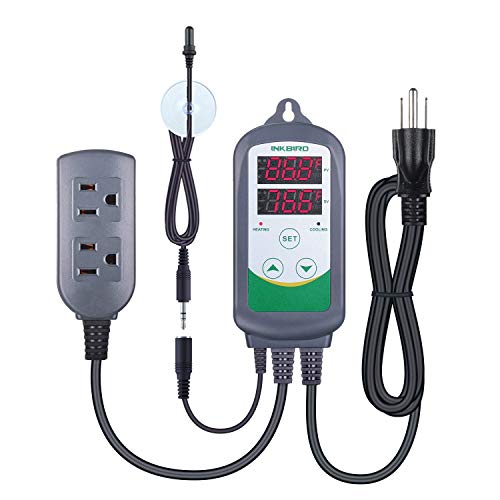
- Uses a fully submersible aquarium probe
- Controls heating and cooling devices
- Includes calibration and sensor-fault alarms
Best For: Aquariums needing direct water-temperature monitoring
Best Overflow Protection
Aquarium High-Water Safety Switch

- Cuts power at a high water level
- Adds backup protection to ATO systems
- Supports freshwater, saltwater, and 350W pumps
Best For: Preventing aquarium overflow from failed top-off or pump systems
Best Heating Controller

- Day/night temperature scheduling
- Dual measured and set-temperature displays
- Heating-only control up to 1,200 watts
Best For: Aquarium keepers who need scheduled heating control
Best Wi-Fi Lighting Controller
Lominie Programmable LED Controller

- Wi-Fi connectivity for remote control
- Programmable ramp timer and dimming
- Designed for LED aquarium lighting
Best For: Aquarium owners automating compatible LED lights
Best Aquarium-Specific Heater Controller
Inkbird ITC-306T Aquarium Controller

- Aquarium probe with suction tray
- Day/night temperature scheduling
- Corrosion protection for freshwater and saltwater use
Best For: Aquariums needing dedicated heating control
Best Fan Cooling Controller
DaToo Aquarium Fan Temperature Controller

- Real-time LCD temperature display
- Automatic fan start/stop from 68–86°F
- Power-off memory and compact mounting design
Best For: 12V DC aquarium fan cooling
Best Dual-Outlet Thermostat
HiTauing Digital Temperature Controller

- Independent heating and cooling outlets
- Seawater-resistant probe with long cables
- Wide -22–230°F control range
Best For: Freshwater or saltwater tanks using heater and chiller equipment
Best Multi-Outlet Timer Controller
Reptile Temperature Controller with 3 Outlets

- Three independently controlled outlets
- Day/night temperature and timing functions
- Dual waterproof probes for separate zones
Best For: Aquarium, terrarium, or plant setups needing schedules and multiple controls
Best Dual-Stage Control – Inkbird ITC-308S Aquarium Temperature Controller
For aquarium controllers under 100, the Inkbird ITC-308S is a practical choice when you need automatic control of both heating and cooling. It supports freshwater, saltwater, coral, shrimp, and tropical fish setups, with dual temperature displays and built-in alarms.
Best For: Aquarists managing temperature-sensitive freshwater or marine tanks with separate heating and cooling equipment.
Pros:
- Controls heating and cooling devices simultaneously or operates with one device.
- Supports freshwater, saltwater, coral, ornamental shrimp, and tropical fish aquariums.
- Displays measured and set temperatures in Celsius or Fahrenheit.
- Includes high- and low-temperature alarms plus a sensor-failure alarm.
Cons:
- Maximum output is limited to 1,200 watts at 110 volts.
- Requires separate heating or cooling equipment to operate.
Its dual-stage design and alarm system make it a versatile option for keeping aquarium temperatures within a selected range, provided your equipment stays within the rated load.
Best Timer and Power Strip – Zoo Med AquaSun Aquarium Controller
Among aquarium controllers under 100, the Zoo Med AquaSun focuses on lighting schedules rather than water temperature. Its programmable timer and eight grounded outlets help automate aquarium lamps and create a consistent day/night cycle.
Best For: Aquarium owners who want simple, analog lighting control with multiple grounded outlets.
Pros:
- Combines a programmable timer and power strip in one unit.
- Provides eight grounded outlets for aquarium equipment.
- Helps create a natural day/night cycle for fish.
- Works with aquarium lamps.
Cons:
- Its analog design may offer less scheduling flexibility than digital timers.
- Designed for lighting and outlet scheduling, not temperature or water-level control.
This is a straightforward pick for lighting automation, especially if you prefer an easy-to-program analog controller and need several grounded outlets in one enclosure.
Best Submersible Probe – Inkbird ITC-308S Aquarium Controller
For aquarium controllers under 100, this Inkbird ITC-308S offers an all-in-one way to manage heater and cooling-fan operation. Its fully submersible probe is designed for aquarium water, while the dual display, calibration function, and alarms add practical monitoring features.
Best For: Freshwater or marine aquariums needing a submersible temperature probe and automatic heating or cooling control.
Pros:
- Controls heating and cooling using on/off temperature control.
- Uses a fully submersible aquarium probe.
- Allows temperature calibration and displays measured and set temperatures together.
- Includes over-temperature and sensor-fault alarms.
Cons:
- Maximum output is 1,200 watts at 110 volts.
- Requires compatible heater or cooling equipment for temperature adjustment.
The submersible probe makes this model well suited to aquarium applications, while its simple controls keep heater and fan management in one compact system.
Best Overflow Protection – Aquarium High-Water Safety Switch
For aquarium controllers under 100, this safety switch addresses a specific risk: overflow from a failed auto top-off system, blocked filter, or pump problem. The float sensor cuts power when water reaches the set level and works with freshwater or saltwater systems.
Best For: Aquariums using an auto top-off pump that need an additional high-water shutdown safeguard.
Pros:
- Automatically cuts power when the water reaches the set high level.
- Provides backup protection for failed auto top-off systems.
- Works in both saltwater and freshwater aquariums.
- Supports pumps and devices up to 350 watts with plug-and-play installation.
Cons:
- It is a high-water safety switch, not a complete temperature or lighting controller.
- Its supported load is limited to 350 watts.
This compact controller is best viewed as a dedicated overflow safeguard. It can add a useful layer of protection to an ATO setup, but it does not replace the primary water-level system.
Best Heating Controller – Inkbird ITC-306T-A
If you need aquarium controllers under 100 for temperature management, the Inkbird ITC-306T-A offers straightforward heating control with separate day and night settings. Its dual display shows both the measured and target temperatures, while alarms help flag overheating or sensor problems.
Best For: Aquarium keepers who need scheduled heating control without a cooling function.
Pros:
- Plug-and-play design with Celsius or Fahrenheit display options.
- Supports different day and night temperatures.
- Includes temperature calibration and over-temperature or sensor-fault alarms.
- Handles heating loads up to 1,200 watts at 110 volts.
Cons:
- Heating-only design; it cannot control cooling devices.
- Both outlets are intended for heating devices.
This is a practical choice when your aquarium setup needs scheduled heat control and basic safety alerts, but it is not suitable for systems requiring automatic cooling.
Best Wi-Fi Lighting Controller – Lominie Programmable LED Controller
Lominie Programmable WiFi Controller 2.0 LED Aquarium Light with Ramp Timer Dimmer Remote Control
Check Price On AmazonAmong aquarium controllers under 100, the Lominie Programmable WiFi Controller 2.0 is aimed at LED lighting control rather than water temperature. Its Wi-Fi connectivity, ramp timer, dimming, and remote-control features can help organize a programmable aquarium lighting routine.
Best For: Aquarium owners who want Wi-Fi-enabled control over compatible LED lighting.
Pros:
- Uses Wi-Fi connectivity for remote control.
- Provides programmable timing, ramping, and dimming functions.
- Designed for LED aquarium lighting.
Cons:
- It is a lighting controller, not a heater or cooling controller.
- The supplied details do not specify compatibility with particular aquarium light models.
This option makes the most sense when lighting automation is your priority. Confirm compatibility with your existing LED fixture before purchasing.
Best Aquarium-Specific Heater Controller – Inkbird ITC-306T Aquarium Controller
For aquarium controllers under 100 focused on heating, the Inkbird ITC-306T pairs dual heating outlets with an aquarium probe and scheduled day/night temperature settings. Corrosion protection makes it suitable for freshwater, seawater, coral, shrimp, and tropical fish setups.
Best For: Freshwater, saltwater, reef, shrimp, and tropical fish aquariums that need dedicated heating control.
Pros:
- Includes an aquarium probe with a suction tray for tank placement.
- Supports separate daytime and nighttime temperature settings.
- Offers Celsius/Fahrenheit display, calibration, and sensor-fault alerts.
- Shuts off outputs and sounds an alarm when temperatures exceed its fixed range limits.
Cons:
- Provides heating control only and has no cooling function.
- The over- and under-temperature alarm settings are fixed and non-adjustable.
With its aquarium probe and corrosion protection, this is the most tank-focused heating controller in the group. It remains best suited to setups that do not need active cooling.
Best Fan Cooling Controller – DaToo Aquarium Fan Temperature Controller
For aquarium controllers under 100 focused on cooling, the DaToo controller is a straightforward option for automatically managing a compatible 12V DC fan. Its temperature probe, LCD display, and automatic start/stop function reduce the need for manual fan operation.
Best For: Aquarium owners using a compatible 12V DC plug-in fan to manage warm water.
Pros:
- Displays water temperature in real time on an LCD screen.
- Automatically starts and stops the fan based on set temperatures from 68–86°F.
- Includes power-off memory, mounting holes, and reusable Velcro.
- Compact design and a 12-month warranty.
Cons:
- Designed for 12V DC fans with a 5.5 x 2.1mm barrel connector.
- The 12V adapter is not included.
- It is a cooling controller rather than a complete heating-and-cooling system.
This is a practical pick when your main concern is fan-based cooling. Check your fan connector and obtain a compatible adapter before buying.
Best Dual-Outlet Thermostat – HiTauing Digital Temperature Controller
Among aquarium controllers under 100, the HiTauing S10B stands out for managing both heating and cooling equipment. Its separate outlets, seawater-resistant probe, and broad temperature range make it useful for freshwater or saltwater setups that need more active temperature control.
Best For: Aquariums requiring independent heater and chiller control, including saltwater systems.
Pros:
- Provides separate heating and cooling outlets with independent relays.
- Uses a seawater-resistant probe with long cables for flexible placement.
- Supports Fahrenheit and Celsius settings across a -22–230°F range.
- Touch-control LED display and one-year replacement coverage.
Cons:
- It controls connected equipment but does not include a heater or chiller.
- Setup requires learning the button sequence for modes and saving settings.
- The included probe suction cup is described as small.
The S10B is a versatile controller for users who want one device to coordinate heating and cooling. Verify that your equipment plugs and power requirements are compatible before connecting it.
Best Multi-Outlet Timer Controller – Reptile Temperature Controller with 3 Outlets
For aquarium controllers under 100 that also need scheduling, this three-outlet thermostat combines temperature management with day/night timing. Its independently controlled outlets and dual probes can support aquarium equipment as well as reptile, plant, or incubation setups.
Best For: Users who need timed lighting or equipment control alongside temperature regulation.
Pros:
- Three outlets can operate independently for flexible equipment control.
- Offers day/night temperature settings, timing, and cycle functions.
- Includes dual waterproof temperature sensors for separate zones.
- Supports heating and cooling control, temperature calibration, alarms, and °C/°F settings.
Cons:
- The supplied notes do not specify the exact temperature-control range.
- Its many settings may require more setup than a basic thermostat.
- Included components are listed as none, so verify what accessories are supplied.
This controller suits mixed-use or more complex setups where schedules and multiple zones matter. It may be more functionality than needed if you only want simple single-tank temperature control.
How We Picked the Best Aquarium Controllers Under 100
We focused on controllers that address common aquarium-management tasks: maintaining water temperature, scheduling lights, controlling fans, protecting against failed auto-top-off systems, and coordinating multiple devices. We also considered probe design, outlet configuration, temperature range, timer functions, day/night controls, remote access, and suitability for freshwater or saltwater use.
Because controller needs vary widely, this list includes both dedicated temperature thermostats and more specialized products. A dual-stage controller may be useful for a heater and cooling fan, while a light controller or safety switch is better for a specific automation task.
Quick Comparison
| Controller type | Best for | Features to prioritize |
|---|---|---|
| Dual-stage temperature controller | Heater and cooling equipment | Independent heating and cooling outlets, accurate probe, alarms |
| Light controller | LED aquarium lighting | Ramp timing, dimming, schedules, Wi-Fi access |
| Fan controller | Warm rooms and small tanks | Automatic start/stop, adjustable temperature range |
| Safety switch | Auto-top-off protection | High-water shutoff, reliable sensing, compatible power rating |
| Multi-outlet timer | Several timed devices | Outlet spacing, independent schedules, load capacity |
Key Buying Factors for Aquarium Controllers Under 100
Temperature Control and Probe Placement
Check whether the unit controls heating, cooling, or both. Dual-stage models are more versatile, but they require correct outlet assignment and probe placement. Position the probe in an area with representative water flow, away from direct heater output, and secure it so it cannot drift out of the tank.
Saltwater Resistance and Electrical Safety
Saltwater environments are demanding. Look for sealed or corrosion-resistant probes and keep plugs, power strips, and controller bodies away from splash zones. Never exceed the controller’s rated load, and use a ground-fault circuit interrupter where appropriate. A controller is not a substitute for regular inspection of heaters, pumps, and cords.
Schedules, Timers, and Connectivity
For lighting, sunrise and sunset ramps can reduce abrupt changes and support a consistent photoperiod. Wi-Fi control is convenient for remote adjustments, but it should not be the only safeguard for critical equipment. Confirm that schedules continue during internet or app outages if that matters for your setup.
Outlet Layout and Compatibility
Before buying, total the wattage of connected equipment and check whether plugs will fit beside one another. Some controllers are designed for heaters, fans, or lights rather than pumps with high startup loads. Verify voltage, amperage, plug type, and the manufacturer’s intended use.
Who Should Buy Which Aquarium Controllers Under 100?
Choose a dual-stage temperature controller if stable temperature is your main concern or your room varies significantly throughout the day. Choose a fan controller for a simple cooling solution in warm conditions. Choose a programmable light controller if your priority is consistent lighting, dimming, or remote scheduling.
Choose a safety switch when an auto-top-off failure could cause flooding or salinity problems. For several timed accessories, a controller with multiple outlets may be more practical than separate timers. Breeders and keepers managing specialized heating setups should prioritize accurate sensing, dependable schedules, and easy manual overrides.
Whichever model you choose, test the system before leaving it unattended. Confirm that the controller switches equipment on and off at the intended thresholds, secure all probes and cables, and continue checking aquarium temperature and water level manually during the first several days.