Stable pH is one of the most important parts of aquarium care, but manual testing can make it difficult to spot gradual changes or respond quickly to problems. The right controller can monitor water conditions continuously and, in some setups, automate dosing or alert you when readings move outside a target range.
Our selection of the best pH aquarium controllers includes dedicated pH monitors, multi-parameter systems, dosing controllers, and connected options for freshwater, marine, hydroponic, and pond applications. Use the guide below to compare features, compatibility, maintenance needs, and the level of automation each type provides.
Best 10 Ph Aquarium Controllers Picks for 2026
Best Expandable System
A3 Apex Jr. Aquarium Controller

- Monitors pH, temperature, leaks, and levels
- Wi-Fi alerts through Apex Fusion
- Expandable via AquaBus ports
Best For: Freshwater or saltwater aquariums needing remote monitoring and expansion
Best Manual pH Adjustment Kit

- Includes pH Up, pH Down, and indicator solution
- Dropper and test vial support measured dosing
- Suitable for freshwater aquariums, fish, and shrimp
Best For: Manual pH corrections after testing
Best Dedicated pH Doser

- Combines pH control and dosing
- Includes probe and calibration sachets
- Uses an LED display
Best For: Aquariums where dedicated pH dosing is the priority
Best Budget pH Monitor
Digital pH and Temperature Meter

- Measures pH and temperature locally
- Automatic temperature compensation
- Three-point calibration with replaceable pH probe
Best For: Routine aquarium water checks on a budget
Professional Hydroponic Pick

- LED display with selectable high/low set-point alarm
- Dosing power socket and included 12V adapter
- Includes double-junction probe and pH 7 solution
Best For: Aquariums and hydroponic systems needing simple pH control
Automated Dosing Pick
Automatic pH Controller with Dual Relay

- Integrated pumps dispense pH up and pH down
- Three-day pH and temperature data chart
- ATC, dose count, and max/min/average functions
Best For: Users wanting two-direction automatic dosing and trend data
ORP Monitoring Alternative
Milwaukee MC510 ORP Controller

- Measures ORP across a ±1000 mV range
- ±5 mV accuracy with digital display
- Includes probe, mounting kit, and 12V adapter
Best For: ORP monitoring rather than direct pH measurement
Reliable Aquarium Control

- Continuous pH monitoring with probe
- Automatic set-point power control
- Compatible with CO2 and calcium reactors
Best For: Freshwater and saltwater aquariums needing straightforward pH automation
Connected Dosing Control
- Phone-based remote pH management
- Built-in bidirectional dosing pump
- Alarms, lockouts, and power-loss recovery
Best For: Users wanting automated reservoir dosing and Wi-Fi monitoring
Smart Multi-Parameter Monitor

- Monitors pH, ORP, and temperature
- Tuya app remote monitoring
- Dual relay outputs with replaceable probes
Best For: Aquarium setups needing broader water-quality monitoring and control
Best Expandable System – A3 Apex Jr. Aquarium Controller
The A3 Apex Jr. is a strong choice among ph aquarium controllers for aquarists who want centralized monitoring, remote alerts, and room to expand. It includes temperature and pH probes, leak detection, level-sensor monitoring, and Wi-Fi access through the Apex Fusion app.
Best For: Freshwater or saltwater aquariums needing remote monitoring and future expansion.
Pros:
- Monitors temperature, pH, leaks, and tank levels.
- Sends real-time alerts through the Apex Fusion cloud platform.
- Includes two AquaBus ports for added modules and accessories.
- Connects to Wi-Fi and supports remote access through the app.
Cons:
- Additional control features may require extra modules or an EB832 Power Bar.
- Its compact design is aimed at smaller systems.
This is the most capable all-around option here for owners who want monitoring now and a controllable, expandable setup later.
Best Manual pH Adjustment Kit – FOLLOWIN pH Up and Down Kit
The FOLLOWIN kit is not an electronic ph aquarium controller, but it can help freshwater aquarium owners manually adjust pH after testing. It includes pH Up, pH Down, indicator solution, a dropper, and a test vial for measured, color-based adjustments.
Best For: Freshwater aquarists who want a manual pH adjustment kit for occasional corrections.
Pros:
- Includes both pH Up and pH Down solutions.
- Comes with indicator solution, dropper, and test vial.
- Listed as suitable for freshwater aquariums, fish, shrimp, and aquatic plants.
- Compact liquid format supports measured dosing.
Cons:
- Does not provide continuous monitoring or automatic dosing.
- Its primary design is for hydroponics and gardening as well as aquariums.
Choose this only if you need hands-on pH correction rather than an automated aquarium monitoring system.
Best Dedicated pH Doser – Milwaukee MC122 pH Controller
The Milwaukee Instruments MC122 is a focused option for shoppers comparing ph aquarium controllers with dosing capability. Its supplied description identifies it as a pH controller and doser and lists a controller, pH probes, and calibration sachets in the package.
Best For: Aquarists seeking a dedicated pH controller and doser with included probes and calibration supplies.
Pros:
- Combines pH control and dosing in one unit.
- Includes pH probes and calibration sachets.
- Uses an easy-to-read LED display.
- Compact plastic construction weighs very little.
Cons:
- The supplied notes provide limited details about measurement range and dosing controls.
- It is more specialized than a multi-parameter aquarium controller.
The MC122 is worth considering when pH dosing is the priority, but shoppers wanting temperature, leak, or level monitoring should look elsewhere.
Best Budget pH Monitor – Digital pH and Temperature Meter
This digital combo meter is a practical entry point for comparing ph aquarium controllers when you mainly need handheld or local pH and temperature readings. It measures from 0.0 to 14.0 pH, offers automatic temperature compensation, and supports up to three-point calibration.
Best For: Aquarium owners who want an affordable local pH and temperature monitor with replaceable probes.
Pros:
- Measures pH from 0.0 to 14.0 with stated ±0.1 accuracy.
- Displays pH and temperature on a backlit LCD.
- Supports automatic buffer recognition and up to three calibration points.
- Includes automatic temperature compensation and a replaceable pH probe.
Cons:
- Battery powered and not described as a Wi-Fi or remote-alert controller.
- Listed response time is five minutes.
- Requires periodic calibration and probe care.
This meter is a useful fit for routine water checks, but it is better viewed as a local testing tool than a fully automated aquarium controller.
Professional Hydroponic Pick – Milwaukee MC122 pH Controller
The Milwaukee Instruments MC122 is a straightforward choice for shoppers comparing ph aquarium controllers for aquarium or hydroponic use. Its LED display, selectable high-or-low alarm behavior, and dosing power socket are designed to help automate pH management around a chosen set point.
Best For: Aquarium and hydroponic users who want a dedicated pH controller with an alarm and dosing power connection.
Pros:
- Designed for hydroponic systems and aquariums.
- Selectable alarm activates when readings move higher or lower than the set point.
- Includes a double-junction pH probe, 12V adapter, and pH 7 calibration solution.
- Requires no assembly.
Cons:
- The supplied notes identify an LED display rather than a data-charting interface.
- Its control setup is centered on a single pH set point and dosing power socket.
The MC122 is a practical, compact controller for basic automated pH oversight. It is especially appealing when included accessories and simple set-point alerts matter more than historical data features.
Automated Dosing Pick – Automatic pH Controller with Dual Relay
This wall-mounted option stands out among ph aquarium controllers for its integrated dosing pumps and dual relay output. It is built to measure pH, automatically dispense pH up or pH down, and show recent pH and temperature trends on a three-day chart.
Best For: Aquarium keepers and hydroponic growers seeking automated two-direction pH dosing with trend monitoring.
Pros:
- Dual relay output supports automatic pH up and pH down control.
- Integrated dosing pumps simplify automated nutrient-reservoir management.
- Three-day data chart displays pH and temperature status.
- Includes automatic temperature compensation plus max, min, average, and dose-count functions.
Cons:
- The wall-mounted design is larger than a basic controller, measuring 11.81 by 10.24 by 4.33 inches.
- At 3.08 pounds, it is heavier than a compact monitoring unit.
This controller is the most automation-focused option in the group. Its dual dosing arrangement and data functions suit users who want active pH balancing and more visibility into recent readings.
ORP Monitoring Alternative – Milwaukee MC510 ORP Controller
Milwaukee MC510 ORP Controller with Mounting Kit, +/- 1000 mV, +/-5 mV Accuracy
Check Price On AmazonThe Milwaukee MC510 is an ORP controller rather than a traditional pH controller, making it a useful alternative for shoppers comparing ph aquarium controllers and broader water-monitoring equipment. It provides a digital reading, a selectable set point, and an included double-junction ORP probe.
Best For: Users who specifically need ORP measurement and set-point control for an aquarium or water-treatment setup.
Pros:
- Measures across a ±1000 mV range with ±5 mV accuracy.
- Set-point range runs from 0 to 600 mV.
- Alarm activates when the reading is higher or lower than the set point.
- Includes a double-junction MA921B/2 probe, mounting kit, and 12V adapter.
Cons:
- It measures ORP in millivolts, not pH.
- Its set-point range is specified in millivolts rather than pH units.
The MC510 should not be chosen as a direct replacement for a pH controller. It makes sense when ORP is the measurement you need and the included probe, mounting kit, and alarm functionality fit your setup.
Reliable Aquarium Control – Marine Color PH2010
For shoppers comparing ph aquarium controllers, the Marine Color PH2010 provides continuous pH readings and automatic control in a straightforward setup. Its LED display shows current values, while the controller can switch connected equipment when the pH moves above or below the configured set point.
Best For: Freshwater or saltwater aquarium owners using CO2 systems, calcium reactors, or other compatible equipment.
Pros:
- Continuously monitors pH with an included probe.
- Automatically switches a connected power socket based on the set point.
- Works with CO2 systems and calcium reactors.
- Clear LED display and simple target-value adjustment.
Cons:
- Warranty coverage is listed as six months.
- Its automatic control depends on compatible connected equipment.
The PH2010 is a practical choice when you want online pH monitoring and basic automated regulation without app-based features. It supports multiple water environments, though buyers should confirm compatibility with their specific setup.
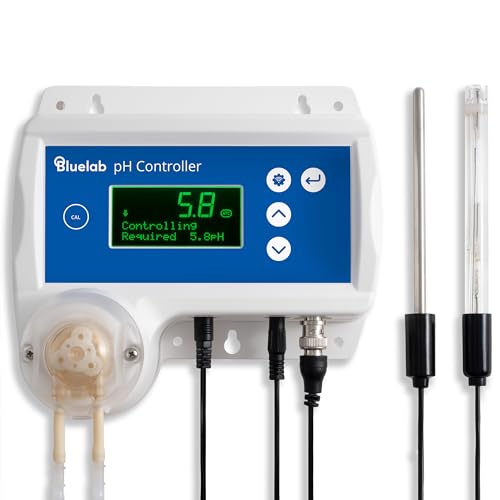
Connected Dosing Control – Bluelab pH Controller Wi-Fi
Among ph aquarium controllers, the Bluelab pH Controller Wi-Fi stands out for remote monitoring and automated dosing. Its built-in Wi-Fi lets users manage reservoir pH from a phone, while the integrated peristaltic pump doses pH adjusters in either direction.
Best For: Growers who want phone-based reservoir monitoring, controlled pH dosing, and alerts.
Pros:
- Provides remote pH management through Wi-Fi and a mobile device.
- Built-in pump supports precision dosing of pH up and pH down.
- High and low alarms help identify pH conditions outside the desired range.
- Lockouts and auto-resume help support safer, continued operation.
Cons:
- Its design is described for plant reservoirs rather than specifically for aquariums.
- Remote features depend on Wi-Fi and mobile access.
- Maximum pump output is 120 ml/min, which may not suit every setup.
This is the most connected option of the three, combining remote access, alerts, mixing intervals, and automated dosing. It is worth considering for users who prioritize convenience and control through a phone, provided the reservoir-focused design fits their application.
Smart Multi-Parameter Monitor – 3-in-1 pH ORP Controller
For buyers seeking versatile ph aquarium controllers, this smart unit combines pH, ORP, and temperature monitoring with app access. Its dual relay outputs can respond to configured pH or ORP limits, supporting connected pumps, valves, ozone generators, or CO2 regulators.
Best For: Aquarium and water-system owners who want remote monitoring, multiple measurements, and flexible relay control.
Pros:
- Displays pH, ORP, and temperature in one controller.
- Supports remote readings through the Tuya Smart app over 2.4 GHz Wi-Fi.
- Dual relay outputs can control compatible water-treatment equipment.
- Replaceable BNC probes and automatic temperature compensation add flexibility.
Cons:
- App connectivity requires a compatible 2.4 GHz Wi-Fi network.
- It has more features to configure than a basic pH-only controller.
- Connected pumps and other devices must be compatible with its relay outputs.
This controller is a strong fit when pH is only one part of your water-quality routine. ORP and temperature readings, replaceable probes, app monitoring, and dual outputs make it adaptable across aquariums and other water applications.
How We Picked the Best Ph Aquarium Controllers
We evaluated these Ph Aquarium Controllers by focusing on the features that affect real-world water management: measurement accuracy, calibration options, probe quality, display readability, alarm or relay functions, dosing capability, connectivity, and installation requirements. We also considered whether each controller is better suited to freshwater aquariums, marine systems, ponds, hydroponic reservoirs, or specialized setups.
A controller should do more than display a number. The strongest options make trends easier to understand, reduce repetitive testing, or provide a safer way to operate equipment. However, automation is only useful when the probe is calibrated, maintained, and installed correctly.
Quick Comparison
| Controller type | Best for | Typical strengths |
|---|---|---|
| Basic pH monitor | Routine testing | Simple displays and lower complexity |
| pH controller with dosing | Automated correction | Relay or pump control for pH adjustment |
| Multi-parameter controller | Complete aquarium monitoring | pH plus temperature, leaks, levels, or ORP |
| Wi-Fi or app-connected model | Remote supervision | Alerts, trends, and off-site access |
| ORP-capable controller | Marine and advanced systems | Additional oxidation-reduction monitoring |
Key Buying Factors for Ph Aquarium Controllers
Accuracy and Calibration
Look for automatic or guided calibration and a replaceable probe when possible. Two-point calibration is often preferable for aquarium work because it can improve accuracy across the expected pH range. Follow the manufacturer’s calibration schedule and use fresh calibration solutions.
Probe Maintenance
pH probes require proper storage, cleaning, and eventual replacement. Confirm that replacement probes are available and that the probe cable is long enough for your aquarium or sump. Avoid choosing a controller solely because of its low initial price if consumables are difficult to source.
Control and Dosing Features
If you want automatic adjustment, check whether the unit controls a dosing pump, solenoid, CO2 system, or other equipment. Verify relay ratings, dosing direction, safety limits, and whether the controller supports separate pH-up and pH-down outputs. Automated correction should use conservative limits to prevent rapid swings.
Compatibility and Connectivity
Check whether the controller is designed for freshwater, saltwater, hydroponics, or mixed applications. Wi-Fi and app monitoring are useful for alerts and trend tracking, while a standalone display may be preferable when reliability and simplicity matter more than remote access. Temperature, ORP, leak, and level sensors can add value in larger or more complex systems.
Who Should Buy Which Ph Aquarium Controllers?
Choose a basic digital meter or monitor if you test manually and want an affordable way to confirm readings. A dedicated controller with dosing or relay outputs is better for aquarists who maintain a demanding pH range or operate CO2 and dosing equipment. A multi-parameter aquarium controller suits owners who want one system for pH, temperature, leaks, water level, and other alerts.
Marine aquarium keepers may benefit from an ORP-capable model, while hydroponic users should prioritize nutrient-dosing compatibility and reservoir monitoring. Choose a connected controller if you travel frequently or want phone alerts; otherwise, a well-calibrated standalone unit can provide dependable monitoring with less setup and fewer potential connection issues.