Choosing the right temperature controller can make a reptile habitat more stable, safer, and much easier to manage. The best options help prevent overheating, reduce daily guesswork, and keep enclosure conditions consistent.
Below, we focus on practical features that matter most: accuracy, probe quality, compatibility, smart controls, and whether the unit fits your heating or cooling setup.
Best 10 Smart Reptile Temperature Controller Picks for 2026
Easy Budget Heat Control
BN-LINK Digital Heat Mat Thermostat

- Simple 3-button setup and easy display
- Heating-only controller for reptile and seed applications
- ETL listed, up to 1000W at 120VAC
Best For: users who want a basic wired thermostat for heating-only setups
Dual-Mode Safety Thermostat
Zoo Med ReptiTemp Digital Thermostat

- Supports both HEAT and COOL modes
- Remote sensor with 6-foot cable
- Memory backup plus high/low alarm
Best For: keepers needing heating and cooling control with safety alarms
Smart Home Temperature Control
Meross Wi-Fi Temperature Controller

- App, voice, and button control options
- Works with Apple Home, Alexa, Google Home, and SmartThings
- Supports heating, cooling, scheduling, and alerts
Best For: buyers who want remote smart-home control and automation
Day-Night Habitat Control
Zilla Digital Temperature Controller

- Programmable day/night settings for reptile habitats
- Temperature probe with overheating shut-off
- Compatible with under-tank heaters, heat tape, and ceramic emitters
Best For: reptile owners who want simple programmable day/night control
Precision Dimming Pick
REPTIZOO PID Dimming Thermostat for Heat Bulbs
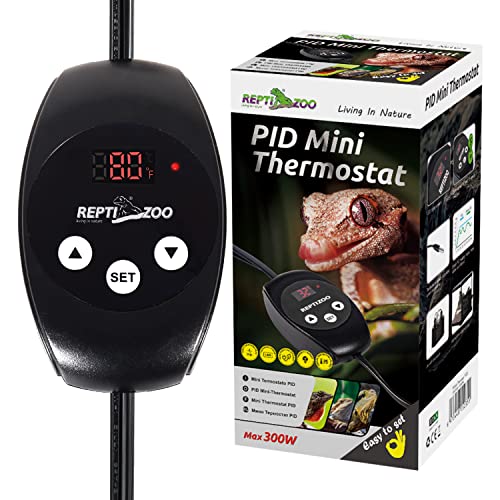
- PID-style dimming helps keep heat more stable
- Made for heat lamps, but works with many heaters
- LED screen shows ambient and set temperatures
Best For: Heat-lamp users who want accurate, stable dimming control
Smart App Control Pick
BN-LINK WiFi Thermostat with Alexa Support

- Controls heating and cooling through the app
- Works with Alexa and Google Home
- Waterproof probe and overload protection
Best For: Users who want remote app control and voice commands
Multi-Zone Timer Pick
3-Outlet Reptile Temperature Controller

- Three outlets can run independently
- Dual probes support two separate temperature zones
- Includes day/night timing and temperature alarms
Best For: Multi-device reptile setups that need timers and zone control
Dual-Zone Precision
Dual Probe Reptile Thermostat Controller

- Two outlets work independently for heat or cooling.
- Dual waterproof sensors support separate zones.
- Includes alarms and compressor-friendly delay.
Best For: Dual tanks, two heat zones, or mixed heating/cooling setups
Simple Control
WH2408 Digital Thermostat Plug Switch

- Two knobs make setup fast and uncomplicated.
- Heating and cooling modes add flexibility.
- Memory function helps after power outages.
Best For: Users who want an easy plug-in thermostat with basic precision control
Easy Budget Heat Control – BN-LINK Digital Heat Mat Thermostat
If you want a practical smart reptile temperature controller for basic heating setups, this BN-LINK model keeps things straightforward. It is designed for heating devices only, with a simple 3-button interface, a clear LED display, and a probe for temperature monitoring in reptile tanks, seed mats, incubators, and more.
Best For: Reptile keepers, seed starters, and hobbyists who want a simple wired thermostat for heating-only equipment.
Pros:
- Easy 3-button setup with Fahrenheit/Celsius switching
- LED indicators and bright display are easy to read, even in the dark
- Includes a sensor probe plus a long power cord and probe lead
- ETL listed and rated for up to 1000W at 120VAC
Cons:
- Heating devices only; not meant for cooling control
- No smart app or voice control features
- Basic design lacks advanced programming options
This is a solid pick if you need dependable temperature control without extra smart-home complexity. It covers the essentials well and offers broad use across heating applications.
Dual-Mode Safety Thermostat – Zoo Med ReptiTemp Digital Thermostat
The Zoo Med ReptiTemp is a practical smart reptile temperature controller choice if you need both heating and cooling support in one unit. With a remote sensor, adjustable range, and built-in alarms, it is aimed at keeping terrariums and other habitats within a safer temperature window.
Best For: Keepers who want a thermostat that can manage heating or cooling with alarm protection and memory backup.
Pros:
- Controls heating devices in HEAT mode and cooling devices in COOL mode
- Temperature range spans 50°F to 122°F
- Remote sensor includes a 6-foot cable for flexible placement
- Built-in memory and alarm functions add extra safety
Cons:
- Heating capacity is limited to 600W
- Cooling capacity is limited to 150W
- No app-based or Wi-Fi smart control features
This thermostat stands out for practical temperature management and safety alerts rather than smart connectivity. It is a dependable option when you need simple dual-mode control for a reptile habitat.
Smart Home Temperature Control – Meross Wi-Fi Temperature Controller
If you want a smart reptile temperature controller that fits into a connected home, this Meross unit brings app control, voice support, and scheduling together. It works with heating and cooling equipment, and the temperature data can be managed remotely through the Meross app or compatible smart-home platforms.
Best For: Users who want app-based temperature control, voice commands, and smart-home integration for heating or cooling setups.
Pros:
- Works with Apple Home, Alexa, Google Home, and SmartThings
- Supports app control, voice control, and device buttons
- Handles heating and cooling equipment with up to 15A/1800W at 120V
- Includes scheduling, power-off memory, and sensor failure alerts
Cons:
- More complex than a basic plug-in thermostat
- Default control range is up to 95°F unless adjusted in the app
- Designed broadly for heating/cooling use, not reptile-only functions
This is the most feature-rich option in the group for buyers who want remote access and automation. It is a strong fit if smart-home convenience matters as much as temperature stability.
Day-Night Habitat Control – Zilla Digital Temperature Controller
The Zilla Digital Temperature Controller is built for reptile habitats that need steady heat and simple day/night programming. As a smart reptile temperature controller option, it focuses on safe operation, temperature monitoring, and compatibility with common non-light-emitting heating sources.
Best For: Reptile owners who want programmable day/night temperature control for terrariums and incubator-style setups.
Pros:
- Includes a temperature probe and automatic shut-off for overheating prevention
- Day/night settings help mimic natural reptile cycles
- Works with under-tank heaters, heat tape, and ceramic emitters
- Designed for geckos, snakes, and lizards in a range of terrariums
Cons:
- Focuses on heat-source control rather than smart app features
- No detailed wattage specification beyond the included 1000 watt reference
- Best suited to non-light-emitting heat sources only
This Zilla model is a straightforward choice for keepers who want programmable habitat control without Wi-Fi or app complexity. Its day/night settings and safety shut-off make it appealing for routine reptile care.
Precision Dimming Pick – REPTIZOO PID Dimming Thermostat for Heat Bulbs
If you want a smart reptile temperature controller built around heat bulbs, this REPTIZOO dimming thermostat is designed for that job. Its PID-style dimming control aims to keep temperatures more stable, reduce lighting swings, and help extend bulb life while still working with many other heaters.
Best For: Reptile keepers using heat lamps or other heating devices who want accurate dimming control.
Pros:
- Designed specifically for controlling heat lamps with stable dimming output
- Highly accurate sensor helps track real-time temperature and adjust quickly
- Easy-to-read LED display shows ambient temperature and set value
- Supports Celsius/Fahrenheit switching and simple button operation
Cons:
- Not for use with sunlamps
- Maximum output is 300W, so it is not for higher-power setups
- Probe placement matters and the first setup may need monitoring
For buyers focused on heat-lamp control, this thermostat offers a practical balance of precision and simplicity. It is especially appealing if you want smoother temperature management for reptile health rather than basic on/off cycling.
Smart App Control Pick – BN-LINK WiFi Thermostat with Alexa Support
This smart reptile temperature controller is a strong pick if remote management matters most. The BN-LINK unit connects through a 2.4GHz WiFi network and lets you adjust heating or cooling from the app, with Alexa and Google Home voice support for added convenience.
Best For: Keepers who want app-based remote control and a thermostat that can manage both heating and cooling.
Pros:
- App control works with iOS and Android through BN-LINK Smart
- Supports Alexa and Google Home voice commands
- Dual outlets handle heating and cooling devices
- Waterproof sensor probe and overload protection add safety features
Cons:
- Only supports 2.4GHz WiFi
- Less specialized for reptile lighting control than a dimming thermostat
- Needs WiFi/app setup for full smart features
If you want remote access and dual-function temperature control, this model stands out. It is more versatile than a basic thermostat, making it useful when you need to manage different environments from one device.
Multi-Zone Timer Pick – 3-Outlet Reptile Temperature Controller
For setups that need timing plus temperature control, this 3-outlet controller offers more flexibility than a simple thermostat. It combines day/night temperature control, timing, alarms, and calibration features, making it a practical smart reptile temperature controller for multi-device terrariums or incubation spaces.
Best For: Reptile keepers who need multiple outlets, timers, and separate zone control.
Pros:
- Three outlets can work independently for different devices or zones
- Dual probes allow separate temperature control in two areas
- Includes day/night timing, high/low temp alarm, and calibration
- Supports both heating and cooling equipment with Celsius/Fahrenheit options
Cons:
- More complex than a basic single-function thermostat
- Bulky compared with simpler plug-in controllers
- Features may be more than needed for a single tank
This is the most feature-rich option in the group for users juggling multiple devices. If your enclosure setup needs scheduled lighting, temperature management, and separate control points, it brings a lot of function into one controller.
Dual-Zone Precision – Dual Probe Reptile Thermostat Controller
If you want a smart reptile temperature controller that can manage two separate outlets, this dual-probe unit stands out for flexible heating and cooling control. It lets you set each outlet to switch on and off at different temperatures, which is useful when you need different conditions across two zones or two tanks.
Best For: Keepers who need independent control for dual terrariums, dual heat sources, or mixed heating and cooling setups.
Pros:
- Two individually separate outlets, each supporting heating or cooling.
- Dual waterproof sensors for monitoring different areas or tanks.
- High/low temperature alarm and temperature-difference alarm for added protection.
- Power-on delay helps protect compressors from frequent cycling.
Cons:
- More advanced than a single-zone plug-in thermostat, so setup may take a little more attention.
- Uses push-button controls rather than app-based smart features.
This is a practical pick when one controller needs to handle more than one environment without sacrificing separate temperature settings. It’s especially useful if you want straightforward, reliable zone-based control for reptile habitat equipment.
App Automation – WiFi Temperature Controlled Outlet with Timer
For buyers looking for a smart reptile temperature controller with app access and cycle automation, this WiFi model is built around remote monitoring and timed operation. It supports temperature control, duration timer, and combined temp-plus-duration modes, making it a strong fit for routine heating cycles and day-night-style schedules.
Best For: Keepers who want app-based monitoring, timed cycling, and automatic recovery after power loss.
Pros:
- 2.4GHz WiFi app control with remote temperature monitoring and phone alerts.
- Duration timer and cycle modes for custom on/off schedules.
- Smart memory restores temperature and timing settings after outages.
- 16A/1800W capacity and IP67 waterproof probe for demanding cyclic use.
Cons:
- Requires 2.4GHz WiFi for app features.
- Its cycle-focused design may be more than you need for simple set-and-hold heating.
This controller is a good match if you want more automation than a basic thermostat plug can offer. The combination of WiFi monitoring, programmable cycles, and memory backup makes it especially appealing for users who need dependable repeatable schedules.
Simple Control – WH2408 Digital Thermostat Plug Switch
If you prefer a straightforward smart reptile temperature controller without complicated menus, the WH2408 is designed for easy knob-based setup. It offers heating and cooling modes, a wide temperature range, and a compact plug-in format that works well for common terrarium and greenhouse applications.
Best For: Buyers who want a simple, reliable plug-in thermostat with easy physical controls.
Pros:
- Two-knob setup keeps on/off temperature adjustment simple.
- Supports both heating and cooling modes.
- Wide control range from -58°F to 230°F with 0.1°F resolution.
- Memory function helps preserve settings during power outages.
Cons:
- Shell is not waterproof, so the unit itself must be kept dry.
- Limited to 10A/1200W, which may not suit higher-power equipment.
Overall, this is a practical choice when ease of use matters more than app connectivity or advanced scheduling. It covers the core temperature-control basics well and adds enough flexibility for a wide range of terrarium and home-use applications.
How We Picked the Best Smart Reptile Temperature Controller
We focused on controllers that make reptile care simpler without adding unnecessary complexity. Priority went to accurate temperature regulation, dependable probes, clear displays or app controls, and support for common enclosure setups such as heat mats, heat lamps, and ventilation fans. We also considered whether each Smart Reptile Temperature Controller is easy to set up and suitable for everyday use.
Quick Comparison
The best pick depends on your setup. Basic plug-in thermostats are often ideal for keepers who want straightforward temperature control. Smart WiFi and app-connected models suit users who want remote monitoring, scheduling, or integration with voice assistants. Dimming thermostats are a strong choice for heat lamps, while on/off styles are often enough for heat mats and simpler enclosures.
Key Buying Factors for a Smart Reptile Temperature Controller
Control Type
Match the controller to the heat source. On/off control works well for many mats and pads, while dimming control is usually better for lamps because it smooths power delivery and can reduce temperature swings.
Probe Placement and Accuracy
A controller is only as good as its sensor. Look for a probe that is easy to position at the animal’s basking or target-zone level, with a design that resists accidental movement. Accurate readings matter more than flashy app features.
Heat and Cooling Support
Some units handle heating only, while others can also trigger a fan or cooling device. If your enclosure tends to run warm, a 2-stage or dual-purpose model may offer better protection.
Smart Features
App control, alarms, scheduling, and voice assistant compatibility can be very useful, but only if they are reliable. For a Smart Reptile Temperature Controller, convenience should come after stability and safety.
Power Rating and Load Capacity
Check wattage and amperage carefully. Your controller must handle the total load of the connected device with a comfortable margin. This is especially important for large enclosures, multiple outlets, or higher-wattage heating equipment.
Memory and Safety Functions
Power-loss memory, calibration options, and over-temperature protection are worth prioritizing. These features can help preserve settings and reduce risk during outages or unexpected fluctuations.
Who Should Buy Which Smart Reptile Temperature Controller?
Beginners usually do best with a simple digital thermostat that is easy to read and set. Advanced keepers may prefer a smart model with app access, schedules, and remote alerts. If you use a heat lamp, consider a dimming controller. If you need both heating and cooling management, choose a model designed for two-stage control. The right choice depends on your enclosure, heat source, and how much automation you want.