Choosing the right pump for a marine aquarium means balancing flow, noise, control, installation, and compatibility with your sump or display tank. The wrong model can create excessive turbulence, dead spots, or unnecessary heat.
This roundup compares 10 aquarium water pumps for saltwater tanks, from compact nano return pumps and wavemakers to higher-output controllable DC pumps. Use the buying guide below to narrow the choices by tank size, plumbing setup, and desired water movement.
Best 10 Aquarium Water Pumps for Saltwater Tanks Picks for 2026
Best Controllable Return Pump

- 20 adjustable speeds with LCD controller
- 10-foot maximum lift and dual-use installation
- Quiet, protected DC24V operation
Best For: Adjustable sump return flow in saltwater or freshwater tanks
Best Compact Nano Pump
185GPH DC Aquarium Return Pump

- Compact, 9-watt design for nano tanks
- 10 adjustable gears and three operating modes
- Saltwater-safe ceramic shaft with dry-run protection
Best For: Small indoor saltwater aquariums and nano sumps
Best Wave Maker for Small Tanks

- 360-degree adjustable flow direction
- Magnetic mount for 4–10mm glass
- Designed for 15- to 40-gallon aquariums
Best For: Supplemental circulation and surface agitation in small reef tanks
Best High-Flow Return Pump

- Up to 3100GPH for larger systems
- 20 speed settings and three operating modes
- Sine-wave motor with rotor-block protection
Best For: High-flow marine and reef sump applications
Steady-Flow Pick

- 290 GPH fixed-flow circulation
- Submersible or inline installation
- Fresh- and saltwater compatible
Best For: Simple, steady circulation in saltwater aquariums
Wave-Making Pick
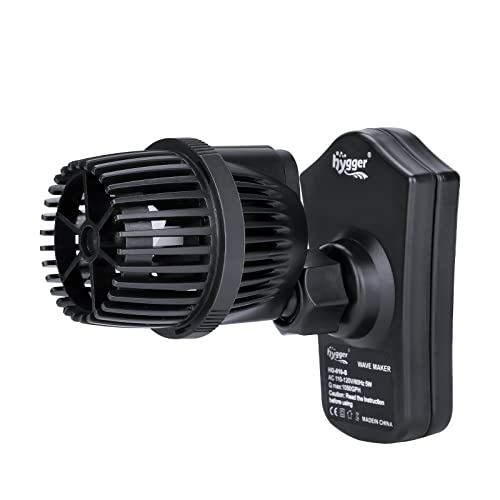
- 1050 GPH strong water movement
- 360-degree flow-direction adjustment
- Magnetic, quiet submersible mounting
Best For: Creating directional current in 20- to 60-gallon saltwater tanks
Adjustable Return Pick
JEREPOND 400 GPH DC Return Pump

- 20 adjustable speed settings
- LCD controller with feeding mode
- Submersible or inline operation
Best For: Tunable return flow in 30- to 50-gallon aquariums
Compact Saltwater Circulation

- Two 3W pumps for flexible circulation
- 360-degree adjustable suction-cup mounts
- Recommended for 45–60 gallon saltwater tanks
Best For: Smaller saltwater tanks needing distributed flow
Filtered Wave-Making Power

- Three-stage filtration for clearer water
- Transparent housing shows filter dirt
- 400 GPH output for waves and circulation
Best For: Large tanks and multipurpose water features
High-Flow Reef Circulation

- 800 GPH output for strong circulation
- 360-degree rotatable flow direction
- Ceramic shaft and anti-backsiphon design
Best For: Saltwater and reef tanks needing vigorous adjustable flow
Best Controllable Return Pump – 660GPH LCD Aquarium Pump
For aquarium water pumps for saltwater tanks, this 660GPH return pump stands out for its adjustable DC control, compact size, and flexible installation. Its 20 speed settings, 10-foot maximum lift, and submersible or inline use make it suitable for tuning sump return flow.
Best For: Saltwater or freshwater sumps needing adjustable return flow and a useful lift height.
Pros:
- 20 speed settings with LCD display and 30%–100% flow adjustment
- Supports steady operation, feeding mode, and wave-maker mode
- Quiet operation rated below 25 dBA
- Dry-run and blockage shutoff protection
Cons:
- Its 660GPH capacity may be excessive for very small systems
- Requires the included DC24V power adapter and controller
This is a versatile choice when precise flow control matters. The included intake covers, controller, and inline/submersible capability add installation flexibility for sump and other aquarium applications.
Best Compact Nano Pump – 185GPH DC Aquarium Return Pump
This compact DC pump is a practical option among aquarium water pumps for saltwater tanks, particularly where space and power consumption are limited. It delivers 185GPH, uses 9 watts, and includes adjustable controls for small indoor aquarium systems.
Best For: Nano saltwater aquariums and small indoor sumps requiring low-power circulation or return flow.
Pros:
- Compact 2.1-by-2.1-by-4.5-inch design
- Adjustable gears from 1 to 10 with constant, wave, and feeding modes
- Low 9-watt power consumption
- Dry-burning protection and a ceramic shaft with no metal parts
Cons:
- 185GPH flow is intended for smaller setups
- Specified for indoor use only
- Shorter 9-foot power cord may limit placement
With two nozzle sizes and low-water-level operation, this pump offers useful setup flexibility for nano tanks. Its modest flow rating makes it better suited to compact systems than larger reef sumps.
Best Wave Maker for Small Tanks – 530GPH Magnetic Powerhead
Unlike a dedicated sump return, this powerhead adds broad circulation and surface agitation, making it a useful supplement to aquarium water pumps for saltwater tanks. The 530GPH flow is intended for 15- to 40-gallon aquariums, with a rotatable head for directing current.
Best For: Small saltwater tanks needing extra circulation, oxygenation, or current around corals.
Pros:
- 360-degree flexible head helps direct flow around dead spots
- Magnetic mount fits 4–10mm glass
- Compact 3-watt design for 15- to 40-gallon tanks
- Removable guard and corrosion-resistant ceramic shaft simplify maintenance
Cons:
- This is a wave maker rather than a sump return pump
- It has no listed electronic speed controller
- Its 5.9-foot power cord may restrict placement
The adjustable head and magnetic mounting make positioning straightforward, while the removable guard supports cleaning. Choose it to improve internal tank circulation, not to replace a return pump responsible for lifting water from a sump.
Best High-Flow Return Pump – DC-12000 3100GPH Pump
For larger systems that need substantial circulation, this high-output model is one of the more powerful aquarium water pumps for saltwater tanks in this group. It provides up to 3100GPH, a listed maximum head pressure of 16.5 feet, and 20 speed settings for tuning return or circulation flow.
Best For: Larger marine, reef, or sump systems requiring high flow and controllable head pressure.
Pros:
- High 3100GPH maximum flow rate
- Up to 20 variable speed settings
- Steady-flow, wave, and feeding modes
- Sine-wave technology, ceramic shaft, and rotor-block protection
Cons:
- 80-watt power draw is higher than the smaller pumps here
- Its larger 8.27-inch body may need more installation space
- The supplied specifications list conflicting maximum head figures of 16.5 and 18 feet
This pump is best evaluated by matching its output to the aquarium’s plumbing, overflow capacity, and desired turnover. Its broad adjustment range helps compensate for system resistance, but its size and power suit larger installations.
Steady-Flow Pick – EcoPlus Eco 264
For aquarium water pumps for saltwater tanks, the EcoPlus Eco 264 is a straightforward choice when you need consistent circulation rather than adjustable wave patterns. Its 290 GPH fixed flow, oil-free magnetic drive, and fresh- or saltwater compatibility suit aquariums, filter systems, and other water setups.
Best For: Aquarists who want a simple fixed-flow pump for circulation, filtration, or a saltwater reservoir.
Pros:
- 290 GPH fixed flow provides steady water movement.
- Can be used submersibly or inline with included inlet and outlet fittings.
- Ceramic shaft and bearings support durability, while the built-in strainer helps protect the impeller.
- Works in fresh or saltwater and includes a 6-foot power cord.
Cons:
- The flow is fixed, so there is no speed adjustment.
- Its 290 GPH output may be limited for larger or high-flow systems.
The EcoPlus Eco 264 emphasizes uncomplicated, dependable circulation. Choose it when installation flexibility and saltwater readiness matter more than electronic controls or variable flow.
Wave-Making Pick – hygger 1050 GPH Wave Maker
The hygger 1050 GPH is designed for aquarists comparing aquarium water pumps for saltwater tanks that need active water movement. Its wave-maker format, 360-degree rotation, and magnetic mounting system help direct circulation through 20- to 60-gallon freshwater or saltwater aquariums.
Best For: Saltwater and coral aquarium keepers who want strong directional flow and improved circulation.
Pros:
- 1050 GPH output creates strong currents for water circulation.
- 360-degree rotation allows flexible flow direction.
- Magnetic suction mounting is designed for stable, quiet installation.
- Suitable for freshwater, saltwater, fish tanks, and coral aquariums.
Cons:
- It must be completely submerged during operation.
- The strong flow may be more than some smaller or low-flow setups need.
- Separating the magnetic base requires careful handling because of its strong suction.
This hygger model is better suited to creating current than serving as a conventional return pump. Its powerful, adjustable-direction output makes it a practical option when circulation and oxygen movement are priorities.
Adjustable Return Pick – JEREPOND 400 GPH DC Return Pump
For aquarium water pumps for saltwater tanks where controllable return flow is important, this JEREPOND pump adds practical electronic adjustment. Its 20-speed controller, LCD display, feeding mode, and wave-maker mode make it useful for tuning circulation in nano and smaller aquarium systems.
Best For: Aquarists who want adjustable return flow for 30- to 50-gallon saltwater or freshwater aquariums.
Pros:
- 20 speed settings adjust flow from 30% to 100% of maximum.
- LCD controller displays speed and operating status.
- Includes 10-minute feeding mode and wave-maker mode.
- Can operate submersibly or inline and offers a maximum lift of 6 feet.
Cons:
- The 400 GPH maximum output is intended for smaller systems rather than large aquariums.
- It requires the included controller and power adapter for operation.
- The listed maximum lift is 6 feet, so installation height should be planned carefully.
This pump stands out for control rather than raw output. The adjustable settings and dedicated feeding mode can make it easier to fine-tune a smaller saltwater return system as conditions change.
Compact Saltwater Circulation – AQUANEAT 480 GPH 2-Pack
For shoppers comparing aquarium water pumps for saltwater tanks, the AQUANEAT two-pack offers compact circulation for smaller marine setups. Each 3W submersible powerhead delivers 480 GPH and includes an articulating suction-cup mount for directing flow around the tank.
Best For: Saltwater aquariums in the recommended 45–60 gallon range that need added circulation and surface agitation.
Pros:
- Two pumps provide flexible circulation coverage.
- 360-degree flow adjustment helps target dead spots.
- Surface agitation supports oxygenation and helps move debris toward the filter.
- Compact design and simple suction-cup installation.
Cons:
- Not intended to be connected to a timer or controller.
- The recommended saltwater range is narrower than the stated freshwater range.
This AQUANEAT set is a practical choice when you want two small circulation points rather than one larger pump. Its adjustable mounts make positioning easy, while the 480 GPH output is best suited to moderate-size tanks rather than demanding high-flow applications.
Filtered Wave-Making Power – 400 GPH Large-Tank Pump
This submersible filter pump combines water movement with three-stage filtration, making it a multipurpose option among aquarium water pumps for saltwater tanks. Its transparent filter box makes accumulated dirt easy to see, while the 400 GPH output creates noticeable circulation for aquariums and other water features.
Best For: Large aquariums, small ponds, fountains, and saltwater or freshwater systems where circulation and visible filter maintenance are useful.
Pros:
- Three-stage filtration is designed to help clear cloudy water.
- Transparent housing makes the dirty sponge easy to inspect.
- 400 GPH flow provides wave-making and water circulation.
- Simple setup requires only the water outlet to be installed.
Cons:
- It is a single pump rather than a multi-pump package.
- The notes do not specify an adjustable flow rate or directional mount.
Choose this model if filtration is as important as circulation. It is less specialized as a directional wavemaker than compact powerheads, but the visible filter chamber and three-stage design add a useful maintenance and water-clarity focus.
High-Flow Reef Circulation – DaToo 800 GPH Mini Pump
The DaToo 800 GPH mini pump is built for shoppers seeking aquarium water pumps for saltwater tanks with strong, adjustable circulation. Its 360-degree rotatable mount, ceramic shaft, anti-backsiphon design, and quiet suction-cup base make it suitable for freshwater, saltwater, and reef-tank use.
Best For: Saltwater and reef-tank owners who want high flow, flexible positioning, oxygenation, and enhanced filtration support from one compact pump.
Pros:
- 800 GPH output creates strong water movement in a compact body.
- 360-degree rotation allows flexible flow direction.
- Anti-backsiphon design and dense cover help support stable, forward flow.
- Ceramic shaft and corrosion-resistant construction are suited to long-term operation.
Cons:
- The 800 GPH output may be more flow than some smaller tanks require.
- It is sold as a single pump.
With the highest stated flow rate in this group, the DaToo is the strongest choice for users prioritizing circulation and reef-tank water movement. Its quiet mounting and adjustable direction add convenience, but tank size and livestock needs should guide whether that output is appropriate.
How We Picked the Best Aquarium Water Pumps for Saltwater Tanks
We organized these pumps by their intended role rather than treating every gallons-per-hour rating as directly comparable. Return pumps move water between a sump and display, while wavemakers and circulation pumps create in-tank movement. We also considered adjustable flow, controller quality, mounting options, power consumption, noise claims, cord length, and whether each pump is designed for submersible, inline, or dual-use installation.
Published flow ratings are usually measured with little or no head pressure. Actual return flow can drop substantially as water travels through tubing, elbows, valves, and the vertical distance to the aquarium. Use the ratings as a starting point, not a guarantee of delivered flow.
Quick Comparison
| Best For | Recommended Type | What to Look For |
|---|---|---|
| Nano or small reef tanks | Compact return pump or mini wavemaker | Low wattage, adjustable output, small footprint |
| Sump-based marine systems | Controllable DC return pump | Head-height capability, reliable controller, restart function |
| Large aquariums | High-flow DC pump or multiple circulation pumps | High maximum flow, durable mounting, speed control |
| Budget circulation | Fixed-flow powerhead | Secure mount, acceptable noise, easy cleaning |
Key Buying Factors
Flow Rate and Head Pressure
Match the pump to the aquarium’s plumbing and livestock. A return pump should provide the needed flow at the system’s actual head height, not merely its advertised maximum. For wavemakers, choose a controllable model if corals or smaller fish may be stressed by a constant high-speed stream.
Return Pump or Wavemaker?
Return pumps circulate water through filtration and the sump. They are not always a substitute for display-tank circulation. Wavemakers spread flow across the aquarium and help reduce stagnant areas, but they do not replace a properly sized return pump in a sump system.
Saltwater Compatibility and Maintenance
Look for corrosion-resistant materials and a design that allows the impeller, intake, and protective cover to be removed for cleaning. Salt creep and calcium buildup can reduce performance, so routine inspection is important. A sponge or screen may help protect livestock, but it also requires regular cleaning.
Controls, Mounting, and Noise
Variable-speed controllers make it easier to tune flow, create calmer periods, and limit splashing. Magnetic mounts are convenient for many displays, while suction cups can loosen over time, especially on larger pumps. Check the pump’s dimensions, cord arrangement, and operating noise before installation.
Who Should Buy Which Aquarium Water Pumps for Saltwater Tanks?
Choose a compact nano return pump for a small sump or rear-chamber marine aquarium. A mini wavemaker is better when the main need is gentle circulation in a nano or small reef tank. For medium systems, a controllable DC return pump offers useful adjustment and quieter operation than many fixed-speed alternatives.
Large aquariums and demanding reef setups should prioritize head-pressure performance, dependable mounting, and adjustable output over the highest advertised number. Budget shoppers can use fixed-flow circulation pumps, but should verify that the stream is not too strong for their livestock. When in doubt, start below the maximum flow, observe fish and coral behavior, and increase circulation gradually.