When it comes to maintaining crystal clear water in your saltwater aquarium, the right RO/DI unit can make all the difference. With so many options available, it’s essential to understand which systems stand out for their efficiency and reliability. From user-friendly designs to advanced filtration capabilities, each unit has unique features tailored to meet your needs. Let’s explore the top picks that can help guarantee your aquatic life thrives in pristine conditions.
Aquatic Life RO Buddie 4-Stage Aquarium Water Filter System
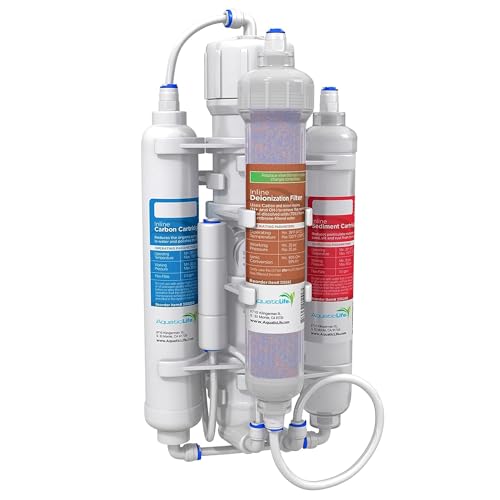
If you’re looking for a reliable and efficient water filtration solution for your saltwater aquarium, the Aquatic Life RO Buddie 4-Stage Aquarium Water Filter System is an excellent choice. This compact unit offers a capacity of 50 gallons per day, effectively removing debris from your tap water through its reverse osmosis process. It features a sediment filter for dirt and sand, a carbon block filter for chlorine, and an RO membrane that eliminates most total dissolved solids. Plus, the color-changing deionizing resin lets you know when it’s time for a replacement, ensuring your aquarium remains crystal clear and healthy.
Best For: Aquarists seeking a compact and efficient water filtration system for their saltwater or freshwater aquariums.
Pros:
- Compact design makes it easy to install in smaller spaces.
- 4-stage filtration process effectively removes contaminants for healthier aquarium water.
- Color-changing deionizing resin provides a clear indication of when to replace filters.
Cons:
- Non-electric unit may limit some users looking for automated solutions.
- Does not remove chloramines, which may be a concern for some water supplies.
- Limited capacity of 50 GPD may not meet the needs of larger aquariums.
Aquatic Life Twist-in 4-Stage RO/DI Aquarium Water Filter System
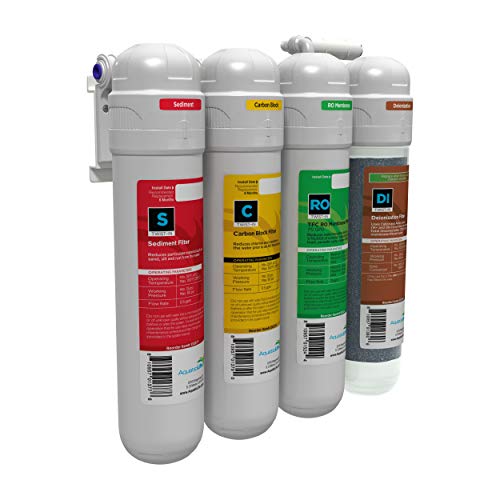
The Aquatic Life Twist-in 4-Stage RO/DI Aquarium Water Filter System is perfect for saltwater aquarium enthusiasts who demand high-quality, purified water for their aquatic life. With a capacity of 75 gallons per day, it tackles impurities effectively through four filtration stages, including sediment, carbon, reverse osmosis, and deionization. You’ll appreciate the easy twist-in cartridges that simplify maintenance—no tools required! Designed for under-sink installation, this manual system supports a TDS level of up to 1000 PPM. Highly rated by users, it’s a reliable choice for ensuring crystal clear water in your aquarium. Keep your aquatic environment thriving!
Best For: Saltwater aquarium enthusiasts who require high-quality, purified water for their aquatic life.
Pros:
- Easy twist-in cartridges allow for quick maintenance without the need for tools.
- Four-stage filtration effectively removes impurities, ensuring crystal clear water.
- High customer rating of 4.5 out of 5 stars, indicating user satisfaction.
Cons:
- Does not remove chloramines during carbon filtration.
- Limited capacity of 75 gallons per day may not meet the needs of larger setups.
- Requires manual installation, which may be challenging for some users.
Max Water 6 Stage RODI Water Filtration System for Aquarium

For saltwater aquarium enthusiasts seeking pristine water quality, the Max Water 6 Stage RODI Water Filtration System stands out as an ideal choice. It filters particles down to 1/10,000 of a micron, effectively removing 99.99% of impurities, including lead and harmful cysts. The six-stage process, featuring an additional deionization stage, guarantees total dissolved solids (TDS) are reduced to zero. Installation is straightforward, thanks to color-coded quick connects and labeled filter housings. With over 15 years of experience, Max Water delivers reliable, BPA-free components, making this system a trusted option for maintaining the health of your aquarium fish.
Best For: Aquarium enthusiasts looking for high-quality, purified water for their freshwater or saltwater setups.
Pros:
- Filters out 99.99% of impurities, ensuring a safe environment for aquatic life.
- Easy installation and maintenance with color-coded quick connects and labeled filter housings.
- Constructed with BPA-free components, promoting safety and reliability.
Cons:
- Final output may show some TDS due to the inline carbon filter, which might concern some users.
- Additional float valve is sold separately, increasing overall cost.
- May require regular filter replacements, which could incur ongoing maintenance expenses.
Aquatic Life 4-Stage Reverse Osmosis Deionization Water Filter System
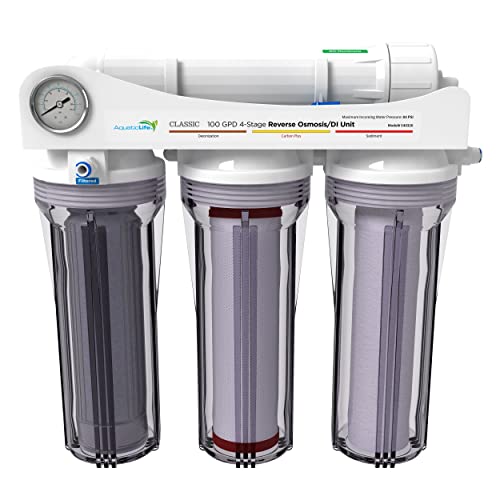
Designed specifically for saltwater aquarium enthusiasts, the Aquatic Life 4-Stage Reverse Osmosis Deionization Water Filter System guarantees you get the purest water possible for your aquatic habitat. With a capacity of 100 gallons per day, this model features a sediment cartridge, Carbon Plus cartridge, and a refillable color-changing resin deionization cartridge. It effectively removes up to 99% of chlorine and 98% of chloramines. The built-in pressure gauge and automatic shutoff solenoid guarantee efficient operation. Measuring 18.5L x 7W x 19H inches and weighing 7.21 kilograms, it fits under sinks easily, providing reliable filtration without the need for electricity.
Best For: Aquatic Life 4-Stage Reverse Osmosis Deionization Water Filter System is best for saltwater aquarium enthusiasts seeking high-quality water filtration for their aquatic habitats.
Pros:
- 4-stage filtration system effectively removes up to 99% of chlorine and 98% of chloramines.
- Built-in pressure gauge allows for easy monitoring of system performance.
- Compact design fits conveniently under sinks without needing electricity.
Cons:
- Not intended for drinking water filtration.
- Manual power source may not be convenient for all users.
- Not compatible with smart home systems.
DREO Reverse Osmosis Water Filter Countertop
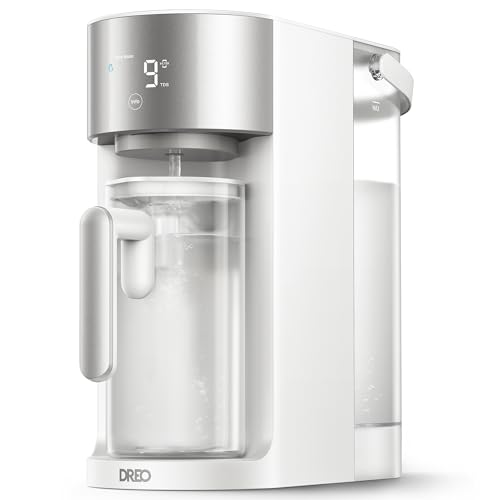
Looking for a reliable water filtration solution that fits perfectly in your kitchen? The DREO Reverse Osmosis Water Filter Countertop offers exceptional filtration, removing over 1000 impurities, including PFOA and chlorine, with a 99.99% efficiency rating. Its real-time TDS monitoring and timely filter change reminders make maintenance a breeze. Plus, the auto-fill sensor provides hands-free refills, while the self-cleaning feature guarantees consistent purity. With a compact design that doesn’t require plumbing, it’s ideal for 1 to 2 people. At just $0.025 per bottle, it’s eco-friendly and cost-effective, making it a perfect addition to your home.
Best For: Individuals or small households looking for a compact, efficient, and cost-effective water filtration solution.
Pros:
- Exceptional Filtration: Removes over 1000 impurities with a 99.99% efficiency rating, ensuring clean and safe drinking water.
- User-Friendly Features: Real-time TDS monitoring and filter change reminders simplify maintenance and enhance usability.
- Eco-Friendly Design: Cost-effective with a low pure-to-drain ratio, reducing water waste and minimizing plastic usage.
Cons:
- Limited Capacity: The 3L tank may not be sufficient for larger families or heavy water consumption needs.
- Dependency on Electricity: Requires power to operate, which might be a drawback during outages.
- Initial Cost: The upfront investment may be higher compared to basic filtration systems.
Philips AUT9340 Reverse Osmosis System (400 GPD, Tankless)

The Philips AUT9340 Reverse Osmosis System is an ideal choice for saltwater aquarium enthusiasts who need high-quality, purified water without the hassle of a bulky tank. With a remarkable 400 GPD capacity and tankless design, it fits conveniently under your sink. This system features multi-stage filtration down to 0.0001 microns, effectively removing impurities like chlorine and lead. Thanks to Aquaporin Inside technology, you’ll enjoy efficient water flow, filling an 8oz cup in under 11 seconds. Plus, its easy maintenance guarantees peace of mind, while the NSF certification assures safety. Trust Philips for a reliable, compact solution to your water needs.
Best For: Saltwater aquarium enthusiasts seeking a compact, high-capacity reverse osmosis system for purified water without a bulky tank.
Pros:
- Multi-stage filtration technology effectively removes contaminants down to 0.0001 microns.
- Tankless design allows for convenient under-sink installation, saving space.
- Quick water flow, filling an 8oz cup in under 11 seconds, ensures efficient use.
Cons:
- Requires basic DIY skills for installation, which may not be suitable for all users.
- Limited to a maximum water TDS level of 500 PPM, which may not meet all needs.
- The filter replacement frequency may be a consideration for some users, with 12-month and 24-month intervals.
DREO Reverse Osmosis Water Filter Countertop (WF511)

For saltwater aquarium enthusiasts who want pristine water quality, the DREO Reverse Osmosis Water Filter Countertop (WF511) stands out with its advanced 7-layer filtration system. This system boasts a 0.0001μm RO membrane, effectively removing 99.99% of over 1,000 contaminants, including lead and fluoride. Thanks to its installation-free design, you can plug it in and enjoy purified water instantly. With real-time TDS readings and filter life tracking, you’ll always know your water’s purity. Plus, it operates sustainably, purifying up to 1,050 gallons while minimizing waste. The included pitchers make hydration easy, whether at home or on-the-go.
Best For: Saltwater aquarium enthusiasts looking for pristine water quality and an easy-to-use filtration system.
Pros:
- Advanced Filtration: The 7-layer filtration system effectively removes 99.99% of contaminants, ensuring high water quality.
- Convenient Installation: Installation-free design allows for quick setup with no tools or plumbing required.
- Real-Time Monitoring: Features like TDS readings and filter life tracking provide assurance of water purity and timely maintenance.
Cons:
- Initial Cost: The upfront investment may be higher compared to standard water filters.
- Limited Capacity: Although it purifies up to 1,050 gallons, heavy users may need to consider filter replacement frequency.
- Electricity Requirement: The system requires power to operate, which may not be ideal for all settings.
Philips AUT9360 Reverse Osmosis System (600 GPD)

If you’re seeking a reliable solution for maintaining ideal water quality in your saltwater aquarium, the Philips AUT9360 Reverse Osmosis System stands out with its impressive 600 gallons per day capacity. Its multi-stage filtration technology reduces contaminants like chlorine, lead, and TDS down to 0.0001 micron. Plus, the efficient 2.3:1 pure to drain ratio saves water while ensuring exceptional performance. Installation is a breeze under your sink, and you can easily replace filters without tools. Backed by Philips and certified for lead-free materials, this system offers peace of mind along with crystal clear water for your aquatic life.
Best For: Aquarists seeking a reliable and efficient reverse osmosis system for maintaining high water quality in their saltwater aquariums.
Pros:
- High capacity of 600 GPD ensures quick filling and ample supply for aquarium needs.
- Multi-stage filtration technology effectively reduces harmful contaminants down to 0.0001 micron.
- Tool-free filter replacement simplifies maintenance and saves time.
Cons:
- Installation requires under-sink space, which may not be suitable for all kitchens.
- The initial cost may be higher compared to standard water filtration systems.
- Filter lifespan may vary based on water quality, necessitating regular replacements.
Geekpure 4 Stage Portable Aquarium Reverse Osmosis Water Filtration System

Designed with versatility in mind, the Geekpure 4 Stage Portable Aquarium Reverse Osmosis Water Filtration System is ideal for aquarium enthusiasts and travelers alike. With a capacity of 100 GPD, it fits perfectly in apartments, RVs, and boats. Its four-stage filtration process effectively removes impurities, chlorine, and harmful metals, ensuring crystal-clear water. Installation is a breeze thanks to quick connect fittings and color-coded tubes. Plus, you can count on 24/7 technical support and easy filter replacements. Whether you need water for your aquarium or for drinking, this system meets your needs efficiently and reliably.
Best For: Aquarium enthusiasts and travelers looking for a reliable and portable water filtration solution.
Pros:
- Versatile design makes it suitable for various settings, including apartments, RVs, and boats.
- Four-stage filtration process effectively removes impurities, ensuring high-quality water for both aquariums and drinking.
- Easy installation and maintenance with quick connect fittings and 24/7 technical support available.
Cons:
- Filter lifespan may vary between 6-12 months, requiring periodic replacements.
- Dependent on specific feed water requirements which may not be met in all locations.
- DI filter needs replacement when a rotten egg taste occurs, which can be inconvenient for some users.
Geekpure 3 Stage Portable Aquarium Reverse Osmosis Water Filter System

The Geekpure 3 Stage Portable Aquarium Reverse Osmosis Water Filter System is an ideal choice for aquarium enthusiasts who need a compact and efficient filtration solution. With a capacity of 100 gallons per day, it effectively reduces TDS, heavy metals, and chlorine, filtering water down to 0.0001 micron. Its tankless design suits apartments, RVs, and mobile homes, while the easy DIY installation makes setup a breeze. Plus, you’ll enjoy fresher drinks and clearer ice cubes. With a filter lifespan of 6-12 months and 24/7 technical support, you’ll have peace of mind while maintaining crystal clear water for your aquarium.
Best For: The Geekpure 3 Stage Portable Aquarium Reverse Osmosis Water Filter System is best for aquarium enthusiasts and individuals living in compact spaces like apartments, RVs, or mobile homes who require a reliable water filtration solution.
Pros:
- Compact and tankless design makes it ideal for small living spaces and mobile setups.
- Easy DIY installation with all necessary parts included, allowing for quick setup without professional help.
- High filtration efficiency reduces harmful contaminants, providing better tasting water for drinks and food.
Cons:
- Filter lifespan of 6-12 months may require regular maintenance and replacement costs.
- Limited maximum TDS of 1000 ppm may not be suitable for extremely contaminated water sources.
- Flushing requirement of 30 minutes for new filters may be inconvenient for some users.
Factors to Consider When Choosing Ro Di Units for Saltwater Aquariums
When choosing an RO DI unit for your saltwater aquarium, you need to take into account several key factors. Think about the filtration stages and how they impact water purity levels, as well as the unit’s size and capacity. Don’t forget to assess installation requirements and maintenance needs to guarantee you pick the right system for your setup.
Filtration Stages Importance
Choosing the right RO/DI unit for your saltwater aquarium means understanding the significance of its filtration stages. Each stage plays a crucial role in removing contaminants and ensuring your water is safe for marine life. The sediment filter, as the first stage, captures dirt and sand, preventing clogging and extending the life of other filters. The carbon block filter follows, eliminating chlorine and odors, which can harm sensitive species. The reverse osmosis membrane greatly reduces total dissolved solids (TDS), achieving purities down to 0.0001 microns. Finally, the deionization resin polishes the water, removing any remaining TDS and indicating when it’s time for a replacement through color changes. These stages collectively protect the health of your aquarium.
Water Purity Levels
Understanding water purity levels is vital for maintaining a healthy saltwater aquarium. You want to keep Total Dissolved Solids (TDS) as low as possible, ideally below 5 PPM, to guarantee your fish thrive. Reverse osmosis/deionization (RO/DI) systems are your best bet, as they can reduce TDS considerably, even achieving near-zero levels. These units use multiple filtration stages, including sediment and carbon filters, along with a reverse osmosis membrane that removes contaminants down to 0.0001 micron. Regularly monitoring TDS levels is important; elevated TDS can stress your marine life. Consider using color-changing deionization resin in your RO/DI system, which visually indicates when it’s time for a filter replacement to maintain ideal water purity.
Installation Requirements
Before you select an RO/DI unit for your saltwater aquarium, it’s crucial to take into account several installation requirements that can impact its performance and convenience. First, consider the installation type; some units fit under sinks, while others are portable or wall-mounted, affecting where you can place them. Make certain the unit’s feed water pressure aligns with the manufacturer’s recommendations—typically between 40-100 psi—for ideal filtration. Check the dimensions of the unit to guarantee it fits your designated space. Many systems come with quick connect fittings, making DIY installation easier and reducing the need for professional help. Finally, decide if the unit needs a dedicated faucet or can connect to existing water lines, as this affects installation complexity.
Maintenance and Replacement
Maintaining your RO/DI unit is essential to guarantee your saltwater aquarium thrives, as regular upkeep directly impacts water quality. Periodic flushing of the system removes contaminants and prolongs filter lifespan. You’ll need to replace filters based on usage and water quality, usually every 6 to 12 months for sediment and carbon filters. Keep an eye on TDS levels; a significant increase may signal that it’s time for immediate filter replacement to secure water purity. Many systems feature color-changing deionization resin that indicates when a replacement is necessary, simplifying your maintenance tasks. Proper installation and ongoing maintenance practices enhance your filtration system’s efficiency and longevity, ultimately assuring ideal water quality for your marine life.
Size and Capacity
Choosing the right size and capacity for your RO/DI unit is key to meeting the water demands of your saltwater aquarium. For most setups, units with capacities ranging from 50 to 100 gallons per day (GPD) work well, but larger tanks may require systems that produce 100 GPD or more. This guarantees you maintain water quality without frequent filter changes. Pay attention to the flow rate, as a higher rate can help you fill tanks more quickly, reducing wait times. Additionally, consider the unit’s dimensions, especially if you have limited installation space. Finally, verify your RO/DI unit can handle your source water’s total dissolved solids (TDS) levels, aiming for units rated for 500 or 1000 PPM.