The best adjustable-difficulty dog puzzle toys turn treats and kibble into engaging challenges that encourage problem-solving, slow fast eating, and provide productive mental stimulation.
This roundup compares 10 options with different layouts, skill levels, dispensing methods, and durability features so you can choose a puzzle that fits your dog’s size, habits, and experience.
Best 10 Adjustable Difficulty Dog Puzzle Toys Picks for 2026
Best Adjustable Starter
PETSTA 2-Pack Rolling Treat Dispensers

- Adjustable opening controls treat-release speed
- Rolling play encourages movement and problem-solving
- Detachable parts make filling and cleaning easier
Best For: Small and medium dogs that enjoy gentle rolling treat games
Best Classic Multi-Step Puzzle

- Combines bones, lids, and sliders in one puzzle
- Offers easy, medium, and hard challenges
- Can hold 3/4 cup for treats or slow feeding
Best For: Dogs ready to progress through hands-on puzzle challenges
Best Squeaky Slider Challenge

- Slider design teaches sequential problem-solving
- Built-in squeaker adds an attention-grabbing element
- Washable food-grade PP construction
Best For: Small and medium adults that enjoy sliders and squeaky play
Best Advanced All-in-One

- Three settings support progression as dogs learn
- Spin-to-release play adds multiple problem-solving actions
- 2-cup capacity supports meals and enrichment
Best For: Dogs 10 pounds and up needing progressive play and slow feeding
Expert Challenge

- Level 4 puzzle for advanced solvers
- Adjustable setup supports skill progression
- No removable parts; easy to clean
Best For: Smart dogs ready for advanced indoor puzzle play
Level-Up Pick

- Three levels support gradual progression
- Large board suits all breed sizes
- Doubles as a treat puzzle and slow feeder
Best For: Dogs needing flexible, washable enrichment
Rolling Reward

- Adjustable switches control treat release
- Rolling format adds chasing and exercise
- ABS design is suitable for all breed sizes
Best For: Treat-motivated dogs that enjoy active rolling play
Multi-Level Challenge Pick

- Four challenge types across levels 1-3
- 14-hole design helps slow feeding
- Six anti-slip pads improve stability
Best For: Dogs ready for varied, progressively harder treat puzzles
Meal-Size Training Pick
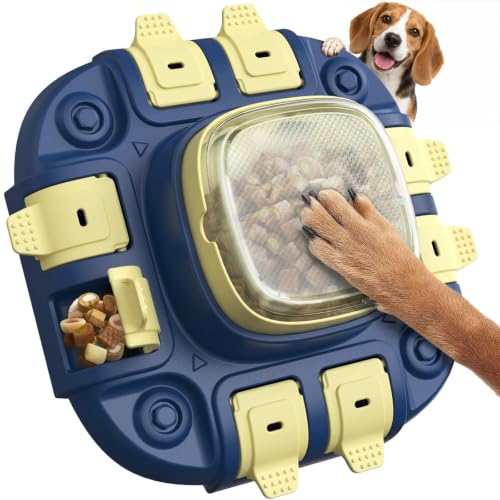
- Two-stage press, flip, and slide game
- Holds up to 2 cups of food
- Attached covers simplify setup and storage
Best For: Dogs learning puzzle skills during meals or indoor play
Stability-Focused Pick
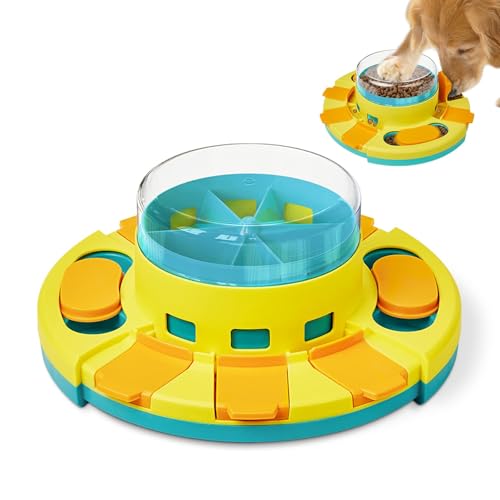
- Progresses from nudging to pressing
- Weighted base helps prevent tipping
- 0.85-liter top reservoir supports fewer refills
Best For: Small dogs needing a stable slow feeder and treat game
Best Adjustable Starter – PETSTA 2-Pack Rolling Treat Dispensers
The PETSTA 2-pack is a practical entry point for dogs that enjoy rolling, nudging, and chasing treats. Its adjustable opening lets you control reward speed, making it one of the more approachable adjustable difficulty dog puzzle toys for small to medium dogs.
Best For: Small and medium dogs that prefer food-motivated rolling games and gentle to moderate play.
Pros:
- Adjustable opening changes how quickly dry rewards are dispensed.
- Rolling play adds movement and mental engagement to indoor enrichment.
- Detachable design supports easier filling and cleaning.
- Two-pack provides a spare or a second toy for rotation.
Cons:
- Not designed as a chew toy, so supervision is important.
- Works best with small, dry rewards; sticky or oversized treats may not flow well.
- May be less suitable for powerful chewers or highly rough play.
Choose this set if you want a simple, adjustable treat dispenser that can make short indoor enrichment sessions more engaging. Remove it after play, particularly if your dog starts chewing rather than rolling.
Best Classic Multi-Step Puzzle – Nina Ottosson Dog Brick
The Nina Ottosson Dog Brick offers a 3-in-1 challenge with easy, medium, and hard elements. As adjustable difficulty dog puzzle toys go, it suits beginners who can progress from lifting bones to opening lids and moving sliders to find hidden rewards.
Best For: Dogs of all life stages that enjoy hands-on treat puzzles, interactive play, or slower mealtimes.
Pros:
- Combines removable bones, flip lids, and sliders for varied play.
- Tips and tricks help adjust the challenge as your dog learns.
- Can hold up to 3/4 cup of kibble or treats and double as a slow feeder.
- Supports problem-solving and interactive engagement indoors.
Cons:
- It is not water resistant, so it is intended for indoor use.
- The separate puzzle elements require supervision and storage.
- Dogs may need guidance when first learning the different mechanisms.
This is a strong choice for owners who want one puzzle with several ways to increase difficulty. Its combination of treat hiding and slow feeding also makes it useful beyond occasional play sessions.
Best Squeaky Slider Challenge – FOXMM IQ Training Puzzle
The FOXMM puzzle uses sliding pieces and sequential steps to reveal food, while a built-in squeaker helps attract attention. Its S-Level 2 design makes it a reasonable option among adjustable difficulty dog puzzle toys for small and medium adult dogs that enjoy interactive training.
Best For: Small and medium adult dogs that like slider puzzles, food rewards, and squeaky interactive play.
Pros:
- Sliding mechanism encourages dogs to learn sequential problem-solving steps.
- Built-in squeaker can add interest during interactive sessions.
- Can support mental exercise, boredom relief, and slower eating.
- Food-grade PP construction is washable with water or in a dishwasher.
Cons:
- It is not designed as a chew toy and requires supervision.
- The S-Level 2 format may need coaching for dogs new to slider puzzles.
- The squeaky feature may not suit dogs or households sensitive to noise.
Consider the FOXMM if your dog is motivated by both food and sound and you want a compact slider-style challenge. Inspect it regularly and replace it if damaged, since no toy is indestructible.
Best Advanced All-in-One – KADTC 3-Level Spin Puzzle
The KADTC combines three challenge settings with four ways to play, allowing dogs to start with easier tasks and progress as they learn. Its spin-to-release design and 2-cup capacity make it one of the most versatile adjustable difficulty dog puzzle toys for supervised enrichment and slow feeding.
Best For: Dogs weighing 10 pounds or more, including households seeking one puzzle for progressive play, meals, and indoor enrichment.
Pros:
- Three challenge settings support progression from beginner to advanced play.
- Spin-to-release activity combines turning, pawing, sniffing, and searching.
- Two-cup capacity works for treat sessions or everyday dry-food slow feeding.
- One-piece construction, non-slip pads, and dishwasher-safe material simplify use.
Cons:
- Its larger footprint may require more storage and floor space.
- It is designed for supervised puzzle play, not chewing.
- Dogs unfamiliar with spin puzzles may need an introductory learning period.
Pick the KADTC when you want a progression-friendly puzzle that can also serve as a slow feeder. The attached components reduce the chance of loose pieces, while the larger surface accommodates small, medium, and large dogs weighing at least 10 pounds.
Expert Challenge – Tower of Treats Puzzle
For dogs that have mastered simpler games, the Outward Hound Nina Ottosson Tower of Treats is an adjustable difficulty dog puzzle toy with a Level 4 challenge. Its layered design lets you begin with easier setups and increase the complexity as your dog learns.
Best For: Smart dogs ready to progress beyond Level 3 puzzle games.
Pros:
- Multiple setup options let you make the puzzle easier or harder.
- Requires dogs to unlock layers in sequence to find hidden treats.
- No removable parts and an easy-to-clean design.
- Provides mental stimulation that can help redirect boredom-related behaviors.
Cons:
- Its Level 4 design may be too difficult for dogs new to puzzle toys.
- It is intended for indoor use and is not water resistant.
This tower is a strong choice when you want a structured, progression-based challenge rather than a simple treat dispenser. Start with the layers unlocked, then add difficulty as your dog gains confidence.
Level-Up Pick – KADTC Dog Chess Puzzle
The KADTC Dog Chess Puzzle is an adjustable difficulty dog puzzle toy with three levels, giving puppies and experienced solvers room to progress. Its large board supports searching, sliding, lifting, and nudging while also working as a treat puzzle or slow feeder.
Best For: Multi-dog households or owners seeking a large, washable puzzle that grows from beginner to advanced play.
Pros:
- Three adjustable levels accommodate different skill levels.
- Large 16.73-inch board gives dogs more room to work.
- Can dispense treats or small kibble for slower meals.
- Non-slip pads, storage for pieces, and dishwasher-safe construction add convenience.
Cons:
- The large footprint may require substantial floor or storage space.
- Removable cups and lids need to be stored after play.
- Designed for indoor use.
With its broad board and three-stage format, this puzzle is a practical option for building problem-solving skills gradually. It also adds versatility by combining enrichment with treat dispensing and slow feeding.
Rolling Reward – Adjustable Treat Ball
The BSISUERM adjustable treat-dispensing ball is an adjustable difficulty dog puzzle toy focused on movement and food rewards. Its switches control both the food size it accepts and the amount released, allowing you to lengthen or shorten the challenge while your dog rolls and chases it.
Best For: Dogs that enjoy active rolling games and owners who want adjustable treat portions during enrichment or slow feeding.
Pros:
- Adjustable switches control treat compatibility and dispensing speed.
- Rolling design combines food rewards with chasing and exercise.
- Compact barbell shape is suitable for small, medium, and large dogs.
- Curved ABS construction is designed for quieter rolling and comfortable handling.
Cons:
- It is not intended to be a chew toy.
- Not water resistant, so it is suited to indoor use.
- Rolling play may be less suitable for dogs that prefer stationary puzzles.
This toy is a good fit when your dog is motivated by motion as much as treats. Adjust the openings to control the pace, then supervise play since the product is designed for interactive enrichment rather than chewing.
Multi-Level Challenge Pick – Barkwhiz 3-Level Dog Puzzle
The Barkwhiz is a strong option for shoppers seeking adjustable difficulty dog puzzle toys. Its four play methods combine flip compartments with a linear sliding track, giving dogs several ways to work toward hidden treats across levels 1 through 3.
Best For: Small, medium, and large dogs that need varied indoor or outdoor mental stimulation and slower treat-based feeding.
Pros:
- Offers four challenges across three difficulty levels.
- Its 14 food-storage holes can help extend feeding time.
- Six silicone anti-slip pads help keep the toy steady.
- Food-safe materials and built-in components support supervised play and easier cleanup.
Cons:
- The toy is not water resistant.
- Dogs should be supervised to discourage chewing or attempted destruction.
Choose this model when you want the widest progression of the three options and multiple puzzle styles in one toy. The built-in design reduces concerns about loose game components, but supervision remains important.
Meal-Size Training Pick – KADTC 2-Level Dog Puzzle
The KADTC combines adjustable difficulty dog puzzle toys with meal-sized capacity. Start with treats under its eight attached covers, then progress to pressing the center dispenser before flipping and sliding the covers to find the remaining food.
Best For: All breed sizes, especially dogs that need an indoor boredom outlet, slower meals, or a gradual introduction to pressing, sniffing, and searching games.
Pros:
- Two stages let you begin simply and increase the challenge.
- Holds up to 2 cups of kibble or treats.
- Attached covers prevent loose pieces from being chased or misplaced.
- Food-grade, BPA-, PVC-, and phthalate-free PP is dishwasher-safe according to the supplied notes.
Cons:
- Its two levels provide less progression than a three-level puzzle.
- The relatively large footprint may be less convenient in tight spaces.
This is a practical choice for owners who want one toy to handle snacks, training rewards, and fuller meals. The clear top keeps food visible, which can help maintain engagement as dogs learn the press-and-slide sequence.
Stability-Focused Pick – Potaroma 2-Level Treat Puzzle
The Potaroma offers adjustable difficulty dog puzzle toys in a two-stage format. Dogs can first nudge treats from the base compartments, then learn to press the transparent top cover so food dispenses into the lower compartments for a more involved reward sequence.
Best For: Small breeds and dogs of all ages that benefit from a compact slow feeder, treat dispenser, and boredom-reducing brain game.
Pros:
- Two levels provide a clear step up from nudging to pressing.
- The transparent top granary has a 0.85-liter capacity and reduces frequent refilling.
- A weighted base and four rubber mats help resist tipping.
- Non-removable parts require no assembly and support straightforward use.
Cons:
- It is recommended in the supplied details for small breeds.
- Hand washing is required.
- The two-level format offers less difficulty range than the Barkwhiz.
Consider this model when stability and slow feeding matter most. Its elevated 4.2-inch design and large top reservoir make it useful for extended treat play, while the two-step progression keeps the learning path easy to follow.
How We Picked the Best Adjustable Difficulty Dog Puzzle Toys
We focused on puzzle toys that let owners vary challenge level through multiple settings, compartments, sliding pieces, spinning mechanisms, or staged treat access. We also considered ease of loading and cleaning, stability during play, suitability for different dog sizes, and whether each design can serve as enrichment, a slow feeder, or both.
Because dogs solve puzzles differently, the best choice is not always the most complicated one. A useful toy should offer an achievable starting point and enough progression to remain interesting as your dog learns.
Quick Comparison
| Best For | Look For |
|---|---|
| Beginners | Simple sliders, spinners, or two-level designs |
| Experienced puzzle solvers | Multi-step compartments and three-level difficulty |
| Fast eaters | Slow-feeding layouts that spread out kibble or treats |
| Active chewers | Sturdy construction and supervised play |
| Small spaces | Compact toys that stay stable on the floor |
Key Buying Factors for Adjustable Difficulty Dog Puzzle Toys
Difficulty and Progression
Choose a toy with a clear entry level, then increase complexity gradually. Three-level models can provide more room for progression, while two-level designs are often easier for puppies, seniors, or dogs new to enrichment toys.
Food Capacity and Dispensing Style
Sliding boards and compartment puzzles work well with small treats or measured kibble. Balls and rotating dispensers may encourage movement but can release food unpredictably. Check opening sizes if you use larger biscuits or wet food.
Stability, Size, and Durability
A puzzle that slides across the floor can frustrate dogs and damage surfaces. Look for a broad base, nonslip elements, and dimensions appropriate for your dog’s muzzle. Durable does not mean indestructible, so inspect plastic, seams, and moving parts regularly.
Cleaning and Supervision
Removable parts and accessible compartments make routine cleaning easier. Introduce every toy while supervising, especially if your dog chews, paws aggressively, or tries to pry pieces loose. Remove damaged components and avoid leaving food inside between sessions.
Who Should Buy Which Adjustable Difficulty Dog Puzzle Toys?
For Puppies and First-Time Users
Start with a simple two-level puzzle or slow-feeding dispenser. Use high-value treats sparingly and demonstrate the mechanism rather than letting frustration build.
For Clever, Experienced Dogs
Choose a three-level board, tower, or multi-step design that requires more than one action. Rotate puzzles to prevent the dog from memorizing a single routine.
For Dogs That Eat Too Quickly
Prioritize a slow-feeder layout or treat-dispensing toy that spreads food across multiple openings. Measure the full meal so enrichment does not unintentionally add excess calories.
For Bored or High-Energy Dogs
Look for a sturdy interactive design that combines movement with problem-solving. Short, successful sessions are usually more effective than leaving a difficult toy out unattended.